


Author: Site Editor Publish Time: 2025-11-14 Origin: Site


Last updated: August 30, 2026
Automotive interiors are full of laminated films: soft-touch PVC skins, TPO foils, decorative veneers, protective films and technical layers. For OEMs and Tier 1 suppliers, these laminates have to look perfect and survive years of heat, UV, abrasion and mechanical stress. Getting the heat step right in film laminating machines is critical—and this is where infrared heaters for automotive film laminating machines offer a powerful advantage over conventional hot-air or contact heating.
This article explains how infrared (IR) heating fits into automotive film laminating lines, how to select the right IR technology, and what plant engineers and machine builders should consider when integrating IR modules or laminating ovens into new machines or retrofits.
Infrared heaters are already widely used in automotive interior laminating to heat TPO and PVC foils in vacuum laminating machines, helping achieve short cycle times, stable forming and strong adhesive activation.
Compared with purely convection-based ovens, IR laminating ovens can speed up heating and reduce energy consumption because they heat the film and adhesive directly instead of the surrounding air.
Short-wave and medium-wave IR emitters are most common in laminating machines: short-wave for very fast cycle heating, medium-wave when better spectral match with plastics and adhesives is needed.
A well-designed IR infrared heating system with proper zoning, control and shielding supports stable processes, repeatable quality and easier recipe management.
The global industrial infrared heater market is expanding at around 6% CAGR, driven by demand for efficient, electrified heating solutions—automotive laminating lines are part of that trend.
Infrared heating can be applied at different points in the laminating process: preheating the foil, heating the substrate, reactivating adhesives or providing post-cure energy. Below are three common scenarios in the automotive sector.
Vacuum laminating machines are widely used to cover 3D substrates such as door panels, consoles and instrument panels with PVC or TPO skins.
Process snapshot
Materials: PVC/TPO film, often with foam or backing layers; PP, ABS or natural-fiber (NFPP) carrier substrates
Line type: Single-station or multi-station vacuum laminating machine
Temperature window: Typically 110–160 °C at the adhesive interface, depending on adhesive and film
Cycle time: 30–120 seconds, depending on part size and complexity
Pain points with conventional heating
Slow, bulky hot-air heaters struggle to heat 3D shapes uniformly.
Long cycle times to bring the entire substrate package to temperature.
High energy use when large air volumes are heated and exhausted.
Difficult to control local overheating at corners, edges and deep draws.
How infrared heaters help
Fast, targeted film heating: Short-wave IR cassettes or modules can bring the film surface to forming temperature within seconds, without overheating the entire environment.
Better control of local heat: Multi-zone IR arrays allow you to give more energy to problematic zones (sharp radii, deep pockets) and less to flat, easy areas.
Reduced footprint: IR modules are compact, enabling shorter machines and easier retrofits.
For this scenario, plant engineers typically choose short-wave IR modules for rapid film heat-up and medium-wave panels for substrates requiring deeper penetration.
Dash mid-panels, armrests, center consoles and luxury trim often use soft-touch foils or laminated composites.
Process snapshot
Materials: Soft-touch PU or PVC foils, carrier foams, decorative foils
Objective: Activate polyurethane or hot-melt adhesives without damaging surface texture or gloss
Constraints: Sensitive surfaces, tight thickness tolerances, strict appearance standards
Pain points with conventional heating
Risk of orange peel, gloss changes, or surface shrinkage from uneven or excessive heating.
Hot air makes it difficult to “shield” sensitive regions and only heat the adhesive side.
Slow response when changing recipes (new foil, colors, substrates).
How infrared heaters help
Spectral matching: Medium-wave IR heaters can be tuned closer to absorption peaks of many plastics and adhesives, improving efficiency and control.
Gentle yet precise heating: Lower surface temperatures at the emitter with good control of heat flux to avoid surface defects.
Recipe-based operation: Different IR zones and power levels can be stored as recipes for quick changeovers, supporting short production runs.
Automotive exterior parts and electronics may be laminated with protective films to prevent scratching, UV damage or contamination.
Process snapshot
Materials: PET, polyolefin or special protective films; painted metal or plastic parts; electronics assemblies
Goal: Firm bonding of film without bubbles, distortion or warpage
Challenge: Heat sensitive components and coatings with narrow process windows
Pain points with conventional heating
Local hot spots and thermal gradients from contact rollers or poorly designed heaters.
Long heating times can cause coatings or plastics to soften or warp.
Difficult to integrate heat into compact, automated cell layouts.
How infrared heaters help
Local, on-demand heating: IR modules can be placed close to the film path or part surface for quick adhesive activation.
Compact and modular: Cassette-style IR modules fit easily into robot cells or small laminating stations.
Zonal control: Power can be matched to specific product areas or sizes without redesigning the entire oven.
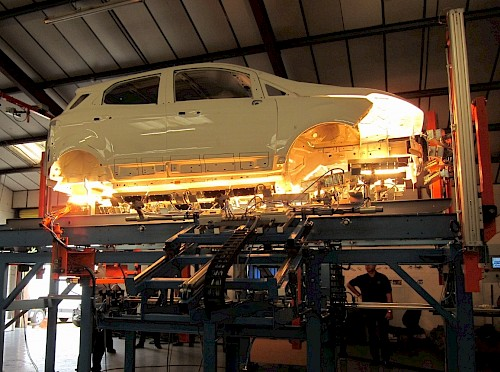
Selecting the right industrial infrared heater modules for an automotive laminating line means balancing wavelength, power density, emitter type and control strategy. Below are the key parameters and how they affect your process.
1. Wavelength band (short-, medium-, long-wave)
What it is: The dominant infrared wavelength emitted, typically expressed by emitter type (short-wave ≈ 0.8–1.5 µm, medium-wave ≈ 2–3 µm, long-wave ≈ 3–10 µm).
Why it matters: Plastics and adhesives absorb IR differently at different wavelengths. Better spectral match = higher efficiency and more uniform heating.
Trade-offs: Short-wave offers very fast response and high power density, but can be aggressive. Medium-wave is often better matched to many polymers. Long-wave is gentler but less common in fast-cycle laminating.

2. Power and power density (kW, kW/m²)
What it is: Total power per module and how much power is delivered per unit area.
Why it matters: Power density drives how fast films and substrates reach target temperature; too low and you never hit temperature in time, too high and you risk scorching or warpage.
Trade-offs: High power density allows short cycles and compact machines, but requires precise control and good zoning.
3. Heater/emitter type
Quartz tube (short-wave)
Quartz cassette modules
Ceramic heaters (often medium to long-wave)
Panel heaters and IR laminating ovens
Each type has different response times, maximum temperatures and mounting options.
4. Emitter length / panel size and zoning
Longer emitters and panels cover wider areas but can be harder to control precisely.
Dividing heaters into zones (e.g., left/center/right, or zones for deep draws) makes it easier to tune laminating quality.
5. Surface temperature and response time
High emitter surface temperatures and fast response allow quick start/stop and high throughput.
Slower, cooler heaters can be more forgiving but need longer warm-up and cool-down times.
6. Working distance and layout
The gap between emitter and film affects intensity and uniformity. Too close may cause banding or hot spots; too far wastes energy.
In vacuum laminating, IR arrays must fit within the moving hood and tooling constraints.
7. Control options
On/off or stepped control for simple applications.
SSR/SCR (thyristor) phase-angle or burst-firing for precise power modulation.
Temperature control via PID controllers, PLC analog outputs, or fieldbus control within a larger infrared heating system.
8. Enclosure, insulation and IP rating
Laminating environments may have dust, plastic fumes or release agents.
Enclosures and insulation improve energy efficiency and protect heaters and wiring.
| Infrared Solution Type | Wavelength Band | Typical Power Density | Response Time | Recommended Applications | Control Options |
|---|---|---|---|---|---|
| Short-wave IR cassette module | Short-wave | High (up to very high) | Very fast (seconds) | Fast film preheating in vacuum laminating of door/instrument panels | SCR/SSR, PLC/PID, multi-zone control |
| Medium-wave IR panel | Medium-wave | Medium to high | Fast (tens of sec) | Soft-touch foils, interior trim, substrates needing deeper heating | SSR, PID, PLC |
| Long-wave ceramic heater | Long-wave | Low to medium | Medium (minutes) | Gentle heating of sensitive substrates, low-temperature adhesives | On/off, stepped SSR |
| Custom multi-zone IR laminating oven | Mixed/balanced | Application-dependent | Application-dependent | Complete laminating lines with complex 3D parts and varying recipes | Fully integrated PLC/DCS control |
If you need very short cycle times and primarily heat thin films → prefer short-wave IR cassette modules with high power density.
If your films and adhesives need deeper penetration and gentler heating → prefer medium-wave IR panels with tuned spectral response.
If you handle heat-sensitive substrates and lower temperature adhesives → consider long-wave or lower-power medium-wave heaters.
If you are an OEM integrating IR into multiple machine models → choose modular cassette-style heaters with standard mounting, field-replaceable emitters and clear control interfaces.
Start: What is your main constraint?
Measure specific energy consumption (kWh per part or m²).
If high → Improve insulation, reduce overshoot, add closed-loop control and recipe management.
Are hot spots visible?
Yes → Add more zones, reduce power locally, consider medium-wave.
No → Check line speed vs. power, refine adhesive temperature window.
Can you increase available power?
Yes → Use higher-power short-wave modules, add zones, check cooling.
No → Improve insulation, reduce distance, optimize recipes.
→ Cycle time is too long
→ Quality issues (scorching, gloss change, bubbles)
→ Energy cost too high
Integrating IR heaters into laminating machines is as much an electrical engineering task as a thermal one.
Mains voltage and phases: Most laminating lines will use 3-phase power (e.g., 400–480 V). Check compatibility of IR modules and ensure proper load balancing across phases.
Protection and safety:
Circuit breakers or fuses sized for peak load.
Over-temperature cut-outs to protect heaters and nearby materials.
Emergency stop circuits that safely de-energize IR loads.
Control strategies:
Simple systems: on/off control via relays or contactors.
Advanced systems: SCR/SSR power controllers with 4–20 mA or fieldbus command from PLC, PID temperature control using IR sensors or thermocouples.
Recipe-based control: Store zone power levels, ramp rates and dwell times by product/part. This is crucial for Tier 1 plants with many programs.

Mechanical integration defines how well the heat is delivered to the film and substrate.
Mounting:
Frame-mounted arrays inside vacuum hoods or above conveyors.
Cassette modules for easy removal and maintenance.
Distance and angle:
Typical film-to-heater distances are chosen to balance heat flux and uniformity.
Angled arrays can help reach flanges and deep pockets on 3D parts.
Reflectors and shielding:
Polished or coated reflectors increase effective efficiency and direct energy to the film.
Shields protect non-target components and wiring from stray IR.
Insulation:
Proper insulation behind IR panels reduces heat loss to machine structure.
Insulation also supports faster warm-up and consistent conditions.
Pro tip for plant engineers: During retrofit projects, spend time validating mechanical clearances—IR emitters run hot, and you must keep wiring, seals and plastics within their allowable temperature limits.
Getting from “IR installed” to “IR running reliably” requires structured tuning.
Define the thermal target
Adhesive activation temperature and time.
Film and substrate temperature limits to avoid deformation or gloss change.
Instrument the line
Thermocouples on representative points of the substrate and film.
IR pyrometers aimed at film surface, where appropriate.
Run step tests
Start with lower power and longer dwell, then adjust line speed and zone powers.
Observe where defects appear (blisters, lack of adhesion, surface defects) and link them to temperature measurements.
Lock in a “recipe”
For each part/film/adhesive combination, save zone-by-zone setpoints and timings.
Document these recipes so they can be reproduced across shifts and sites.
A robust validation path helps OEMs convince automotive customers that the laminating process is stable.
Lab testing:
Bench-top IR setups with small emitters and sample coupons.
Heating curves vs. power levels and distances for key materials.
Pilot line tests:
Limited-width laminating machine or test cell.
Evaluate cycle time, energy input, adhesion strength and appearance on full-size parts.
Full-scale acceptance criteria:
Throughput (parts/hour or m²/hour).
Temperature uniformity (across width and length).
Specific energy consumption (kWh per part or per m² of laminate).
Product quality metrics: peel strength, appearance, dimensional stability.
Automotive customers expect laminating machines and heating systems to comply with relevant regulations and standards.
CE and EU directives (where applicable):
Low Voltage Directive (LVD) for electrical safety.
EMC Directive for electromagnetic compatibility.
Machinery Directive for integrated machines and safety devices.
North American markets: UL/CSA or equivalent listing may be required for electrical systems.
RoHS/REACH:
IR heaters and systems should avoid restricted substances.
Documentation may be requested in supplier qualification.
Safety considerations:
High surface temperatures require guarding, labels and safe access.
Over-temperature protection, interlocks on access doors and emergency stops are essential.
Clear operator instructions, warning signs and PPE guidelines.
You should describe compliance capabilities honestly and avoid claiming specific certifications unless they are confirmed for the product family. A dedicated support or compliance page from Huai’an Yinfrared Heating Technology can give more detailed information.
For automotive OEMs, Tier 1 suppliers and machine builders, the buying model is often OEM/ODM rather than simple catalog purchase.
Engagement models
Standard modules:
Catalog short-wave IR modules, medium-wave panels and ceramic heaters that can be integrated into existing laminating machines.
Customized emitters and panels:
Special lengths, power ratings, mounting methods and connector types to fit specific machines.
Complete infrared laminating ovens or zones:
Turn-key custom infrared heating solution with structure, emitters, reflectors, controls and commissioning support.
MOQ and sampling
Small sample quantities (a few modules or panels) for lab and pilot tests.
Larger MOQs for mass production supply once the process is frozen.
Typical lead times
Samples: a few weeks, depending on customization.
Custom designs: additional engineering time plus manufacturing lead time.
Mass production: aligned with automotive program timing, including ramp-up and service parts.
Below is a generic comparison between a conventional hot-air laminating oven and an IR laminating oven for a similar output. Real numbers will depend strongly on your process and energy prices.
| Item | Conventional Hot-Air System | Infrared Laminating System |
|---|---|---|
| Annual energy use (kWh) | 100% baseline | ~60–75% of baseline* |
| Annual energy cost | 100% baseline | ~60–75% of baseline |
| Typical maintenance cost / year | Higher (fans, ducts, filters) | Lower (fewer moving parts) |
| Warm-up time to production | Longer | Shorter |
| Indicative payback period | – | Often 2–4 years** |
* Some industrial sources report IR systems achieving up to 50–65% lower energy use than traditional hot-air ovens, but actual savings depend on insulation, process design and operating regime.
** Payback is highly scenario-dependent; always calculate based on your own energy prices, operating hours and production volumes.
Choosing the wrong wavelength for the film and adhesive
Result: poor absorption, slow heating, unexpected defects.
Under-sizing power relative to line speed
Result: parts never reach activation temperature at target throughput.
Ignoring insulation and shielding
Result: higher energy use, hot machine frames, drift in process.
Poor zoning strategy
Result: difficult tuning, persistent hot spots or cold areas.
No structured commissioning process
Result: recipes based on operator “feel”, inconsistent between shifts.
Insufficient safety interlocks and over-temperature protection
Result: increased risk of damage or operator injury.
Inadequate maintenance planning
Result: fouled reflectors, reduced output, unplanned downtime.
Heat-up time:
Films often need to reach activation temperature within a few seconds in fast laminating lines.
Temperature uniformity:
Aim for a few degrees of variation across the critical adhesive interface region; requirements may be stricter for high-end interior parts.
Specific energy consumption:
Track kWh per m² of laminate or per part; compare before/after IR retrofit to quantify improvements.
Huai’an Yinfrared Heating Technology can support QA at system level through:
Incoming inspection of heating elements and components.
Burn-in or functional tests of IR modules.
Documentation of typical performance envelopes (power, temperature, distance).
Support for on-site commissioning, recipe tuning and troubleshooting.
Q1. How do I size infrared heaters for my existing film laminating machine?
Start from your required line speed, laminate width, target adhesive temperature and current energy input. From there, you can estimate required power density (kW/m²) and total IR power, then choose emitter types and zones to achieve that with reasonable distances and control.
Q2. What energy savings can I expect compared to hot-air heating?
Case studies and industry reports suggest that well-designed IR ovens can reduce energy use by roughly 25–50% in many industrial heating applications, sometimes more. Actual savings depend on insulation, operating schedule and how well the IR system is tuned to your materials.
Q3. Will infrared heating damage sensitive automotive films or foams?
With proper wavelength selection, zoning and control, IR heating can actually be gentler than some conventional methods, because you can avoid overheating non-critical areas and reduce overall heat exposure time. Correct commissioning is key.
Q4. How long do IR emitters last in a laminating line?
Emitter lifetime depends on type (short-wave vs. medium-wave vs. ceramic), operating temperature, on/off cycling and environment. Many emitters are designed to run thousands of hours; planning for periodic inspection and replacement minimizes unexpected downtime.
Q5. Can you supply OEM-specific modules and private-label solutions?
Yes—in an OEM/ODM model, IR modules and laminating oven sections can be mechanically and electrically tailored to your machine, including mounting, connectors, control interfaces and branding, while keeping a standardized internal design.
Q6. What information do you need to make a recommendation?
Typically: material stack-up (film, adhesive, substrate), line speed, product width, target temperatures, available line length and power supply details.
Q7. Do you support global installation and service?
For automotive projects with multi-site deployments, engineering support can include remote design reviews, on-site commissioning support (often together with the machine builder) and training for local maintenance teams.
If you are designing or upgrading automotive film laminating machines, infrared heating can be a powerful lever for faster cycles, better quality and lower energy use.
Share your basic process data—materials, line speed, target temperatures and current heating setup—and Huai’an Yinfrared Heating Technology can help you evaluate whether an IR retrofit or a new custom infrared heating solution makes sense. To discuss your project and explore OEM/ODM options, simply contact Huai’an Yinfrared Heating Technology via your usual sales channel or inquiry form.
Review YFR industrial infrared heating lamps and heating modules and controls. Confirm emitter choice, mounting, sensing and recipes with representative product trials.
Send YFR your material, dimensions, target, cycle time and current equipment details for an application-specific review.


