Author: Site Editor Publish Time: 2025-07-09 Origin: Site
Last updated: September 1, 2026
“Traditional heat lamp” and “infrared heating lamp” are not perfectly separate technical categories. A general-purpose incandescent or halogen heat lamp already emits much of its output as infrared radiation. The useful industrial comparison is therefore between a simple local-warming bulb and an engineered infrared emitter or heating system designed around a defined material, heat-flux profile, reflector, geometry and control method.
This distinction prevents a common buying mistake: choosing by visible brightness or by a broad product label instead of by the process. For drying, curing, forming or production-line heating, the question is not which lamp feels hotter to a person. It is which source delivers a repeatable temperature profile to the actual target without exceeding the limits of the coating, substrate, enclosure or electrical system.
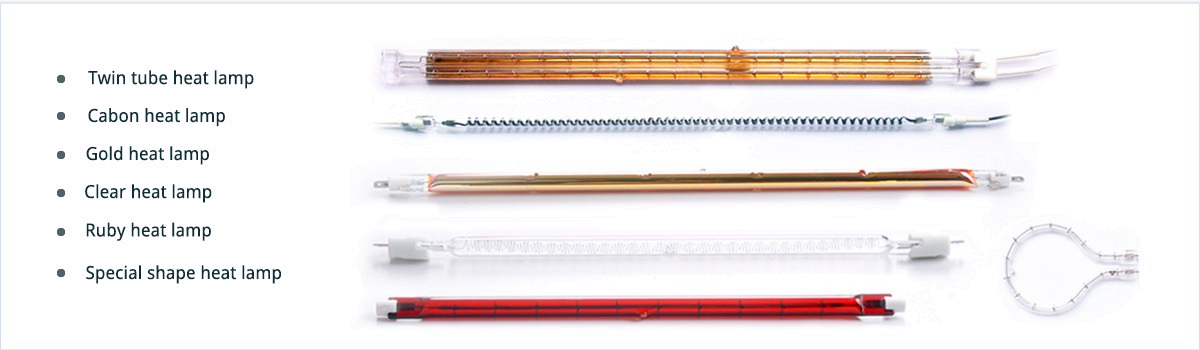
In everyday use, “heat lamp” often describes an incandescent-style bulb installed for spot warming, food holding, an enclosure or another low-complexity task. It converts electrical input into filament heat and radiates energy toward nearby objects. The lamp may be inexpensive and familiar, but it is normally selected by socket, wattage and basic coverage rather than by a measured process profile.
That does not make it a non-infrared source, nor does it make it obsolete. It may be appropriate when the target is simple local warmth, the heated area is small and tight temperature uniformity is not required. Its limitations appear when a production process needs defined working distance, rapid zone response, repeatable edge-to-edge coverage or integration with feedback and interlocks.
An industrial infrared system begins with the application rather than the bulb. The emitter construction, operating temperature, spectral output, reflector, heated length, spacing and power control are selected together. Short-wave, fast-medium-wave, medium-wave and carbon emitters provide different response and emission characteristics, but none is universally best.
Engineering the system can make radiant input more directional and more controllable. It can also divide a wide process into independent zones or place a compact heating stage exactly where a coating, web or molded part needs it. The benefit comes from the complete design and from how effectively the target absorbs the radiation—not from the word “infrared” alone.
| Decision point | General-purpose heat lamp | Engineered industrial IR emitter/system |
|---|---|---|
| Typical selection basis | Socket, nominal wattage and local coverage | Material, process temperature, working distance, line speed, heat flux, geometry and control |
| Coverage | Broad spot or simple local warming | Reflector-shaped field, defined heated length and optional multi-zone layout |
| Response | Depends on filament, bulb and switching method | Emitter family and controller can be selected for the required response |
| Uniformity | Usually adjusted mainly by position and quantity | Can be engineered through spacing, reflector geometry, zones and measured mapping |
| Process integration | Limited in many basic installations | Can include feedback, recipes, interlocks, airflow coordination and line-speed tracking |
| Best starting use | Simple spot warmth with modest repeatability requirements | Drying, curing, forming and production heating with a defined process window |
Both lamp types can transfer energy by radiation. What changes the result is how much of that radiation reaches the target and is absorbed. A shiny metal surface may reflect a large share of incident energy, while a coating, polymer or moisture-rich layer may respond differently. Pigment, thickness, surface finish and angle can change the heating rate even when lamp wattage is unchanged.
This is why visible glow is a poor specification. A brighter-looking lamp is not automatically more effective, and a nominally lower-power system with better spectral fit, reflector design and working distance may produce a more useful temperature profile. Sample trials should record part temperature, exposure time, surface quality and energy per acceptable part.
Engineered infrared systems are often selected where fast control action or local zoning matters. A controller can reduce output during line stops, track a recipe or compensate for different product widths. However, actual response still depends on emitter thermal mass, electrical design, sensor placement and control logic. It should be measured for the complete assembly.
For moving webs or repeated parts, map temperature across the width and along the travel direction. For stationary parts, check edges, corners, shadowed regions and surfaces facing away from the emitter. A fast lamp cannot correct poor geometry by itself; additional banks, reflectors, part rotation or convection may be required.
Infrared is not automatically the lower-energy choice in every application. System performance depends on absorbed radiation, reflector losses, stand-by time, enclosure losses, airflow, production rate and reject level. Compare kWh per acceptable part or per square metre at the same product quality and throughput. Avoid comparing only lamp nameplate power.
Service life also depends on the specific emitter, voltage stability, switching pattern, contamination, cooling, mounting stress and access for cleaning. A simple lamp may be easy to replace; a custom industrial emitter may reduce process variation but require more careful specification. Maintenance decisions should include downtime, spare compatibility and safe access—not a generic lifetime claim for either category.
Both approaches require correct clearances, guarding, electrical protection and control of nearby combustible or temperature-sensitive materials. Industrial installations may also require ventilation or exhaust for moisture, solvent or process fumes. The lamp alone does not determine the safety or environmental rating of the complete machine.
Verify the final enclosure, wiring, cooling, interlocks, emergency stop, sensor failure response and applicable local requirements. Any IP rating or certification should refer to the complete tested appliance or specifically identified component, not be inferred from the tube material or reflector colour.
Define the task: warming, drying, curing, forming or maintaining temperature.
Document the target: material, colour, coating, thickness, geometry and allowed temperature range.
Define production conditions: heated width, line speed or cycle time, working distance and available space.
Review the existing heat path: radiation, convection, exhaust and any shadowed surfaces.
Select a starting emitter and reflector: based on absorption, response and geometry rather than visible brightness.
Plan control and safety: zones, feedback, line-stop response, guarding, cooling and interlocks.
Validate with samples: measure temperature uniformity, quality, throughput and energy per acceptable part.
A general-purpose heat lamp can remain the sensible choice for a simple warming task. An engineered infrared system becomes more valuable as process repeatability, zoning, geometry and control requirements increase.
Many incandescent and halogen heat lamps emit a substantial part of their output as infrared radiation. The meaningful industrial comparison is usually simple local-warming hardware versus an emitter and system engineered for a defined process.
No. Useful efficiency depends on how much energy reaches and is absorbed by the target, plus reflector, distance, control, airflow and production conditions. Compare the complete process at equal quality and throughput.
The answer depends on coating chemistry, wet-film load, substrate, airflow, exposure time and temperature limits. An engineered IR system offers more ways to tune the process, but sample testing is still required.
No. Voltage, heated length, total length, tube diameter, reflector orientation, end connections, mounting, working distance and control method also matter.
Share the material, process target, working distance, line speed, available installation space, voltage, power range and any existing lamp drawing or photo. YFR can review whether a lamp, replacement emitter, cassette or controlled module is the appropriate starting point.


