


Author: Site Editor Publish Time: 2022-08-09 Origin: Site


Infrared quartz lamps (often called tungsten-halogen quartz infrared emitters) are widely used for fast, controllable heating in industrial processes such as printing and coating drying, plastics forming, film heating, and many other thermal applications.
Despite the simple appearance—a quartz tube with terminals—reliable performance depends on precise material choices, sealing methods, filament design, and strict quality control. This article explains how infrared quartz lamps are made (at an industrial manufacturer level, not a DIY project) and what you should look for when specifying or sourcing them.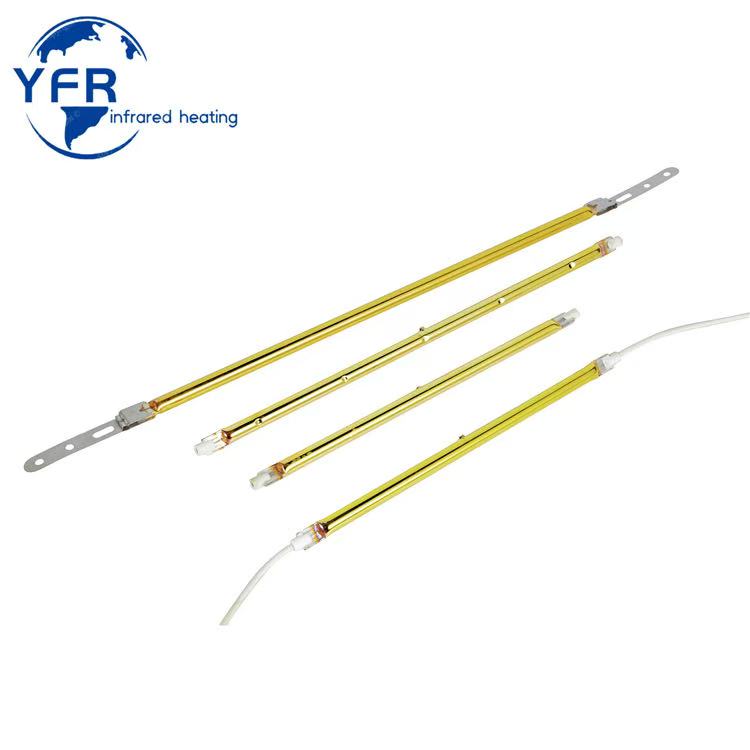
Most industrial “quartz infrared lamps” are a type of tungsten-halogen lamp: a tungsten filament is sealed inside a high-temperature quartz envelope with an inert gas plus a small amount of halogen. The halogen chemistry helps reduce bulb-wall blackening and can stabilize output over life when operating conditions are correct. wiki
When power is applied, the filament heats rapidly and emits radiation across visible and infrared wavelengths, with a strong infrared component that can be directed to the target using reflectors or coatings.
Before any glass is formed or any filament is mounted, manufacturers define the lamp design around the end-use process. Key decisions include:
Short-wave designs emphasize fast response and high intensity, useful for high-speed drying and rapid heat-up.
Medium-wave designs provide broader heating behavior for materials that absorb better in longer IR wavelengths.
(Exact peak wavelength depends on filament temperature and design, so this is chosen based on process needs, material absorption, and line speed.)
Rated voltage and wattage
Target power density (e.g., W/cm or W/in of heated length)
Electrical connections and lead style (single-end, double-end, ceramic terminals, etc.)
Overall length vs heated length (heating zone)
Tube diameter and wall thickness (especially important for long lamps and thermal shock resistance)
Single tube vs twin-tube / double-tube layouts for mechanical stability and radiation density (commonly used in industrial emitters).
Many industrial lines want more energy forward and less wasted backward. A common solution is a reflective coating applied over part of the tube circumference (often around half coverage) to direct radiation toward the product.
A “gold reflector” coating is frequently described as an IR mirror-like layer to improve directional heating efficiency.
A stable lamp starts with stable materials:
High-purity fused quartz tube
Chosen for high temperature capability, thermal shock behavior, and optical transmission.
Tungsten filament and support structure
Filament geometry (coil, coil pitch, support points) strongly affects radiant output and lifetime.
Sealing components
Many industrial designs rely on robust sealing assemblies (often including metal foils and compatible metals) to maintain hermeticity through repeated thermal cycling.
Fill gas mixture
Inert gas plus halogen additives support the halogen cycle that helps keep the envelope clearer and can slow lumen/IR output depreciation—provided the lamp operates within its intended thermal envelope.
Optional coatings
Reflective coatings (gold/white/other) and protective surface treatments are selected based on directionality, environment, and cooling design.
Manufacturers typically:
Cut quartz tubing to target length.
Prepare tube ends for sealing assemblies and terminal interfaces.
Clean the quartz to remove residues that can cause hot spots, devitrification risk, or coating adhesion problems.
Cleanliness is not cosmetic—it directly affects reliability under high temperature and high power density.
Filament manufacturing and mounting often includes:
Forming the tungsten filament to the required geometry for the lamp’s power density.
Adding support elements to reduce filament sag and vibration sensitivity during rapid heat cycling.
Aligning the filament within the quartz envelope for uniform output across the heating zone.
Small alignment differences can create uneven heating profiles—critical in processes like ink drying, coating curing, or film heating.
After the filament assembly is inserted:
Lamp ends are sealed using the manufacturer’s sealing method and terminal design.
The lamp is evacuated and filled with the specified gas mixture (including halogen additives for tungsten-halogen designs). wiki
Hermeticity is verified to prevent premature failure.
Why this matters: If the seal is weak, oxygen/moisture ingress can accelerate filament failure and alter the internal chemistry.
Thermal treatment (annealing) helps:
Relieve stress in quartz
Stabilize seals and end structures
Reduce early-life failures from manufacturing stress
This is one reason industrial lamps are not “just glass tubes with a wire.”
If directional heating is required, manufacturers apply a reflective coating over part of the tube circumference.
Many reflector lamps use partial coverage (commonly described as around half-tube) to project more energy forward.
Gold reflector concepts are often described as reflecting a high portion of IR toward the target surface to reduce rear losses.
Engineering note: A reflector coating changes not only directionality but also the lamp’s thermal behavior. Cooling design and mounting clearances should be considered to avoid overheating the quartz or terminals.
Reputable manufacturers run tests that typically include:
Resistance and power draw at rated voltage
Insulation and dielectric checks
Terminal temperature behavior under load
Overall length, heated length, straightness
End cap and lead integrity
IR output profile and uniformity (where required)
Early-life burn-in to screen infant mortality failures
| Spec item | Why it matters |
|---|---|
| Voltage & wattage | Ensures compatibility with your power system and control method |
| Overall length & heated length | Defines fit and the true heating zone |
| Target power density | Drives heating rate and material risk (overheating/scorching) |
| Tube diameter & wall thickness | Impacts strength, thermal shock behavior, and long-length feasibility |
| Lead/terminal style | Affects installation, serviceability, and safety |
| Reflector type & coverage | Determines directionality and energy efficiency |
| Operating environment | Heat, airflow, contaminants, vibration—affect lifetime |
| Mounting & cooling method | Prevents hot spots and premature seal/coating failures |
| Process details | Material type, line speed, target temperature, distance to product |
If you provide these details, the supplier can design a lamp that matches process physics, not just a generic catalog item.
Envelope darkening / output drop
Tungsten evaporation can deposit on the envelope; halogen-cycle chemistry helps reduce that under proper operating temperature conditions.
Seal failure and gas leakage
Often caused by thermal cycling stress, poor sealing materials, or installation-induced mechanical strain.
Filament sag or breakage
Triggered by vibration, rapid cycling, or unsupported filament geometry at high power density.
Quartz devitrification risk
Quartz can weaken if contaminated or operated outside intended thermal conditions.
Coating degradation (reflector peeling or discoloration)
Can occur if cooling and mounting are not designed for the lamp’s temperature profile.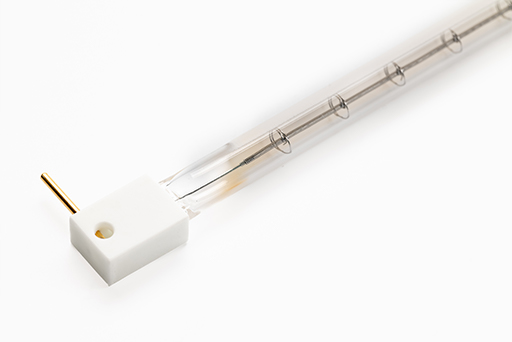
Printing and coating drying (ink, varnish, adhesives)
Film and sheet processing (plastic films, laminates)
Thermoforming and plastics heating
Paper and textile heating processes
Targeted preheating before bonding or forming steps
The right lamp design depends heavily on material absorption, distance to the product, and how fast the line moves.
Many industrial quartz infrared emitters use a tungsten-halogen design (tungsten filament + quartz envelope + inert gas + halogen additive).
Overall length is the end-to-end physical size; heated length is the active zone that emits most of the usable IR for your process.
When you need target heating (more energy forward, less wasted backward) or when surrounding components must be protected from rear radiation.
Yes—most industrial designs can be engineered around your voltage, wattage, geometry, and heating profile, but the final design must also match cooling and mounting constraints.
Twin-tube or similar layouts are used for mechanical stability and high radiation density in industrial emitters.
Material type, line speed, target temperature, distance to product, available voltage, required dimensions, and whether you need directional heating.
Last modified: 2025-12-30


