


Author: Process Heating Engineer Publish Time: 2026-03-16 Origin: Site


Last updated: August 30, 2026
Many people search infrared radiation lamp before they know whether they actually need a short wave emitter, a medium wave quartz lamp, a replacement heater for machinery, or a complete infrared heating module.
That search behavior is normal. In industrial projects, the application is often clear before the lamp terminology is.
A production team may know it needs faster drying, more stable heating before forming, or a replacement for an existing heater bank. What it may not know yet is which infrared lamp family, reflector arrangement, or installation geometry will actually solve the problem.
That is where this term becomes useful. It is broad enough to catch early research, but still close enough to real industrial heating that it can lead to an informed specification rather than a generic product search.
For YFR Heating, this is an important educational entry point because the company’s current product range already spans short wave, fast medium wave, medium wave, special-shape emitters, replacement IR lamps, heating modules, and power controls rather than a single standard lamp line.
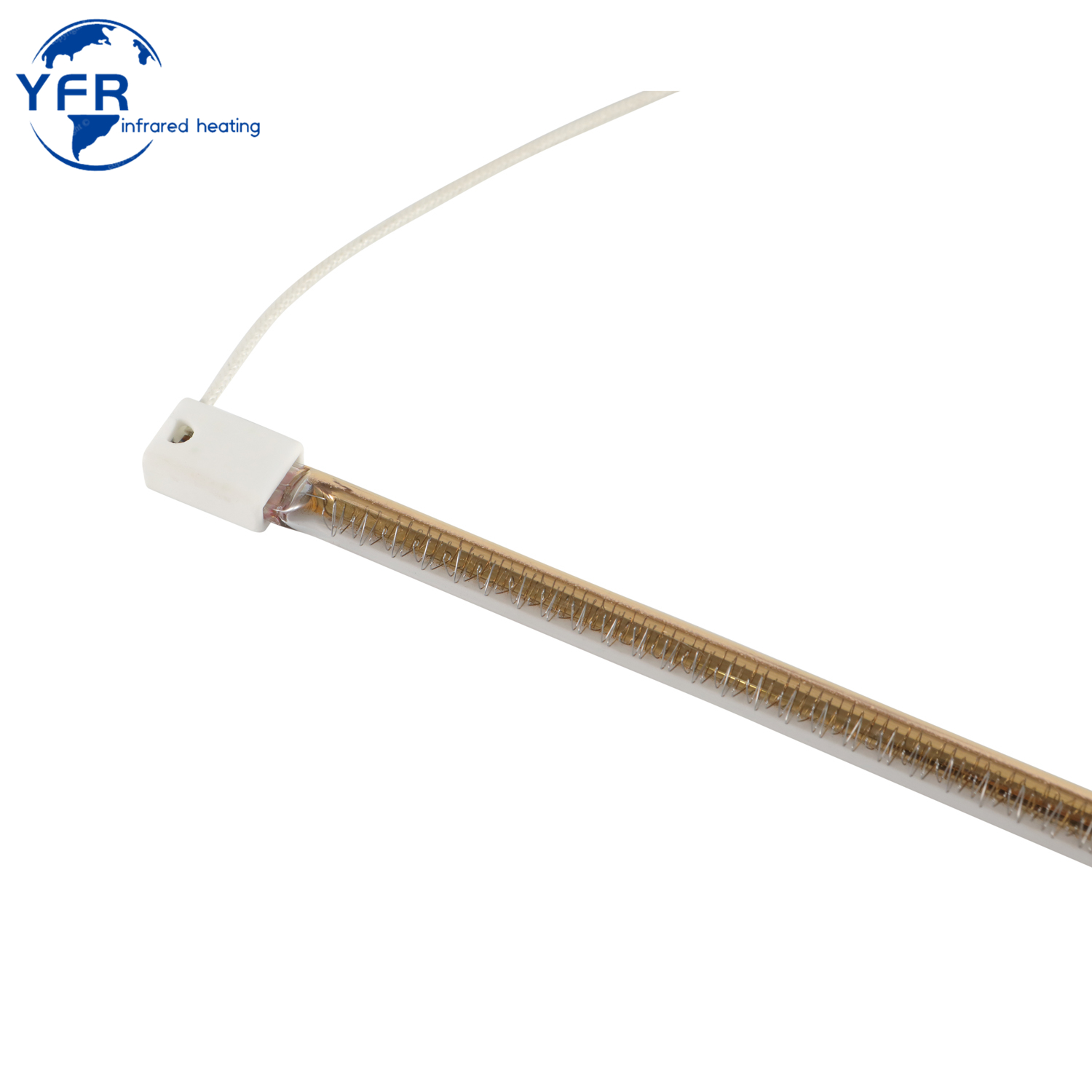
The phrase infrared radiation lamp sounds simple, but it hides several decisions that matter in real production.
It does not tell you the wavelength family. It does not tell you whether the lamp is meant for surface-dominant heating or deeper penetration. It does not tell you whether the process needs fast switching, a reflector, a specific heated length, or compatibility with an existing machine layout.
That is why two readers can search the same term and mean very different things. One may be looking for an infrared lamp for drying. Another may need a replacement infrared lamp for a printing or conveyor system. A third may be trying to understand whether an industrial infrared heater should use short wave or medium wave radiation.
A manufacturer-led article should not answer that confusion with a textbook definition. It should answer it by showing what actually changes lamp performance on the line.
In industrial heating, the practical question is not “What is the lamp called?” It is “What must the radiation accomplish?”
Noblelight’s industrial IR documentation notes that emitter selection depends on the material to be heated, absorption behavior, emitter wavelength, geometry, and distance between the source and the target. It also notes that medium wave radiation is often well absorbed by materials such as plastics, glass, and water, while short wave radiation can be useful where deeper penetration into some solids and very fast response are required.
That is why industrial readers should treat infrared radiation lamp as a starting term, not a final specification.
If the target is drying a coating, shrinking a sleeve, preheating a sheet, or heating a soldering zone, the useful next question is always process-related: what material is being heated, how fast the line runs, what temperature profile is needed, and how much installation space is available.
For readers browsing YFR’s site, this is also the natural point to move from a broad educational term into more precise pages such as Short Wave Infrared Lamp, FMW Infrared Lamp, Medium Wave Infrared Lamp, or Infrared Heating Module. YFR’s current catalog structure supports exactly that transition.
Industrial IR lamps are rarely used in isolation from a process. They usually appear inside a line, chamber, tunnel, oven, press, or machine zone where non-contact heating, quick response, or directional energy delivery is needed.
YFR’s current public pages show this industrial context clearly. Its site includes replacement IR lamps, modular heater systems, and application content for solar cell welding and solar wafer soldering, in addition to broader industrial lamp categories. Those examples reinforce that infrared radiation lamps are usually selected as part of a process solution rather than as generic stand-alone bulbs.
That distinction matters for beginners. An industrial infrared radiation lamp is not defined only by the fact that it emits IR. It is defined by how precisely that IR can be matched to a real heating task.
A broad term like infrared radiation lamp hides the biggest early decision: which part of the infrared range is appropriate for the material and the process.
Helios Quartz and Noblelight both show that different IR wavelengths behave differently in practical heating. Short wave emitters are associated with very fast response and strong heating intensity, while medium wave options are often favored where surface absorption by plastics, glass, water, or coatings matters more.
Some lines need the heater to react quickly to control changes. Others care more about steady surface heating across a wider zone.
Helios states that short wave quartz emitters are characterized by very fast on/off response and places them in wavelength ranges typically associated with fast-response industrial heating. That is relevant for compact zones, rapid cycling, or processes that need tight thermal control.
The same lamp can behave differently if its heated length, installation spacing, or reflector direction changes.
Noblelight’s documentation emphasizes that performance is influenced not only by wavelength, but also by emitter shape, position, and distance to the heated body. In real machines, this is why “same wattage” does not guarantee the same result.
Quartz construction, filament configuration, reflector coating, and end connections are not small details. They are part of how the lamp delivers energy and how easily it integrates into machinery.
YFR’s current lamp pages list transparent quartz, ceramic white coating, and gold reflective options, along with twin-tube constructions and custom shapes. Helios also describes how filament and ending configuration can be customized to match different heating geometries and installation needs.
What the reader is really trying to do | The better next question | Why this matters |
|---|---|---|
Dry a coating or remove surface moisture | How well does the material absorb the selected wavelength? | Material absorption often matters more than raw wattage |
Heat quickly in a short zone | How fast must the lamp respond to on/off or control changes? | Response speed affects controllability and line speed |
Replace an existing lamp in machinery | Do the heated length, terminals, reflector side, and voltage match the installed part? | Mechanical and electrical mismatch causes avoidable downtime |
Heat a shaped or contoured part | Does the emitter geometry need to be straight, twin-tube, round, or special-shape? | Geometry affects how radiation reaches the target |
Build a more complete heating section | Is a modular heater or power-control solution more appropriate than a lamp alone? | Some applications are easier to stabilize at module level |
This table is useful because it redirects the reader away from the vague term and toward the process conditions that actually determine fit.
For internal linking on YFR’s site, these rows naturally connect to Replacement IR Lamps, Special Shape Infrared Lamp, Infrared Heating Module, and Power Controls, depending on the reader’s situation.
A common misconception is that infrared radiation lamps can be compared mainly by voltage and wattage.
That is rarely enough in industrial heating. Noblelight’s technical material makes clear that wavelength, emitter geometry, and installation distance influence how effectively radiation reaches the target. Helios adds that filament configuration changes heated-area layout and lead position, which directly affects how a lamp behaves inside a machine.
This is why two lamps with the same nameplate rating may still produce different results in production.
One may heat more aggressively at the surface. Another may respond faster. Another may fit the same mounting points but shift the useful hot zone slightly enough to change drying, forming, or curing behavior.
For new readers, this is the key mindset shift: the lamp’s label tells only part of the story. The usable heating result comes from the combination of spectrum, geometry, reflector choice, spacing, and control.
A more useful question is: Which lamp is a good fit for this material, this machine, and this thermal objective?
That framing is more realistic, and it leads to better specification awareness.
A reader-friendly checklist can help:
Identify the material
Is it metal, glass, plastic, coated substrate, solvent-bearing layer, or something heat-sensitive?
Identify the thermal task
Is the goal drying, preheating, curing, forming, soldering, shrinking, or maintaining temperature?
Check the line behavior
Is the process continuous, indexed, rapid-cycling, or zone-controlled?
Check the physical constraints
How much space exists between the lamp and the target? Is the installed part straight, contoured, or modular?
Check the replacement risk
If this is a retrofit, are the existing voltage, heated length, reflector direction, and terminal details already known?
Check whether a lamp alone is enough
Some projects are easier to manage as a module plus control system rather than as a lamp-only purchase.
That last point matters because YFR’s current offering includes not only lamps, but also modular heating solutions and power controls for process integration.
Readers often encounter terms like quartz, gold reflector, white coating, or twin tube before they fully understand why they matter.
In industrial use, quartz matters because it supports high temperature operation and good transmission of infrared energy. Noblelight states that quartz tubes provide good transmission and temperature resistance, while its twin-tube design is used for high radiation power and strong mechanical stability.
Reflector choice matters because it changes where the energy goes. Noblelight notes that gold reflectors can redirect radiation toward the product, and YFR’s product pages show transparent, white-coated, and gold-reflector configurations across its lamp range.
That means reflector choice is not a cosmetic option. It is part of the thermal design.
For readers comparing an infrared heating lamp with a broader industrial infrared heater solution, this is often the first sign that lamp construction should be discussed together with the machine layout, not separately from it.
Readers who search infrared radiation lamp are not always planning a new design. Many are trying to identify or replace something already installed.
That replacement scenario changes the conversation immediately. A lamp that is thermally appropriate but mechanically incompatible is still the wrong part. So is a lamp that fits the machine but shifts the heated zone, terminal layout, or reflector direction enough to change process behavior.
YFR’s replacement pages emphasize standard and custom lengths, wattages, and voltages for new installations or direct replacements. That is useful because real replacement work usually depends on more than part naming. It depends on heated length, total length, reflector orientation, lead-end configuration, and machine context.
This is also why manufacturer involvement matters even for an informational keyword. A good educational article should help the reader realize when a broad term has to become a drawing-level discussion.
The value of an article like this is not that it gives one universal answer to the phrase infrared radiation lamp.
Its value is that it helps readers ask better questions.
By the time a reader finishes, the goal should be clearer:
not just to identify a lamp name
but to connect wavelength, response speed, quartz construction, reflector choice, spacing, voltage, and replacement requirements to a real industrial process
That is also the point where YFR Heating becomes more than a catalog source. Its current site structure supports the full progression from educational term to product family to replacement discussion to modular heating and control.
It is both. The phrase is broad enough that many readers use it during early research, but in industry it usually points toward a more specific emitter family such as short wave, fast medium wave, medium wave, or a replacement lamp for machinery. YFR’s current catalog structure reflects those more specific categories.
Process fit. In industrial heating, wavelength relevance, response speed, reflector choice, installation distance, and replacement compatibility usually matter more than the generic name alone. Noblelight and Helios both describe performance in those practical terms.
No. Quartz lamps can differ in wavelength behavior, filament configuration, reflector arrangement, heated length, cross-section, and end connections. Those differences can materially change heating performance and compatibility inside industrial equipment.
When the application needs a more integrated heating section, easier installation, or coordinated control. YFR’s current module page describes ready-for-installation systems using emitters, housing, and suitable control units, which is often more practical than choosing a lamp in isolation.
Yes, but only if the replacement matches the installed system correctly. Voltage, heated length, reflector orientation, terminal style, and machine context all matter. YFR’s replacement IR lamp pages are built around exactly that replacement logic.
[Application Review]
If you arrived here by searching infrared radiation lamp, there is a good chance you are still narrowing the problem rather than shopping a final part number.
That is a reasonable place to start. In industrial heating, the right next step is usually to connect the broad term to the actual application: the material, the line speed, the required heating effect, the available space, and whether the job is a new design or a replacement.
YFR Heating’s current product structure supports that progression with short wave, fast medium wave, medium wave, special-shape emitters, replacement IR lamps, infrared heating modules, and power controls. That makes it easier to move from general understanding to a more workable technical discussion.
If you already have an old lamp drawing, machine photo, voltage, heated length, or application description, those details can turn a broad search into a much more precise recommendation.
Review YFR industrial infrared heating lamps and heating modules and controls. Confirm emitter choice, mounting, sensing and recipes with representative product trials.
Send YFR your material, dimensions, target, cycle time and current equipment details for an application-specific review.


