Author: Site Editor Publish Time: 2025-08-06 Origin: Site
Last updated: August 30, 2026
Infrared emitters have become a core technology in modern plastics processing. From preheating and thermoforming to welding, coating, and quality control, they enable fast, precise, and energy-efficient heat delivery that traditional convection or contact heating cannot match. Yet the emitter itself is only one part of the story. Real performance comes from how the emitter is combined with materials, controls, sensors, and optical components across the entire production line.
This article explores the ecosystem of complementary innovations that work with infrared emitters for plastic: advanced emitter designs, IR-transmitting plastics, specialty coatings, plastic welding methods, in-line sensing, smart controls, and carefully engineered optics. The goal is to provide practical, technically grounded guidance for process engineers, equipment designers, and operations managers who need stable quality, higher throughput, and better energy performance.
Quartz and carbon-based infrared emitters can reach high radiant efficiency and fast response times, enabling rapid heating with lower overall energy usage in plastics processing.
IR-transmitting plastics such as tailored acrylic and polycarbonate allow infrared light to pass while blocking visible light, protecting sensors and electronics without compromising signal quality.
Infrared plastic welding provides strong, particle-free joints and, in many cases, can achieve shorter welding times and reduced contamination versus hot plate welding when the process is properly optimized.
Multi-spectral and near-infrared sensing integrated into plastic lines supports real-time material identification, microplastic detection, and automated quality control, significantly improving recycling and process consistency.
Smart power controls and IoT connectivity help infrared systems use only the energy required for each batch while enabling remote monitoring, fault prediction, and data-driven optimization.
Lenses, filters, and reflectors tuned to specific wavelength bands ensure that more of the emitted energy reaches the plastic where it is needed, improving both throughput and uniformity.
Implementing infrared emitters successfully requires structured risk assessment and compliance with machinery and electroheating safety standards such as ISO 12100, IEC 60519-1 and IEC 60204-1.
At its core, an infrared emitter converts electrical energy into radiant heat. In plastics processing, this radiant heat must be delivered quickly, uniformly, and in a controlled way to surfaces or through thin sections of polymer.
Common infrared emitter types used with plastics include:
Short-wave (SWIR) quartz emitters
These operate in the near-infrared region and heat up in fractions of a second. They are useful where high surface power density and fast cycle changes are required, such as high-speed coating lines or thin film processing.
Fast medium-wave and medium-wave emitters
Medium-wave radiation couples particularly well with many plastics and water-based coatings. Carbon-based medium-wave emitters can dry water-based coatings more efficiently than many short-wave systems, making them attractive for thicker parts and coating processes.
Specialty emitters and shaped emitters
Custom-shaped emitters (for example, contoured or twin-tube designs) match complex part geometries such as bumpers, housings, and profiles. When designed correctly, they enable localized heating with minimal overshoot, supporting deburring, embossing, shrink processes, and complex forming.
The choice of emitter is tightly linked to polymer type, layer thickness, target temperature profile, and allowable cycle time. In practice, many lines use a combination of short-wave and medium-wave emitters to balance speed, penetration depth, and surface quality.
Well-designed infrared systems can be switched on and off within seconds and deliver high radiant efficiency, reducing losses to the environment.
Key drivers of energy performance include:
Matching wavelength to polymer absorption peaks
Using reflectors and insulation to minimize stray radiation
Switching emitters off during gaps in production rather than running in standby
Applying closed-loop power control instead of simple on/off regimes
When these principles are applied, many plants report significant reductions in energy consumption and heating time compared with conventional hot air ovens or long hot plate sections, especially where frequent start/stop is required.
Beyond the heaters themselves, the materials placed around and in front of infrared emitters have a major impact on performance.
Infrared-transmitting plastics are used as windows, covers, and protective shields in front of emitters and sensors. Their task is to allow the desired infrared band to pass with minimal loss while blocking visible or ultraviolet light for aesthetic and protective reasons.
Typical materials include:
IR-transmitting acrylic (PMMA)
Clear or specially formulated acrylic sheets can transmit a high proportion of near-infrared radiation in a few millimetres of thickness over bands such as 700–1400 nm, while blocking most visible light.
IR-transmitting polycarbonate
Tailored grades transmit strongly in selected NIR ranges but offer higher impact strength and better heat resistance than PMMA, making them suitable for demanding environments such as automotive cabins or outdoor devices.
Specialized IR optical plastics and filters
Certain engineered plastics and coated films are optimized for narrow bands, for example 800–1100 nm, with high transmittance while blocking ultraviolet and most visible light.
For process engineers, the practical takeaway is to treat these plastics not as generic “black windows”, but as optical components with specific transmission curves that must be matched to emitter and sensor wavelengths.
Coatings on either the plastic part or surrounding fixtures strongly influence how infrared energy is absorbed, distributed, and dissipated.
Important coating strategies include:
High-emissivity and absorptive coatings
Dark, IR-absorbing coatings on metal fixtures or backers help convert more radiant energy into usable heat, reducing hot and cold spots and stabilizing process temperatures.
Water-based and UV-curable coatings optimized for IR
Water-based paints and clear coats often dry significantly faster under tailored infrared radiation compared with conventional convection ovens, especially when the IR spectrum is tuned to the absorption characteristics of the coating.
Thermal management coatings
Composite coatings with high emissivity and good thermal stability can protect plastic substrates from overheating while still allowing rapid surface curing, which is valuable in automotive exterior and electronic housings.
When selecting coatings, it is good practice to request IR absorption curves from suppliers and to test samples under representative IR conditions rather than relying solely on standard oven data.
Infrared plastic welding has evolved from a niche alternative to a mainstream joining technology for thermoplastics. In this method, infrared radiation heats and melts the faying surfaces of parts without contact; the parts are then pressed together to form the weld.
Compared with hot plate welding and some ultrasonic processes, IR welding offers several advantages:
Non-contact heating eliminates direct contact between the heat source and molten plastic, reducing the risk of particles or contamination entering the joint.
High controllability of intensity, exposure time, and spatial distribution allows precise tuning for complex geometries and sensitive materials.
Shorter heating times can often be achieved because the IR energy is delivered directly into the surface region rather than through a metal plate, which can significantly reduce overall welding time in many applications.
Results do vary depending on resin, rib geometry, and power density. In some scenarios, well-optimized hot plate welding can still perform similarly or even better from a cycle time perspective. For this reason, prototype trials under realistic conditions are essential before making large-scale investments.
Modern IR welding systems come in several configurations:
Fixed emitter plates for larger planar joints
Focused or segmented emitters with independently controlled zones for complex 3D contours
Rotary IR welding for circular or small components with high cycle rates
Typical applications include:
Instrument panels, interior trim, and safety-critical automotive components
Multi-part housings and connectors in electronics
Filter housings, medical disposables, and fluid containers
For high-value or safety-relevant parts, infrared welding is particularly attractive because it delivers strong, gas-tight welds with narrow, well-controlled heat-affected zones.
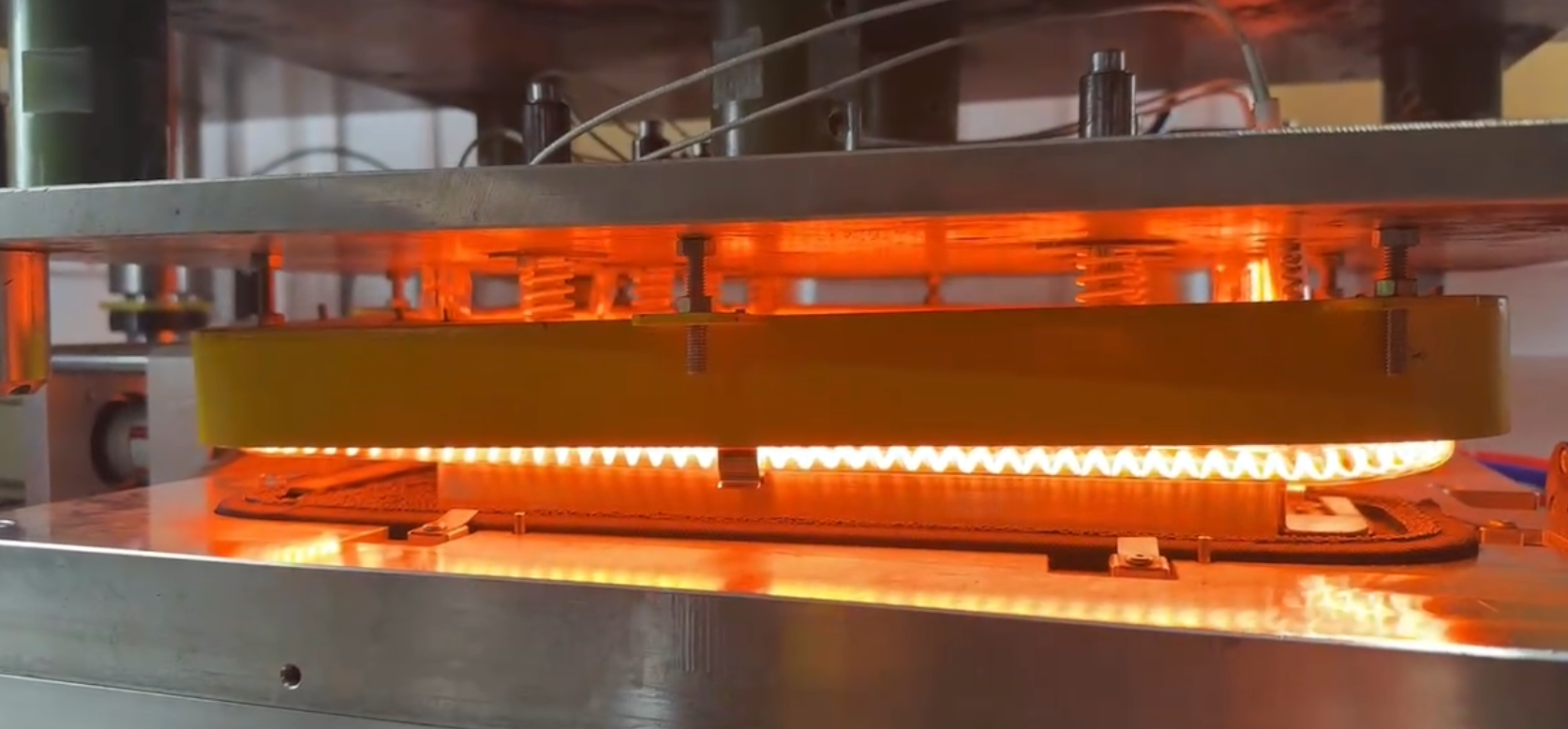
Infrared emitters do not operate in isolation; increasingly, they are paired with sensors and spectral analysis tools that monitor material, temperature, and contamination in real time.
Advanced infrared sensors using techniques such as micro-Fourier transform infrared (µ-FTIR), attenuated total reflectance FTIR, and multi-spectral near-infrared sensing can identify and classify microplastics down to small particle sizes.
For plastics processors, this type of sensing supports:
Monitoring of recycled feedstocks and pre-concentrates
Detection of contaminant particles in critical flows
Verification that process changes (for example, new coatings or new cleaning steps) are not introducing unexpected debris
Coupled with machine learning, these sensors can automatically analyze complex spectral data and flag deviations without manual interpretation, improving both detection speed and consistency.
In recycling and waste management, near-infrared and multi-spectral sensors are now standard for identifying common packaging polymers such as PET, HDPE, PVC, LDPE, PP, and PS. Recognition pipelines using NIR spectra and machine learning can reach high classification accuracy, and industrial sorter systems can achieve very high purity levels when the process is optimized.
For processors using recycled material, understanding the capabilities and limitations of these systems helps:
Specify minimum purity or contamination levels for incoming streams
Decide whether on-site pre-sorting or in-line verification is necessary
Build realistic assumptions about variation in material properties over time
Even with the right emitter and materials, infrared heating can underperform if it is controlled like a simple on/off heater. Modern power controls and IoT platforms turn IR systems into smart, adaptive assets.
Adaptive power control continuously adjusts emitter output based on sensor feedback—typically temperature, line speed, or material thickness. Instead of fixed setpoints, algorithms modulate power within each cycle to maintain target conditions while avoiding overshoot.
Practical benefits include:
Lower energy consumption through elimination of unnecessary “headroom”
Reduced scrap caused by local overheating or under-cure
Ability to switch quickly between recipes and product variants
In many plants, these controls are integrated with higher-level line automation, enabling coordinated changes in emitter power, conveyor speed, and pressure or cooling conditions.
IoT-enabled infrared systems expose key parameters—power, status, fault codes, temperature, cycle count—via standard protocols such as MQTT or OPC UA. This opens the door to:
Central dashboards across multiple lines or plants
Automated alerts when parameters drift outside defined windows
Remote support for troubleshooting and parameter tuning
By analyzing long-term data, maintenance teams can detect patterns that precede failures, such as increasing warm-up time or repeated over-temperature events, moving from reactive repairs to predictive maintenance.
For critical plastics applications, this approach supports higher uptime and extends emitter life, which contributes directly to lower total cost of ownership.
Optical engineering is often overlooked in plastics heating, yet it directly determines how much of the emitter’s power actually reaches the part.
Lenses and filters made from IR-transparent materials such as germanium, zinc selenide, chalcogenide glass, or IR-transmitting polymers can be used to shape and select the radiation reaching the plastic.
Design considerations include:
Wavelength range – selecting optics that match the emitter spectrum and polymer absorption band, for example SWIR 0.9–1.7 µm, MWIR 3–5 µm, or LWIR 8–14 µm.
Numerical aperture and F-number – lower F-numbers provide a wider field of view and higher irradiance on the part, which is helpful for high-speed lines.
Coatings – anti-reflection and protective coatings reduce reflection losses and protect against contamination or abrasion.
For sensor windows in harsh environments—such as automotive, industrial, or outdoor devices—IR-transmitting acrylic or polycarbonate with tailored filters is frequently used to protect electronics while maintaining signal quality.
Reflectors surround many infrared emitters and are critical to system efficiency. Highly reflective materials such as polished aluminum or gold-coated surfaces redirect otherwise lost radiation back onto the target.
Typical reflector geometries include:
Parabolic reflectors, which concentrate energy onto a narrow zone—ideal for localized heating and weld ribs.
Elliptical or custom reflectors, which spread energy more uniformly across wider parts or webs.
When designing or specifying reflectors, engineers should consider:
The specific plastic geometry and thickness distribution
Required uniformity and acceptable temperature gradients
Accessibility for cleaning, since dust or coating overspray can degrade reflectivity over time
Infrared emitters and the innovations around them play roles in multiple sectors that rely on plastic components.
Automotive – IR systems support welding of instrument panels, door trims, and airbag covers; rapid drying of coatings on bumpers and trims; and heating of preforms for lightweight structures. Sensors using IR in driver monitoring and cabin applications rely on IR-transmitting plastics and optics.
Medical – Infrared thermography and controlled heating are used in plastic surgery planning, wound assessment, and device manufacturing, where precise, non-contact heating reduces risk to sensitive materials.
Security and access control – Many access systems use IR beams and sensors within plastic housings to detect presence and authorize entry while operating reliably across a range of ambient conditions.
Consumer electronics and wearables – Remote controls, smart lighting, sensors in smart home devices, fitness trackers, and robot vacuum cleaners all rely on infrared emitters and receivers placed behind IR-transmitting plastic covers designed for specific wavelengths.
To implement or upgrade infrared emitters for plastics in a way that aligns with best practice and safety requirements, consider the following checklist:
Define the process window
Target temperatures, heating and cooling rates
Cycle time and allowable line speed range
Part geometry and critical quality characteristics
Match emitter type and wavelength to the plastic and coating
Obtain spectral absorption data when possible
Test combinations of short-wave and medium-wave radiation if the process relies on both surface and sub-surface heating
Engineer the optical path
Select IR-transmitting windows or shields with suitable transmission curves
Design reflectors and, where needed, lenses or baffles to focus energy where it is needed and minimize stray radiation
Integrate sensors and controls
Install temperature or pyrometric sensing at representative locations
Use closed-loop power control and, if possible, integrate line speed and thickness feedback
Log data for later analysis and continuous improvement
Plan for safety and compliance
Apply risk assessment according to ISO 12100 and related machinery safety standards
Ensure electrical and control systems comply with IEC 60204-1 and electroheating safety requirements such as IEC 60519-1.
Validate with real parts
Run trials using production-grade materials and geometries
Measure temperature distributions, weld strength, coating properties, and deformation
Adjust emitter layout, reflector design, and control algorithms based on measured data rather than assumptions
Infrared emitters for plastics are no longer simple heaters; they sit at the center of complex, data-driven systems that combine tailored emitter technology, IR-friendly materials, precision welding, spectral sensing, smart controls, and engineered optics. When these elements are designed together, manufacturers can achieve faster cycles, lower energy consumption, and more stable quality while supporting ambitious sustainability and recycling goals.
For engineering and operations teams, the most effective strategy is to treat the infrared emitter as one part of a larger ecosystem:
Choose the right emitter type and wavelength for the polymer and coating.
Use IR-transmitting plastics, coatings, and optics that cooperate with the emitter rather than fighting it.
Integrate sensing, adaptive control, and IoT monitoring to turn heating into a controlled, measurable, and optimizable process.
Anchor the entire installation in recognized safety and machinery standards to ensure long-term, compliant operation.
By approaching infrared heating for plastics in this holistic way, plants can convert a conventional heat step into a strategic differentiator—supporting higher productivity, better product performance, and reduced environmental impact.
Review YFR industrial infrared heating lamps and heating modules and controls. Confirm wavelength, emitter geometry, mounting, sensing and recipes through representative trials.
Send YFR your material, dimensions, target, cycle time and current equipment details for an application-specific review.


