


Author: Process Heating Engineer Publish Time: 2025-12-08 Origin: Site


Last updated: August 30, 2026
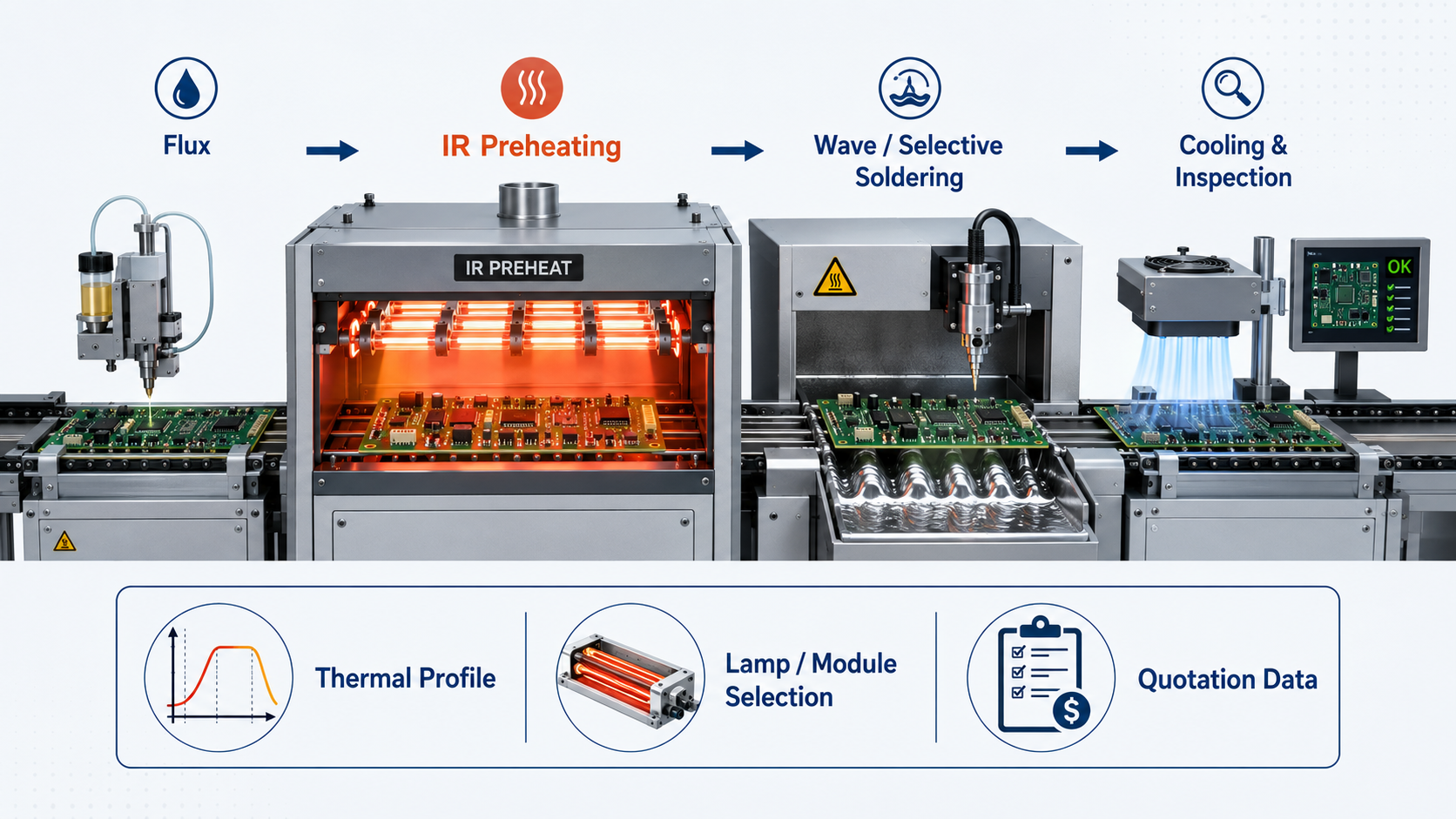
A simplified wave-soldering process includes four stages:
Flux application → controlled preheating → contact with molten solder → cooling and inspection
Infrared belongs to the preheating stage.
Its purpose is to provide controlled thermal input before the PCB reaches the solder wave or selective solder nozzle. The infrared emitters do not directly form the solder joints.
A suitable preheat profile may support several process objectives. It can raise the temperature of high-thermal-mass areas, help the applied flux progress through its intended heating stages and reduce the temperature difference between the PCB assembly and the soldering stage.
However, these benefits are not created by the lamp alone. Final solder quality also depends on flux application, solder alloy, solder temperature, contact time, wave condition, conveyor speed, PCB design and component solderability.
A populated PCB is not a uniform surface.
It may contain thin laminate areas, heavy copper planes, large connectors, metal shields, polymer housings and small surface-mounted components. These parts absorb and distribute heat differently.
A thick multilayer board with large ground planes may require more thermal input than a smaller board running through the same machine. At the same time, lightweight or heat-sensitive components may reach their temperature limits more quickly.
Component height also creates shadowing. A tall connector or metal shield can block direct radiation from areas behind it. Pallets, rails and board supports can create additional shaded regions when the emitters are installed below the conveyor.
For this reason, a universal preheat temperature, lamp distance or conveyor speed should not be applied to every assembly.
The IPC-7530A temperature-profiling guidance describes a thermal profile as the temperature-versus-time history of a complete printed board assembly as it moves through the soldering process.
The profile should be measured on the actual board rather than inferred from heater temperature or chamber-air temperature.
Representative thermocouple locations may include:
a large connector or high-copper area;
a low-thermal-mass area;
a temperature-sensitive component;
a plated-through-hole region;
a location affected by a pallet or component shadow;
corresponding top and bottom locations where needed.
The acceptable profile should follow the flux supplier’s guidance, equipment requirements, component limits and the validated soldering process.
NASA’s wave-soldering workmanship standard also illustrates the system-level principle that preheat temperature, conveyor speed, solder temperature and wave settings must be documented and controlled together. Its numerical values should not be treated as universal modern settings, but the process-control principle remains relevant.
A stable preheat profile can support process consistency, but it cannot independently guarantee complete hole fill or eliminate bridging, icicles and cold joints.
For example, insufficient hole fill may also result from heavy copper planes, inadequate solder contact time, limited flux activity, poor solderability or unsuitable hole-to-lead geometry.
Bridging can be related to lead spacing, component orientation, conveyor angle, solder drainage and wave condition.
Infrared preheating should therefore be treated as one controlled variable within the complete soldering process.
Selection should begin with the required PCB thermal profile and the available machine structure.
It should not begin with a general rule such as “short wave is always best” or “a higher wattage heats more evenly.”
| Heating option | Suitable starting point | Main point to verify |
|---|---|---|
| Short-wave quartz lamp | Compact preheat zones, rapid response and systems requiring fast power reduction | Local intensity, hotspots and direct exposure of dark or sensitive components |
| Fast-medium-wave emitter | Longer preheat zones or assemblies requiring a broader control window | Response time, working distance and available heating length |
| Medium-wave or carbon emitter | Auxiliary heating with a less intense visible output | Slower response and residual heat after a conveyor stop |
| Hybrid infrared and convection | Assemblies with significant shadowing or large thermal differences | Airflow uniformity, exhaust and total equipment complexity |
Short-wave quartz emitters provide rapid response and high available radiant intensity. These characteristics can be useful in high-speed lines, compact retrofit zones and systems where the output must change quickly when conveyor speed changes.
The same high intensity can create local overheating when the lamp is mounted too close to the PCB or when several lamps overlap excessively.
Fast-medium-wave emitters may be considered when the process requires a more gradual heating profile or a longer controllable preheat section. Their suitability must still be verified on the actual PCB.
The correct emitter is the one that produces the required board profile without exceeding component limits—not necessarily the lamp with the highest surface temperature.
Bottom-side heating is a common starting configuration because the fluxed and solder-side regions need to be prepared before contact with the solder wave.
Bottom heating may nevertheless be affected by pallets, support rails, conveyor structures and flux contamination on the lamps or reflectors.
Top-side heating can assist some high-thermal-mass assemblies, but it exposes component bodies directly to radiation. Plastic connectors, labels, displays, electrolytic capacitors and other sensitive parts must remain within their allowable limits.
A top-and-bottom arrangement should only be selected after representative thermocouple profiling. It should not be treated as an automatic improvement over bottom-only heating.
Working distance affects both radiant intensity and coverage.
A shorter distance can increase local intensity, but the heating field may become narrower and more sensitive to PCB position and component height.
A longer distance can increase overlap between neighbouring lamps and widen the heating field. However, the intensity reaching the board may decrease and more radiation may reach rails or other machine components.
Lamp spacing must also be coordinated with the reflector geometry. Lamps installed too far apart can create colder bands, while excessive overlap can create hot regions.
There is no universal lamp-to-board distance. The final arrangement should be confirmed by profiling the actual assembly.
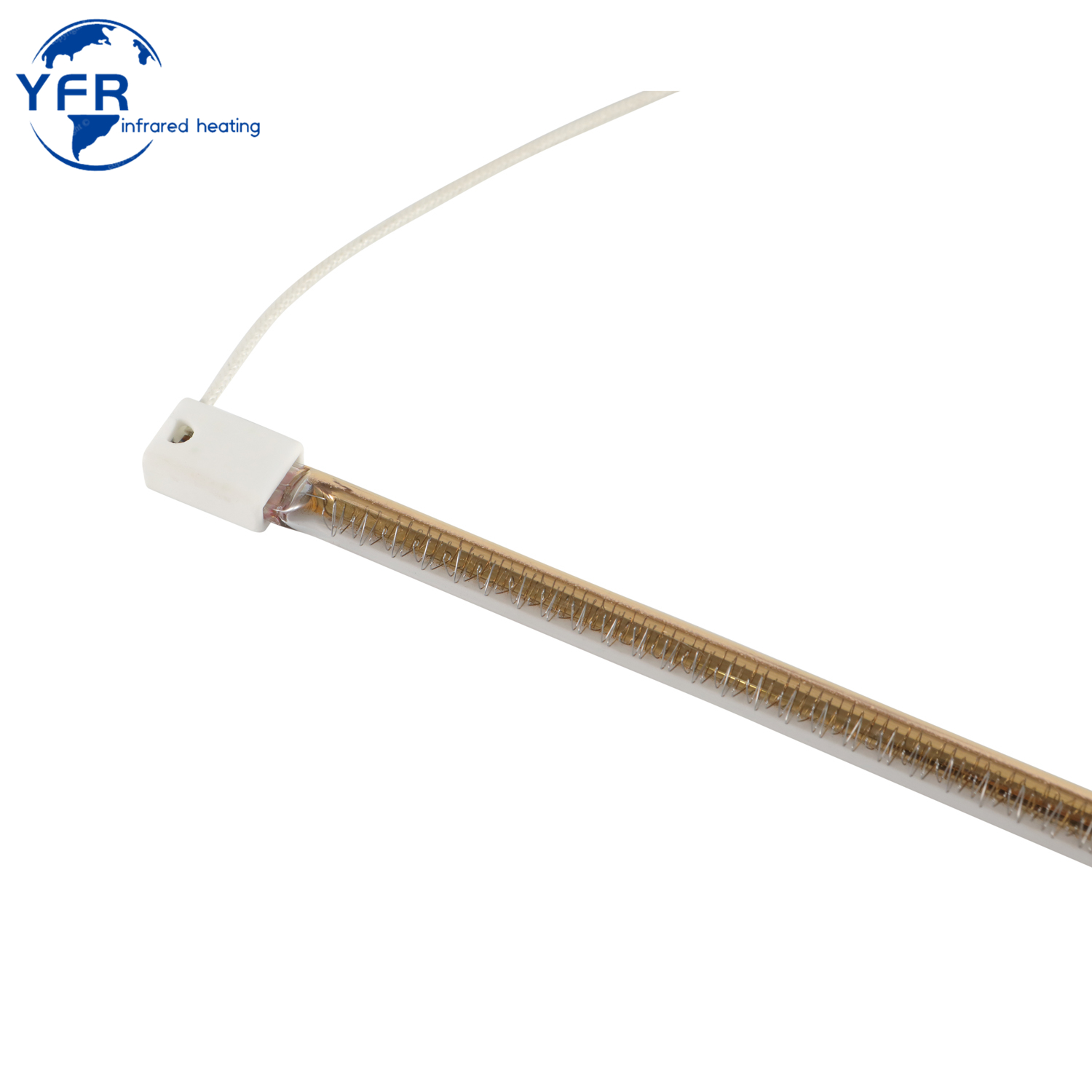
A reflector directs more radiation toward the working area and reduces unnecessary heating of the module housing.
The reflector must match the lamp dimensions, PCB width and mounting distance. Dirt, flux deposits and deformation can change the heating pattern over time.
For replacement lamps with a gold or ceramic coating, the reflector direction must also match the original installation. A lamp installed in the wrong rotational position can direct heat toward the housing rather than the board.
YFR supplies reflector housings and lamp cassettes where a complete mechanical assembly is more suitable than loose tubes.
A preheat section normally benefits from several controllable zones rather than one high-power area.
The first zone can provide a gradual temperature rise. The main zone supplies most of the required thermal input, while the final zone stabilizes the assembly before solder contact.
For wide conveyors, left, centre and right zones can also be controlled separately. Unused sections may be reduced when a narrow PCB is running.
Conveyor speed determines exposure time. When the line slows down, the PCB remains under each emitter for longer. The controller should therefore coordinate output with conveyor speed and board presence.
An IR lamp power controller can support adjustable output, but it must match the lamp voltage, current and required control method.
The machine also requires protection for conveyor stops, board jams, over-temperature conditions and exhaust failure. Depending on the emitter design, the response may include rapid power reduction, complete shutdown, shutters or board evacuation.
A loose replacement lamp may be sufficient when the existing holder, reflector, wiring and controller remain in good condition.
A complete infrared heating module may be more appropriate when the project requires:
several lamps in a coordinated array;
a new reflector arrangement;
revised mounting dimensions;
separate heating zones;
improved maintenance access;
replacement of obsolete holders or wiring;
integration into a new machine.
A module can combine lamps, reflectors, supports and wiring, but the equipment manufacturer remains responsible for guarding, ventilation, interlocks and complete process safety.
A useful quotation requires more than conveyor width and total wattage.
YFR must understand both the original equipment and the PCB process requirement.
| Required information | Why it is needed |
| PCB length, width and thickness | Defines heating coverage and basic thermal mass |
| Copper layers and heavy-copper areas | Identifies high-thermal-mass regions |
| Largest and most temperature-sensitive components | Establishes profiling and temperature-limit concerns |
| Flux type and process guidance | Helps define the intended preheat condition |
| Conveyor speed range | Determines exposure time |
| Existing preheat-zone length | Defines available module space |
| Bottom, top or dual-side installation | Determines the heating direction |
| Pallet, carrier and rail dimensions | Identifies blocked or shadowed areas |
| Available voltage and electrical capacity | Determines lamp and controller configuration |
| Target thermal profile | Defines the real performance objective |
| Existing lamp specifications | Supports replacement matching |
| Equipment drawings and clear photographs | Supports mechanical design |
When replacing an existing infrared tube, provide:
rated voltage and wattage;
total lamp length;
active heated length;
tube diameter;
single-tube or twin-tube construction;
reflector coating and direction;
ceramic end-cap dimensions;
lead-wire length and terminal type;
photographs of the complete lamp and both ends;
photographs showing the original installation position.
Two lamps with the same voltage and wattage may still have different heated lengths, terminal structures or reflector directions.
YFR’s custom replacement IR tubes can be evaluated from an original sample, technical drawing, equipment model or clear dimensional photographs.
For a new module, also provide:
available installation length, width and height;
required heated width;
conveyor-to-heater distance;
maximum component height;
required number of control zones;
available exhaust arrangement;
machine-controller interface requirements;
preferred lamp replacement and maintenance direction.
The highest-thermal-mass production board and the most temperature-sensitive board should both be considered during validation.
A module designed only around an average PCB may not cover the full production range.
After the candidate lamp or module is installed, the equipment manufacturer or PCB process engineer should validate it using actual production assemblies.
The process should record:
thermocouple locations;
conveyor speed;
zone power settings;
PCB temperature profile;
soldering-machine settings;
final solder-joint inspection results.
If the board profile does not meet the required process window, the working distance, zone output, conveyor speed or emitter arrangement may need adjustment.
The final production recipe must be approved from thermal-profile and solder-quality data, not from lamp brightness or nominal wattage.
YFR can supply:
Custom parameters can include voltage, wattage, total length, heated length, tube construction, reflector coating, end caps, lead wires and module dimensions.
YFR can provide candidate lamps or heating assemblies according to the equipment requirements. Final thermal-profile validation and soldering-process approval remain the responsibility of the equipment manufacturer or PCB process engineer.
No. Infrared normally supplies preheating before the PCB contacts the molten solder wave or selective solder nozzle.
There is no universal setting. It must follow the flux guidance, component limits, machine process and measured thermal profile of the actual assembly.
No. Short-wave lamps provide rapid response, but fast-medium-wave or hybrid systems may offer a better control window for some boards.
Bottom heating is a common starting configuration. Top heating may assist some assemblies but must be validated against component temperature limits.
Provide voltage, wattage, total and heated length, tube diameter, reflector direction, end-cap and terminal dimensions, lead-wire information, machine model and clear photographs.
Infrared preheating can provide fast and controllable thermal input before wave and selective soldering.
Its value is not determined by lamp wattage alone. The complete result depends on PCB thermal mass, copper distribution, component layout, working distance, reflectors, conveyor speed and zone control.
Short-wave and fast-medium-wave quartz emitters are both possible options. Selection should follow the measured temperature profile of representative production boards.
For an accurate YFR quotation, provide the PCB process requirements, available installation dimensions, electrical conditions and detailed information about the original lamp or module.
Review YFR industrial infrared heating lamps and heating modules and controls. Confirm wavelength, geometry, mounting and controls through representative trials.
Send YFR your material, dimensions, target, cycle time and current equipment details for an application-specific review.


