Author: Site Editor Publish Time: 2025-09-30 Origin: Site
Last updated: August 29, 2026
Carbon infrared emitters combine medium-wave-oriented output with relatively fast response. They can be useful for materials that absorb this radiation effectively, but the word “carbon” does not define a complete heater. Electrical data, heated length, tube geometry, reflector, mounting and controls must all match the process.
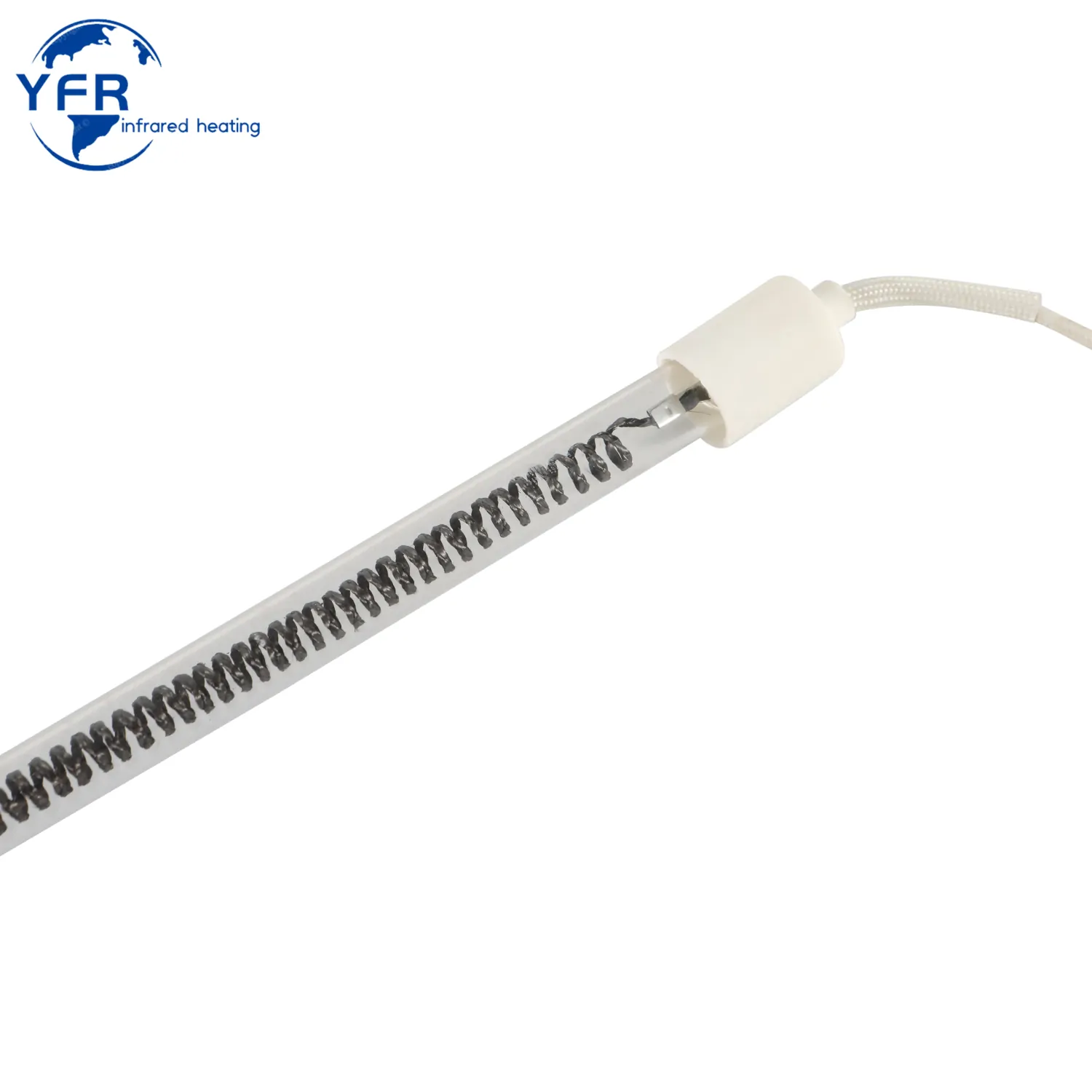
Evaluate the complete material system: substrate, coating, moisture, colour and thickness. Absorption can change during drying or heating, so a spectrum that couples well at the start may not control the final stage. A sample trial is more reliable than choosing an emitter from a material name alone.
Record the overall length, heated length, cold ends, tube diameter, lead orientation and mounting space. Two lamps with the same wattage and overall length may create different heat profiles if their heated lengths or reflector positions differ. For a replacement, provide clear photos and an accurate drawing.
| Factor | Why it matters | Data to provide |
|---|---|---|
| Voltage and wattage | Defines electrical compatibility and load | Rated supply and circuit arrangement |
| Heated length | Shapes the active temperature profile | Required width or part coverage |
| Response time | Affects cycling and line-stop control | Cycle, speed and control objective |
| Reflector | Directs energy and affects the rear environment | Target geometry and cooling conditions |
| Termination | Controls fit, connection and seal area | Cap, lead and connector dimensions |
Carbon emitters can respond faster than conventional long-response ceramic heaters, making zoning and closed-loop power control practical. The chosen controller must still match the lamp voltage, current, start-up behaviour and permitted switching method. Include safe line-stop reduction or shut-off where stationary product could overheat.
Review YFR carbon infrared lamps and systems and controls.
Run trials across the expected speed, material and ambient range. Record surface and internal temperature where relevant, heating uniformity, final quality and cooling time. Inspect terminals and reflector temperature during the test. The approved recipe should include distance, zone power, airflow and sensor settings.
No. Emitter construction, response, spectrum and dimensions vary. Compare the actual specification.
Not without checking electrical, dimensional, optical, mounting and control compatibility.
Provide material, thickness, colour, target temperature, heated area, speed or dwell, distance, available supply and current heater details.
Yes, when the electrical design and controller suit the lamp load. Zone boundaries should follow the actual product and process requirements.
Send YFR the process and lamp drawing for an emitter compatibility review.


