


Author: Site Editor Publish Time: 2025-12-10 Origin: Site
Last updated: August 31, 2026
In most industrial food plants, drying and dehydration are implemented as continuous processes on conveyorized tunnel lines. Typical products include:
Fruit slices and vegetable chips (apple, banana, carrot, sweet potato)
Meat snacks (beef jerky, pork or poultry strips)
Baked goods requiring final moisture adjustment (biscuits, crackers, cereal bases)
Tea leaves, herbs, and spices
Although the recipes differ, the basic line layout is similar:
Feeding and loading
Product is dosed, sliced, or formed, then distributed on a belt or on trays. Achieving a repeatable layer thickness (for example, 3–8 mm for fruit slices or 2–5 mm for jerky strips) is critical for uniform drying.
Initial tempering / preheating
Many plants use mild hot air or residual heat from upstream ovens to bring products from ambient (15–25 °C) toward 40–60 °C before intensive drying begins. This helps reduce thermal shock.
Main hot-air tunnel drying
The core equipment is typically a multi-zone tunnel dryer:
Steam coils, gas burners, or electric heaters heat the circulating air. Moisture is removed via exhaust fans; sometimes heat recovery is installed.
Belt width: 0.8–2.5 m
Line speeds: roughly 1–8 m/min depending on product and moisture load
Air temperatures: commonly 50–120 °C for sensitive products, up to ~150 °C for robust baked items
Residence time: from 10–15 min (biscuits) to 60–120 min (high-moisture fruit or meat)
Finishing / post-drying and conditioning
A final zone or separate cabinet is used to “trim” moisture to the specification and stabilize color and texture. For example:
Fruit chips: target moisture 3–8%
Jerky: low water activity for shelf stability
Tea and herbs: consistent volatile retention and aroma
Cooling and packaging
The product is cooled to safe packaging temperatures to avoid condensation inside bags or trays, then passes to inspection and packing.
In this flow, heat is needed mainly for driving moisture from the product surface and, over time, from the interior. The challenge for engineers is to achieve the required moisture target with:
Acceptable color and appearance
Controlled texture (crisp, chewy, or friable as required)
Maximum throughput per meter of tunnel and per kWh of energy consumed
This is exactly where hybrid concepts using infrared heat lamps alongside hot air are gaining attention.SpringerLink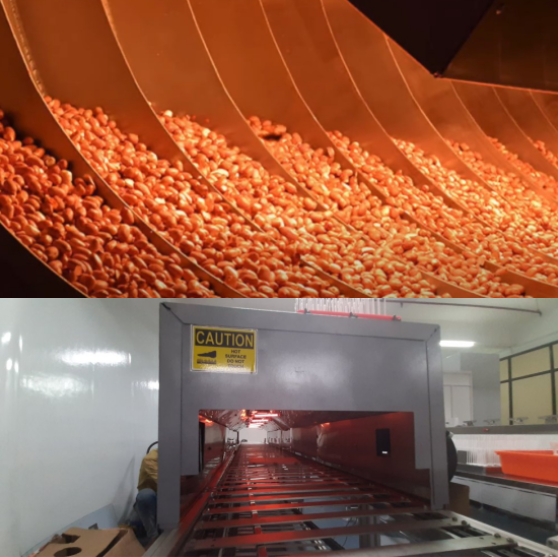
Conventional hot-air, gas-fired, or steam-heated tunnel dryers are robust and well understood, but they face inherent limitations:
Slow heat transfer and long residence times
Convective drying relies on heating the air and then transferring heat to the product. A large fraction of the energy goes into heating air, steel, and insulation rather than the food itself. As a result, residence times are long, and lines occupy a large floor area.
Non-uniform drying and quality variation
Even with careful air distribution, edge zones on the belt often dry faster than the center. For sliced products, thinner pieces over-dry or brown, while thicker pieces remain wet. This can cause:
Color variation across the belt
Cracking or case hardening of the surface
Inconsistent texture and water activity
Energy consumption and operating cost
Typical convective systems utilize only a fraction of the input energy for actual moisture evaporation; a significant portion is lost through exhaust air and thermal leakage from the enclosure.
Footprint constraints
If throughput needs to increase, the usual solutions are:
Increase air temperature (limited by product quality and food safety)
Add more tunnel length (often impossible due to space limits)
Limited flexibility for different products
Changing between fruit chips, jerky, biscuits, and tea leaves may require substantial adjustments to air temperature, humidity, and airflow, but the thermal mass and slow response of a large hot-air dryer make quick changeovers difficult.
These constraints motivate many plants to look for a more direct, responsive heat source that can be added to existing dryers without rebuilding the entire line.
Infrared (IR) heating — especially using quartz infrared heat lamps — delivers thermal energy primarily via radiation, directly to the product surface. A short explanation is sufficient here:
The lamps convert electrical energy into infrared radiation.
The radiation is absorbed by water and organic compounds in the product, raising surface temperature rapidly, with minimal need to heat large air volumes.
Rather than replacing all existing equipment, IR is most effective when strategically integrated at specific points:
An IR preheat zone can be installed at the entrance of a tunnel dryer:
Short-wave or fast medium-wave quartz lamps are mounted above (and optionally below) the belt.
Typical exposure: 10–30 seconds at moderate power density.
Target: bring the product surface quickly from ambient to 50–70 °C, initiating moisture removal before entering the main hot-air zones.
Benefits:
Reduces the time hot air must spend warming the product.
Allows the main dryer to work more efficiently on moisture removal rather than basic heating.
Many retrofits add IR boost modules within or just before a bottleneck zone:
Lamp arrays are installed between existing plenums or in the roof of the dryer, with reflectors to direct energy downward.
Power is adjustable so that IR provides an extra drying “push” where the line is capacity-limited.
Typical use cases:
Increasing line speed from, for example, 2–3 m/min up to 4–6 m/min for fruit or jerky, without extending the tunnel.
Recovering capacity after product recipe changes that increased moisture load or thickness.
For thin, relatively uniform products (fruit slices, biscuits, tea leaves), it can be efficient to create dedicated IR modules:
A short IR tunnel performs 60–80% of the required moisture removal.
A subsequent mild hot-air or conditioning zone trims the final moisture and equalizes temperature.
Configuration options:
Top heating only: suitable when products lie directly on a solid belt or tray.
Top and bottom heating: using mesh belts to expose both surfaces, effective for jerky strips and thin vegetable slices.
Segmented zones: different IR intensities for initial drying, mid-range, and finishing to avoid surface over-heating.
This hybrid approach provides the responsiveness of IR with the gentler equalization effect of convection.SpringerLink
Every project needs detailed engineering based on product, moisture load, hygiene requirements, and available space. However, some practical ranges are useful for initial feasibility work.
In food drying, quartz IR lamps are commonly used in:
Short-wave IR (SWIR)
Wavelength peak: ~0.8–1.4 μm
Very fast response, high power density
Strong surface heating, suitable for thin layers and products with relatively low color sensitivity.
Fast medium-wave IR (FMWIR)
Wavelength peak: ~2–3 μm
Slightly deeper penetration into moist foods, often better match for water absorption bands.
Gentler surface gradients, useful for meat snacks, dense biscuits, and some vegetable products where case hardening is a concern.
Mixtures of both types in different zones are also possible.
As a starting point for conceptual sizing:
Fruit and vegetable slices (2–6 mm thickness):
IR boost zones: about 10–25 kW/m² of active belt area.
Full IR drying sections: 10–30 kW/m², staged in multiple zones to avoid scorching.
Jerky and meat snacks (3–8 mm thickness):
Prefer lower initial surface load: 5–18 kW/m² using FMWIR.
Later zones can be increased once surface moisture is reduced.
Biscuits, crackers, cereal pieces:
IR finishing to remove 1–3% moisture: roughly 5–15 kW/m².
Often used after a conventional baking step.
These values reflect typical industrial practice for conceptual design only; detailed design must consider belt loading (kg/m²), initial and final moisture, and maximum permissible surface temperature.
Common mounting distances between lamp face and product surface:
150–350 mm for most tunnel applications.
Shorter distances provide higher intensity but narrower distribution and higher risk of hot spots.
Larger distances smooth out intensity but require more power or reflector optimization.
Geometry considerations:
Use polished metal or gold-coated reflectors behind lamps to direct IR toward the belt and minimize losses.
Side shields reduce stray radiation and protect adjacent components.
Lamps are typically arranged in rows or cassettes with individual or group control.
For practical line speeds of 1–8 m/min, IR section length and power define the drying contribution:
A 3 m IR module at 3 m/min provides ~60 s exposure.
Two 2 m modules at 6 m/min provide ~40 s each (80 s total) with zoning flexibility.
For many food products, 10–60 s of IR exposure at appropriate power density can substantially reduce overall drying time or final hot-air demand when integrated into a hybrid system.SpringerLink

Studies on IR drying of fruits, vegetables, and cereals show that carefully controlled IR exposure can:
Shorten drying time while maintaining or even improving color and rehydration characteristics.
Enhance crispness for chips and snacks.
Reduce quality loss compared with long, high-temperature convective processes.
For tea, herbs, and spices, precise IR settings can help maintain volatile aroma compounds because the overall thermal exposure time is lowered.
By adding IR boost or preheat zones, many plants can:
Increase line speeds by 20–50% for certain products without modifying the main tunnel length.
Recover capacity after shifting to thicker cuts or higher initial moisture content.
In practice, this often means converting a dryer from a bottleneck to a balanced element in the line.
Because IR delivers high heat flux directly to the product, IR modules can be compact:
A 2–6 m IR section can replace or complement much longer hot-air zones.
Retrofitting IR modules into unused spaces over existing belts is often feasible without structural rebuild.
This is particularly attractive in existing plants where building extension is not an option.
Infrared heating typically exhibits higher useful energy utilization than convective systems since it minimizes heating of air and structural mass. Literature and manufacturer data often cite utilization levels of roughly 60–80% for IR vs. 30–50% for pure convection, depending on system design.
When combined with smart controls and proper exhaust/recirculation strategies, IR-assisted dryers can:
Reduce specific energy consumption (kWh per kg of evaporated water).
Lower peak utility demands by shortening drying times.
Food plants operate under strict hygiene rules. IR systems must be designed accordingly:
Smooth, cleanable surfaces in stainless steel; avoid dust-trapping features.
Lamp protection using quartz or tempered glass covers, with seals and gaskets suitable for wash-down where required.
Access doors or swing-out frames for lamp inspection and cleaning of reflectors.
Attention to IP rating and corrosion resistance of lamp terminals and wiring.
Before committing to full-scale equipment, pilot tests should determine:
Maximum allowable surface temperature before color, flavor, or texture defects occur (for example, surface browning of sugar in fruit slices or protein denaturation in meat snacks).
Drying curves for different power densities and dwell times.
IR drying can cause steep temperature gradients if power is too high; step-wise ramping and staged zones often give better results.SpringerLink
Good control is essential for repeatable results:
Use power-proportional control (phase-angle or burst firing) for lamps rather than simple ON/OFF switching.
Define recipes by zone setpoints (percentage of full power) matched to line speed and product type.
Where possible, add:
Surface temperature monitoring with IR pyrometers.
Exhaust humidity or dew point monitoring to track drying progress indirectly.
Drying uniformity depends strongly on how the product is presented to the IR field:
Prefer single-layer loading for critical products; if multi-layer loading is necessary, ensure layers are thin and well distributed.
Keep spacing between pieces consistent; clusters and overlaps will dry differently.
Coordinate conveyor type with heating: mesh belts are ideal for top-and-bottom IR heating; solid belts require more attention to bottom cooling and cleaning.
For hybrid IR + convection systems:
Avoid simply “adding heat” everywhere; instead, re-balance air temperature and flow after adding IR to avoid over-drying and excessive surface temperature.
Use IR primarily where surface moisture is high and convective transfer is limiting, then rely on hot air to finish the last part of drying gently.
Over-aggressive power density
Applying maximum lamp power to shorten drying time can lead to:
Solution: start with moderate power and adjust stepwise; use multi-zone designs to ramp intensity.
Surface burning or blistering
Case hardening, where the surface dries too fast, trapping moisture inside
Too small working distance
Mounting lamps very close to the product to “save energy” may create hot spots and non-uniform color.
Solution: verify intensity mapping at the product plane; typically 150–350 mm distance provides a workable compromise.
Ignoring reflections and edge effects
Highly reflective enclosures can cause local intensity peaks in corners and along edges.
Solution: simulate or measure irradiation patterns; use diffusers, baffles, or slightly different finishes where needed.
Underestimating product variation
Different batches (thickness, moisture, formulation) absorb IR differently and may dry faster or slower.
Solution: build in process flexibility (independent zones, adjustable power, variable line speed) and define recipes for each product type.
Insufficient maintenance planning
IR systems rely on clean reflectors and healthy lamps. Dust, fat vapors, and product fines will gradually reduce performance.
Solution: specify:
Cleaning intervals for glass covers and reflectors
Quick lamp replacement access
Monitoring of lamp hours and preventive replacement for critical lines
Huai’an Yinfrared Heating Technology typically follows a staged approach for food drying applications using infrared heat lamps:
Process analysis and feasibility
Review existing line layout, products, and bottlenecks.
Collect key data: product type, thickness, initial and final moisture, belt width, current line speed, oven temperatures, and available installation space.
Estimate potential IR integration points (preheat, boost, or dedicated IR stages).
Lab and pilot testing
Using lab rigs or pilot tunnels equipped with short-wave and fast medium-wave quartz IR lamps, we:
Run customer samples (fruits, vegetables, jerky, biscuits, tea, spices) at different power densities and dwell times.
Map drying curves and surface temperature behavior.
Identify safe operating windows and approximate kWh/kg improvements vs. baseline processes.
Concept and detailed design
Based on test data and plant constraints, we propose:
Selection of lamp type (SWIR or FMWIR, or a combination).
Module layout: zone lengths, lamp counts, and reflector design for each belt width.
Mechanical integration details: mounting frames, protection glass, access doors, and hygiene features.
Electrical and control interface: power supplies, temperature/humidity feedback, and recipe management.
Implementation and commissioning support
During installation and start-up, we support:
On-site tuning of power settings and line speeds.
Creation of product-specific recipes (for example: “banana chips, 4 mm, 65% → 5% moisture”).
Training of operators and maintenance teams.
Long-term optimization and service
Periodic review of performance (energy use, throughput, scrap rates).
Support for new recipes or product introductions.
Recommendations for spare parts and inspection routines to keep IR modules running at design efficiency.
By combining application engineering, customized IR modules, and ongoing support, Huai’an Yinfrared helps food processors deploy infrared heat lamps in a way that is technically sound, hygienic, and economically justified.
Send YFR your material, dimensions, target temperature, cycle time and current equipment details for an application-specific review.


