Views: 0 Author: Site Editor Publish Time: 2025-11-03 Origin: Site
In the modern woodworking and timber processing industry, drying is one of the most energy-intensive and time-consuming stages. Traditional kiln drying methods often struggle with uniformity, long cycle times, and high energy costs. In contrast, infrared heaters offer a more efficient, controllable, and sustainable solution for wood drying.
This article provides a comprehensive technical guide on infrared heating technology for drying wood, explaining its working principles, heater classifications, wavelength selection, and key parameters for industrial applications.
Wood contains both free water (in cell cavities) and bound water (within cell walls). The drying process must remove moisture without causing surface cracking or internal stress. Conventional convection-based dryers rely on heated air, which transfers heat indirectly and often inefficiently.
Infrared (IR) heating works differently. It uses electromagnetic radiation in the wavelength range of 0.78–1000 µm to directly heat the surface and near-surface layers of materials. The wood absorbs this radiation and converts it into heat energy, raising temperature from the inside out.
Rapid heating response: IR systems reach operating temperature in seconds.
High energy efficiency: Up to 90% of electrical energy is converted into usable radiant heat.
Improved product quality: Uniform heating minimizes warping and cracking.
Compact system design: No need for massive hot-air chambers or fans.
Reduced drying time: Infrared energy accelerates evaporation from surface layers.

Infrared heaters emit radiation at specific wavelengths that correspond to the absorption characteristics of water and wood fibers. Water molecules absorb energy most effectively in the medium-wave IR range (2–3 µm), where molecular vibration matches the frequency of IR radiation.
When infrared energy strikes the wood surface, part of it is absorbed and converted into heat, which conducts inward. Simultaneously, the elevated temperature drives moisture from within the wood to the surface, where it evaporates. This combined conduction and radiation mechanism ensures faster and more uniform moisture removal than convection drying.
Typical drying process stages include:
Initial heating: Rapid surface temperature rise using short- or medium-wave IR.
Moisture migration: Controlled energy input for internal moisture transfer.
Final stabilization: Gentle heating to reach target moisture without overheating.
Infrared heaters can be classified by wavelength, emitter material, and construction. Choosing the right type depends on the wood species, moisture content, and drying speed requirements.
| IR Type | Wavelength (µm) | Emitter Material | Typical Temperature (°C) | Best Suited For |
|---|---|---|---|---|
| Short-Wave IR (SWIR) | 0.78–1.5 | Tungsten filament in quartz tube | 1800–2600 | Fast surface drying, thin boards |
| Medium-Wave IR (MWIR) | 1.5–3.0 | Quartz or carbon filament | 800–1500 | Moisture removal in thicker timber |
| Long-Wave IR (LWIR) | 3.0–10 | Ceramic or metal oxide | 300–700 | Slow drying, delicate wood species |
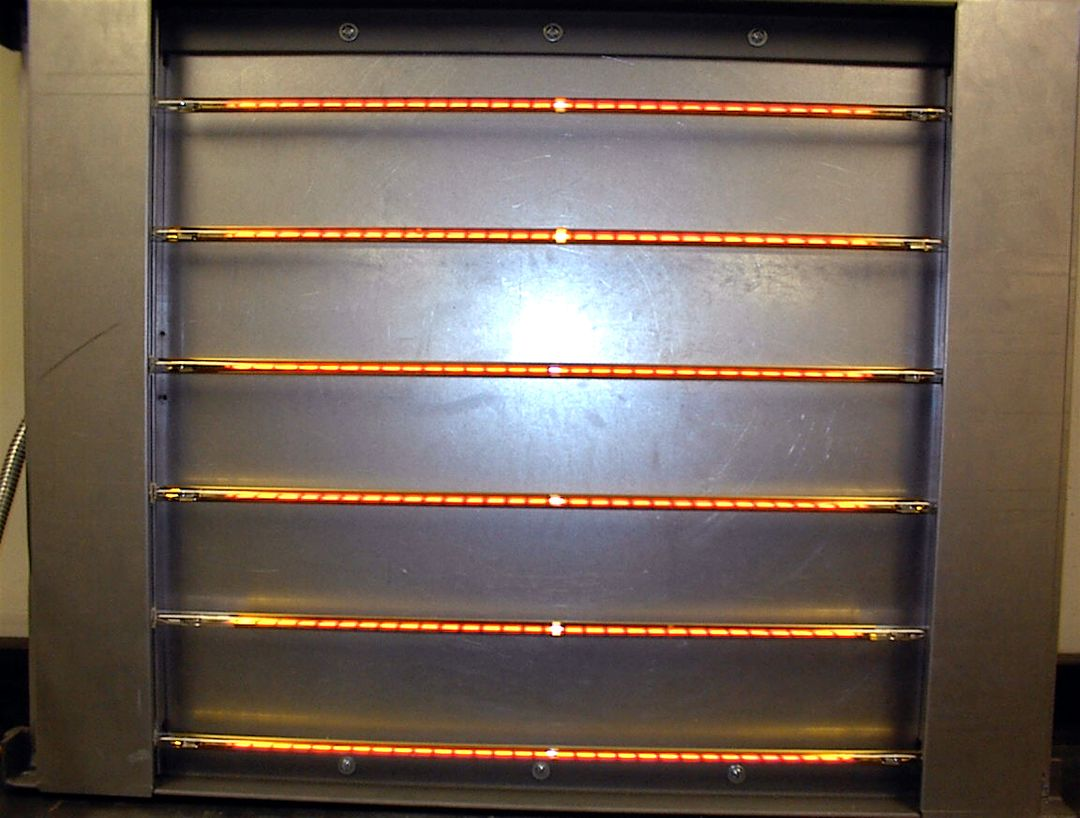
Single-Tube Quartz Lamps: For targeted heating or modular designs.
Twin-Tube Heaters: Provide higher radiant power density for large chambers.
Carbon IR Emitters: Offer softer, deeper penetration and long service life.
Ceramic Emitters: Ideal for stable, low-temperature drying environments.

Wood’s effective absorption peaks around 2–3 µm, aligning with medium-wave IR emitters. For high moisture content materials (above 40%), medium-wave lamps typically yield optimal efficiency.
Short-wave emitters can be used for surface drying or preheating stages, while long-wave emitters are suitable for finishing or stress-relief drying. By combining different IR wavelengths in zones, manufacturers can achieve multi-stage drying curves that balance speed and product integrity.
An industrial IR wood dryer is more than just a set of heaters. It’s an integrated system where thermal uniformity, air exchange, and control precision play critical roles.
Infrared emitter arrays mounted with optimized spacing and reflector geometry.
Reflectors (gold, aluminum, or white ceramic) to focus radiation on the wood surface.
Air circulation to remove evaporated moisture.
Temperature and humidity sensors for feedback control.
Automatic modulation of heater power to follow moisture content profiles.
Proper emitter orientation and reflector design can increase effective heat transfer by up to 30%. Zone-based control allows independent temperature settings for different sections of the dryer, ensuring uniform results even for mixed wood batches.
When choosing the right infrared heaters for wood drying, consider both technical performance and application-specific constraints.
| Parameter | Recommended Range / Notes |
|---|---|
| Peak wavelength (µm) | 2–3 µm (best for moisture absorption) |
| Emitter surface temperature (°C) | 800–1500 depending on wood type |
| Power density (W/m²) | 10,000–25,000 for industrial drying |
| Response time | < 2 seconds for fast control |
| Heater life | 5,000–10,000 hours typical |
| Reflector material | Gold for high reflectivity, aluminum for general use |
| Mounting distance | Typically 150–300 mm from wood surface |
| Zone control | Recommended for large chambers |
Infrared systems reduce overall energy demand compared to convection kilns. They also eliminate fossil fuel combustion, leading to lower CO₂ emissions and easier temperature regulation.
Infrared heaters directly convert electric power into radiant energy, achieving conversion efficiencies above 85–90%. Because radiation heat does not rely on air as a transfer medium, losses due to convection are minimized.
In many industrial case studies, drying time is reduced by 30–60%, while energy savings of 25–40% are commonly achieved. The system’s overall performance depends on factors like wood thickness, chamber insulation, and control precision.
Infrared drying is widely used in:
Furniture and flooring manufacturing
Veneer and plywood production
Laminated beam (glulam) preparation
Coating and surface finishing pre-treatment
By controlling wavelength and intensity, infrared heaters can adapt to a range of applications, from gentle low-temperature drying of decorative veneers to rapid pre-drying of structural timbers.
Modern infrared drying systems integrate advanced control technologies:
Real-time temperature monitoring with thermocouples and IR sensors
Closed-loop power modulation for energy optimization
PLC and HMI interfaces for process automation
Data logging for moisture trends and quality traceability
Automation allows operators to precisely control each drying stage, ensuring repeatable results and minimal waste.
Infrared drying aligns with global sustainability goals in manufacturing. Future innovations include:
Hybrid drying systems combining IR and microwave technologies.
AI-driven process control for predictive drying optimization.
Recyclable reflector materials and improved lamp recycling methods.
Integration with renewable power sources for carbon-neutral production.
Infrared technology continues to evolve as industries seek faster, cleaner, and smarter drying solutions.
Infrared heaters represent a modern and efficient approach to industrial wood drying, delivering faster throughput, better quality control, and substantial energy savings. By selecting the right wavelength, emitter type, and control configuration, manufacturers can significantly enhance productivity while reducing operational costs.
For industrial clients aiming to optimize their wood drying processes, well-designed infrared heating systems provide not just faster results—but smarter, more sustainable performance.

Prepared by: Huai’an Yinfrared Heating Technology
Last modified: 2025-11-03