Views: 0 Author: Site Editor Publish Time: 2025-11-21 Origin: Site
Infrared heating lamps for solar cell welding give PV module manufacturers a way to combine gentle, non-contact heating with high throughput and repeatable solder quality. This article is written for process engineers, production managers, and equipment integrators who are upgrading or designing solar cell tabbing, stringing, and bussing lines. We will focus on how to specify and integrate quartz infrared solutions that improve energy efficiency, line speed, and process control.

Opportunity: Conventional contact or hot-air heating in the solar panel soldering process often struggles with tight thermal windows, cell fragility, and higher energy losses. Infrared heating lamps create a focused, non-contact solar cell welding heating solution with fast ramp-up and controlled cooling.
Best fit: Infrared radiation heating for solar cells is especially effective in tabbing and stringing zones, bussing and interconnection lines, and localized repair and rework, where thin silicon, busbars, and copper ribbons must be heated quickly and uniformly without damaging passivation layers or coatings.
Impact: Compared with purely convective or contact-based heaters, properly engineered quartz infrared heat lamps can reduce wasted heat, shorten cycle times, and support higher conveyor speeds by directing energy exactly to solder joints rather than the surrounding air and mechanics. Actual savings depend on line design and operating conditions.
Key design levers: The most critical technical parameters are wavelength (short- vs medium-wave), power density and zoning, working distance, and control strategy (open-loop vs closed-loop power and temperature control). These define temperature uniformity, risk of microcracks, and achievable throughput.
How Huai’an Yinfrared helps: Huai’an Yinfrared Heating Technology supports OEMs and plants with short-wave quartz infrared lamps, fast medium-wave modules, modular infrared heating cassettes, and compact welding and preheating stations that can be tailored as part of a complete infrared heating system for PV module production lines.
Tabber-stringer machines solder thin copper ribbons onto the busbars of crystalline silicon cells and connect cells into strings. Typical wafers are 150–210 µm thick, with soldering temperatures in the range of about 220–260 °C at the joint, and line speeds often above 1,000–2,000 cells per hour per lane.
Pain points of conventional heating:
Contact hot bars and heated shoes create mechanical stress and risk cell microcracks.
Slow thermal response makes it difficult to maintain a narrow solder profile when line speed changes.
Inefficient heating of surrounding air and fixtures increases energy consumption.
Temperature overshoot can damage passivation layers or cause solder spatter.
How infrared changes the game:
Non-contact short-wave infrared heating lamps focus energy on the solder joint area, minimizing mechanical contact with the cell.
Fast response (on the order of seconds or less) supports rapid heating and cooling phases, which is ideal for rapid heating for solar cell tabbing and stringing.
Zoning along the cell travel direction allows preheat, peak, and controlled cool-down segments to be implemented in a compact footprint.
The result is more uniform joints, reduced risk of bowing or cracks, and better control of series resistance.
Suitable Huai’an Yinfrared solutions:
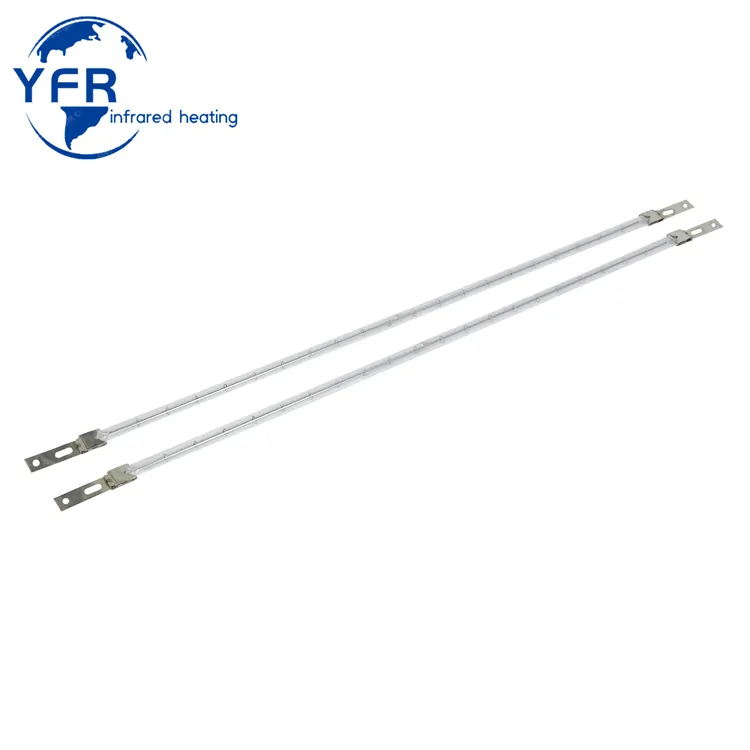
Short-wave quartz infrared lamps mounted in reflectors directly over the solder area.
Modular infrared heating cassettes that can be inserted into existing tabber-stringers with minimal mechanical changes.
Compact infrared welding and preheating stations for new tabbing and stringing platforms using a short-wave infrared heater configuration.
In bussing and interconnection lines, strings are connected in parallel or series, and busbars or foils are soldered to create the final electrical layout. The process involves larger copper cross-sections, encapsulant layers, and sometimes thicker glass or backsheet substrates.
Typical process window:
Larger thermal mass than single-cell tabbing.
Soldering temperatures similar to tabbing, but with longer dwell times and stricter warpage control of the laminate.
Line speeds defined in metres per minute; dwell times from several seconds up to tens of seconds depending on layout.
Conventional heating limitations:
Large plate or belt heaters heat everything – glass, encapsulant, and fixtures – leading to slower response and higher energy use.
Maintaining tight temperature uniformity across wide panels is challenging; hot spots can reduce adhesion or cause local stress.
Infrared benefits for bussing:
Fast medium-wave infrared lamps can provide deeper penetration into busbars and EVA encapsulant compared with pure short-wave, which helps create smoother temperature gradients.
Multi-zone infrared modules allow separate control of edge, centre, and local hot areas to compensate for panel geometry.
Preheating and peak soldering zones can be implemented in one compact infrared heating system, improving throughput without lengthening the line.
Recommended Huai’an Yinfrared solutions:
Fast medium-wave infrared lamps in cassette-style modules above and/or below the bussing section.
Hybrid systems combining short-wave peak heating with medium-wave preheating to manage gradients.
Modular infrared heating cassettes integrated into existing conveyors or gantry soldering equipment.
Despite good process control, PV factories still face rework: for example, replacing defective ribbons, repairing poor joints, or correcting alignment errors.
Process characteristics:
Very localized heating on a finished cell or laminated module.
Critical to avoid overheating nearby encapsulant, backsheet, or glass.
Operators may manually position tools, or robots may handle precise positioning.
Issues with traditional tools:
Hot-air guns and contact tips can be too coarse; they warm a large area, work slowly, and risk visual defects or yellowing of encapsulant.
Contact tools can mark surfaces or induce additional mechanical stress.
Infrared advantages in rework:
Narrow-beam short-wave lamps or small infrared spots can target only the joint or ribbon.
Power can be pulsed or modulated to control the local solder profile precisely.
The approach scales easily to automated repair heads with integrated infrared emitters and temperature measurement.
Huai’an Yinfrared options:
Compact infrared welding and preheating stations designed as plug-in heads for robotic repair tools.
Small-format quartz infrared heat lamps combined with reflectors to shape the beam for localized solar panel soldering process repair.
Infrared heating design for PV welding is about matching the emission characteristics to the material stack and process window. The main parameters are wavelength, power density, emitter type, size and zoning, response time, working distance, and control.
Definition: Short-wave (approximately 0.8–1.4 µm), medium-wave (approximately 2–3 µm), and long-wave (above 3 µm) refer to the peak emission band of the infrared heater.
Why it matters: Silicon, copper, solder alloys, and encapsulant each absorb infrared differently. Short-wave emits close to the visible range, coupling strongly to metals and thin coatings; medium-wave often couples well into polymer layers and thicker busbars; long-wave suits bulk heating and drying rather than precise soldering.
Trade-offs:
Short-wave: fastest response and highest power density, ideal for soldering but can create steep gradients if not well controlled.
Medium-wave: slightly slower but often smoother, good for preheating laminates and bussing.
Long-wave: best for general preheat or drying, not usually the first choice for critical joints.
Definition: Total power (kW) and power per unit area (kW/m²) delivered to the active heating zone.
Importance: Too low and solder does not fully melt; too high and cells crack or solder splashes. Power density must align with dwell time and line speed.
Typical ranges: For tabbing and stringing, short-wave systems often use high power density to reach solder temperature within a few seconds; bussing may use lower densities over longer dwell times.
Quartz tube lamps: Single- or twin-tube quartz infrared emitters with tungsten filaments are standard for solar cell welding due to very fast response and high intensity.
Ceramic or metal-foil heaters: Useful for long-wave or low-temperature tasks, such as general preheating, but less common directly at solder joints.
Panels and cassettes: Combine multiple quartz lamps in a housing with reflectors, insulation, and wiring, forming a modular building block for an OEM machine.
Longer lamps or panels cover more cells or wider modules; zoning allows different power levels in different sections (preheat, peak, cool).
For tabbing, lamp length is often matched to the cell width or slightly longer. For bussing, zones might match busbar paths.
Zoning improves temperature uniformity and allows recipe control for different products.
Lamps operate at filament temperatures in the thousands of degrees Celsius, translating to radiative flux at the product. The key is not the filament temperature itself but the resulting product temperature profile.
Short-wave lamps reach operating power in fractions of a second, which supports dynamic power adjustment as line speed changes.
Working distance (lamp-to-cell) affects irradiance and spot size. Too close and the beam is narrow and intense; too far and power density drops and heat losses rise.
The design must fit around conveyors, vacuum chucks, and optical inspection systems.
On/off or stepped control: Suitable for simple preheat zones.
SSR/SCR phase-angle control: Enables smooth power modulation of lamp voltage.
Closed-loop PID: Uses temperature feedback from thermocouples or pyrometers.
PLC or fieldbus integration: Needed for recipe management and synchronization with motion systems.
Infrared modules must be mechanically protected, with thermal insulation on the rear side to reduce losses and control external surface temperatures.
Protection ratings and shielding are important if flux fumes, dust, or glass shards can be present.
| Infrared Solution Type | Wavelength Band | Typical Power Density | Response Time | Recommended Applications | Control Options |
|---|---|---|---|---|---|
| Short-wave quartz IR lamp | Short-wave | High | Very fast | Tabbing and stringing, high-speed solar cell welding | On/Off, SSR/SCR, PID, PLC |
| Fast medium-wave IR module | Medium-wave | Medium–High | Fast | PV bussing, laminate preheating, reflow profiles | SSR/SCR, PID, PLC or fieldbus |
| Long-wave ceramic IR heater | Long-wave | Medium | Slow–Medium | General panel preheating, non-solder thermal processes | On/Off, basic PID |
| Infrared oven with zoning | Mixed | Application-dependent | Medium | Complete PV module curing and lamination support | Multi-zone PLC with recipes |
If/then rules (simplified):
If your main task is high-speed tabbing and stringing with dwell times under 5 seconds → choose short-wave quartz lamps with high power density and fine power control.
If you are preheating laminates or bussing with dwell times of 5–20 seconds → consider fast medium-wave modules, optionally combined with short-wave peak zones.
If you mainly need bulk preheat or drying, not critical soldering → long-wave or mixed infrared ovens may be sufficient.
If product mix and line speed vary frequently → prioritise closed-loop PID control and recipe-based PLC integration.
If you retrofit an existing line with fixed mechanical geometry → adapt lamp length and working distance to current tooling, using modular infrared heating cassettes.
Mini decision flow (conceptual):
Start: What is your main PV heating task?
For highly localized joints → compact short-wave spots or small cassettes with manual or robotic positioning.
If panel thickness is moderate and EVA heating is critical → fast medium-wave infrared modules with multi-zone control.
If you already have convection preheat → add short-wave peak zones for solder-only heating.
If cycle time is very short and footprint limited → short-wave quartz infrared lamps, narrow beam, high power density.
If you need a softer profile due to fragile cells → combine slightly lower power density with multi-zone control.
A. Tabbing and stringing of individual cells
B. Bussing and interconnection on modules
C. Repair and rework
Electrical integration is foundational for safe and stable operation:
Mains and phase: Define voltage (for example, 230/400/480 V) and phase configuration early. Multi-lamp modules are often split across phases for load balancing.
Wiring and protections: Use appropriately rated cables, fuses, circuit breakers, and residual current devices. Ensure proper earthing of metallic housings.
Control strategies:
For simple zones, on/off control via solid-state relays may be enough.
For critical soldering zones, SCR phase-angle or burst-firing control with PID loops is recommended to stabilise radiant output.
PLCs should manage recipes, ramp rates, and interlocks with motion and vision systems.
Cabinet layout: Group infrared drives in dedicated panels with adequate ventilation, separation from low-voltage PLC hardware, and clear labelling for maintenance.

Mechanical integration around solar welding stations must respect both process and serviceability:
Mounting: Frames and cassettes can be attached to existing machine structures or standalone brackets. Provide fine adjustment for height and angle.
Distance and angle: Optimise the working distance to achieve the required irradiance and spot size. Angling lamps can reduce reflections and improve uniformity across wide panels.
Line speed and dwell time: Verify that lamp length and active zone match conveyor speed to provide the target thermal profile (for example, preheat over 200 mm plus peak over 100 mm at a defined metres per minute).
Reflectors and shielding: Use specular or diffuse reflectors to redirect stray radiation back to the process. Shield sensitive components and operator areas from direct infrared exposure.
Maintenance access: Design lamp housings so emitters can be replaced from the operator side without disturbing alignment. Plan cleaning access for quartz tubes to avoid contamination and efficiency loss.
In solar panel soldering process design, thermal tuning is critical:
Define the profile: Specify preheat, peak, and cool-down temperatures and times for the solder alloy and cell design.
Instrumentation: Use a mix of embedded thermocouples (on dummy cells or ribbons) and infrared sensors to characterise surface temperatures.
From trial to structure:
Start with conservative power settings and gradually increase until solder fillets are fully formed without discolouration or warpage.
Capture thermal curves and correlate them with visual and electrical test results, such as series resistance and electroluminescence imaging.
Defect reduction examples:
Reducing peak overshoot may cut microcrack occurrence and improve long-term reliability.
Adjusting preheat can minimise voids and cold joints, especially for busbars with high thermal mass.
Pro tip for plant engineers: Always validate new infrared recipes with accelerated thermal cycling and EL or IR imaging, not just immediate flash-test results. Subtle thermal damage may only show up under stress.
A staged validation approach reduces risk:
Lab tests:
Use a small infrared test stand to heat sample cells and ribbons.
Record heating curves, maximum temperatures, and cooling rates for different lamp settings.
Pilot or test lane:
Integrate a short infrared module into an existing line or a dedicated pilot lane.
Run limited batches to evaluate process capability and establish preliminary recipes.
Full-scale acceptance: Define clear metrics, for example:
Throughput: strings per hour, modules per hour, or metres per minute.
Temperature uniformity: for example, maximum temperature difference between cells in a string or across a busbar zone.
Specific energy consumption: kilowatt-hours per square metre or per module for the infrared zones.
Product quality: solder wetting, pull strength, series resistance, electroluminescence defect rate, and field failure proxies.
Infrared welding systems must meet both electrical and machine safety requirements:
Regulatory frameworks (examples):
CE marking within the EU, referencing Low Voltage, EMC, and Machinery Directives.
UL or CSA standards for North America.
RoHS and REACH considerations for materials used in lamps, reflectors, and wiring.
Main safety topics:
High surface temperature: Install guards and covers, use warning labels, and design touch-safe external surfaces where possible.
Fire prevention: Maintain clearances to flammable materials, integrate over-temperature cut-outs, and protect against lamp breakage.
Electrical safety: Ensure proper grounding, short-circuit and overload protection, and safe isolation for maintenance.
Huai’an Yinfrared Heating Technology can provide supporting documentation, typical wiring diagrams, and guidance to help OEMs integrate infrared modules into compliant equipment. Detailed certification strategy should be coordinated with your notified body or local certification partner.
Infrared welding hardware for PV lines is usually sourced as part of a broader OEM or ODM cooperation.
Engagement models:
Standard catalog heaters and modules:
Pre-defined short-wave quartz infrared lamps and medium-wave modules.
Fastest option for prototyping or small line upgrades.
Customized emitters and panels:
Tailored lamp lengths, power ratings, filament geometries, and connector layouts.
Panelised modules with specific zoning, reflector profiles, and mounting interfaces.
Complete systems or retrofits:
Turnkey compact infrared welding and preheating stations with lamps, housings, sensors, and basic controls.
Integration into tabber-stringers, bussing stations, or rework cells as a custom infrared heating solution.
MOQ and lead times (typical patterns, not commitments):
Samples or small batches: low MOQ (even 1–10 pieces) for evaluation.
Custom lamp or cassette designs: engineering phase followed by pilot batch (for example, 20–100 pieces).
Mass production: framework orders for regular deliveries synchronised to the OEM’s machine sales.
Lead times depend on design complexity and material availability, but sample lamps are often feasible in weeks, while full system builds require additional time for design, validation, and documentation.
Assumptions (example only, not guaranteed results):
One welding line operates 6,000 hours per year.
Conventional system uses 10 kW average power in the soldering zone; infrared upgrades can reduce effective power or cycle time.
Energy price assumed at 0.12 USD per kWh.
Maintenance costs are indicative.
| System Type | Relative Energy Use | Estimated Annual Energy Cost | Maintenance Effort | Indicative Payback Comment |
|---|---|---|---|---|
| Conventional hot-air/contact | 1.0 | ~7,200 USD | Higher (tips, alignment) | Baseline |
| Quartz IR lamps retrofit | ~0.8–0.9 | ~5,800–6,500 USD | Moderate (lamp changes) | Payback often in 1–3 years, depending on energy and yield gains |
| Optimised IR with zoning & PLC | ~0.7–0.85 | ~5,000–6,100 USD | Moderate to low | Additional savings via recipe optimisation and improved uptime |
Actual savings will depend strongly on the specific line layout, utilisation, and how aggressively the process is optimised.
Common pitfalls to avoid:
Selecting the wrong wavelength for the material stack (for example, only long-wave heaters in a fast soldering zone).
Under-sizing power or over-estimating dwell time, leading to incomplete solder joints.
Ignoring insulation and reflector design, which reduces effective power and drives up energy use.
Poor mechanical mounting, causing misalignment, non-uniform heating, or difficult maintenance.
Insufficient temperature measurement and control, resulting in hidden hot spots and microcracks.
Overlooking lamp ageing – output decreases over time if not monitored and replaced.
Neglecting safety interlocks and over-temperature protection.
Practical benchmarks (directional):
Heat-up time from ambient to soldering temperature at the joint: typically a few seconds in high-speed tabbing and stringing infrared setups.
Temperature uniformity: temperature differences across the cell width should be minimised to reduce stress; uniformity targets are often set based on electroluminescence imaging and reliability testing.
Specific energy consumption: best-in-class PV manufacturers track kilowatt-hours per module and use this as a KPI when optimising infrared welding zones.
Huai’an Yinfrared QA philosophy (overview):
Incoming inspection of quartz tubes, filaments, and connectors.
In-process checks on power and insulation resistance.
Burn-in testing to stabilise early-life behaviour of emitters.
Final functional tests to confirm power, spectral output category, and mechanical robustness before shipping.

We typically need: cell type and size, material stack (busbar, ribbon, encapsulant), line speed or cycle time, target solder profile (preheat, peak, cool), available footprint, and utility constraints (voltage, phases, allowed power). With this, we can propose an infrared cell welding heating solution with appropriate lamp type, power, and zoning.
Infrared lamps transfer energy by radiation directly to the solder joint and surrounding materials, not primarily by heating the air. This focused approach reduces losses and can shorten cycle times. Depending on the starting point, this can translate into noticeable reductions in energy per module, but exact savings depend on line design and operating conditions.
Short-wave quartz emitters used in PV manufacturing commonly offer lifetimes on the order of several thousand operating hours when run within their rated voltage and in a clean environment. Over time, radiant output gradually decreases, so preventive replacement policies and simple runtime counters are recommended.
Yes. By combining lamp power control (via SCR or SSR), closed-loop PID control, and proper sensor placement, we can help your team achieve precise temperature control in PV module welding, including multi-zone profiles for preheat, peak, and cool-down sections.
Huai’an Yinfrared Heating Technology works closely with equipment builders and OEMs, providing customised emitters, modules, and complete subassemblies. Private-label printing and tailored documentation (3D models, wiring diagrams, application notes) can be provided as part of an OEM package.
We support customers globally via remote engineering assistance, documentation, and coordination with local partners. For key OEM and ODM accounts, we can align service models to your installed base and shipment regions.
If you are reviewing how to integrate infrared heating lamps for solar cell welding into your tabbing, stringing, or bussing lines, we invite you to share your basic process data (material stack, line speed, temperature targets). Our engineering team can perform an initial feasibility check and recommend a sizing concept for your next-generation infrared heating system.
To discuss an OEM or ODM project or request sample lamps and modules, please contact Huai’an Yinfrared Heating Technology through your usual sales or technical channels, and our specialists will respond with a tailored proposal.
Last modified: 2025-11-21