


Author: Site Editor Publish Time: 2025-12-11 Origin: Site


Electronics manufacturing has become a tightly controlled thermal process. Whether you run high-volume SMT lines or mixed-technology PCB assembly, your ability to control heat directly affects yield, rework rates, and energy consumption.
Quartz infrared (IR) heat lamps are now widely used to stabilize preheating, shorten drying times, and recover capacity from existing soldering and coating equipment. By delivering fast, controllable radiant energy to specific zones on the PCB and assembly, IR helps align real-world thermal behavior with the ideal profiles defined by process engineering.
This article focuses on where and how to apply infrared heating in PCB and SMT assembly lines, especially for soldering and coating processes, with practical configuration ranges and design guidance.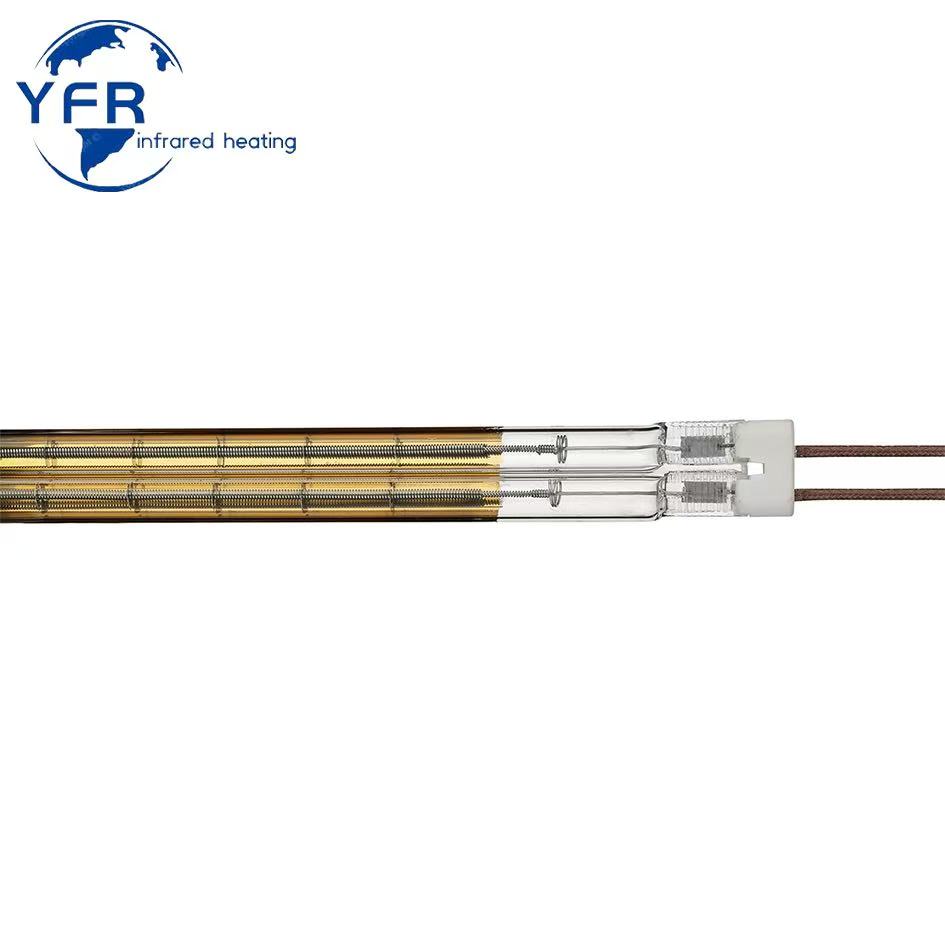
A typical PCB and SMT assembly flow includes:
PCB incoming inspection and storage
Solder paste printing
SMT component placement
Reflow soldering
AOI / X-ray inspection
Through-hole insertion (where applicable)
Wave soldering or selective soldering
Cleaning / drying (if required)
Conformal coating or encapsulation
Coating or potting curing / drying
Final test and burn-in
Across this chain, heat is required in multiple stages:
Reflow soldering: Controlled heating and cooling following a temperature profile (preheat, soak, reflow, cool) to form reliable SMT joints.
Wave soldering preheat: Gradual warming of the PCB underside and flux activation before contact with the solder wave, to reduce thermal shock and improve wetting.
Selective soldering: Localized preheating and soldering at specific through-hole locations.
Rework and repair: Local preheating and top-side reflow for BGA, QFP, CSP and other fine-pitch packages.
Coating and encapsulation: Drying and curing of conformal coatings, underfill, potting compounds, and adhesives without damaging components or substrates.
In many factories, these steps are still driven primarily by long convection ovens or general-purpose hot-air/batch ovens. This is where infrared heating can be strategically inserted to improve control, throughput, and efficiency.
Convection reflow ovens are robust and well understood, but they have inherent limitations:
Long thermal lag: Hot air must heat the entire oven mass and air volume before transferring heat to boards, increasing start-up time and energy use.
Less directional heating: Airflow tends to heat everything in the chamber — not just the solder joints — which can stress heat-sensitive components.
Footprint constraints: Achieving gentle preheat slopes and long soak times often requires long oven tunnels, difficult to fit into existing lines.
Limited local tuning: Adjusting the profile for dense or heavy boards may require slowing the entire line or significantly changing zone temperatures.
Older preheaters (hot plates, simple resistance heaters, basic hot-air modules) often suffer from:
Uneven board temperature across width or length
Slow response when changing line speed or board mass
Poor control of top-side component temperatures
Difficulty achieving recommended preheat slopes and flux activation temperatures without overheating sensitive parts
For conformal coating and potting, batch convection ovens are still common. Their drawbacks include:
Long cycle times to achieve through-cure
High energy consumption from heating large oven volumes
Significant floor space
Unstable drying when racks are over- or under-loaded
These constraints create pressure on engineering teams who are asked to increase throughput and reduce energy use without buying entirely new soldering or coating lines.
Infrared heating does not need to replace existing equipment. In electronics manufacturing, it is most often used as:
Preheating modules ahead of wave solder, selective solder, or reflow
Booster zones inside or upstream of existing ovens
Standalone IR tunnels or chambers for coating and potting drying
Local preheaters for rework and repair stations
Quartz IR lamps can be mounted beneath the conveyor (and, if needed, above) to:
Bring the board from ambient to 90–130 °C in a controlled slope
Activate flux uniformly across the assembly
Reduce ΔT between small and large copper areas prior to the solder wave
This enables higher line speeds or more stable quality at existing speeds, with better control over solder bridging and icicles.
Compact IR modules can be added at:
The entrance to the reflow oven (to shorten preheat zones)
Between existing zones (to increase heating rate for dense boards)
At the exit for controlled post-reflow drying of flux residues or cleaning chemistry
Short-wave or fast medium-wave quartz lamps respond almost instantly to power changes, allowing fine adjustment for different products without long stabilization times.
IR tunnels with top- and bottom-mounted quartz lamps over a mesh or edge conveyor can replace or supplement large batch ovens. Benefits include:
Directional heating of coated surfaces while keeping component temperatures within limits
Tunable lamp zones to handle different coating thicknesses or chemistries
Continuous flow instead of batch queues, smoothing line logistics
Bottom IR plates and top IR emitters are widely used in BGA and SMD rework stations. They preheat the entire local area to a moderate temperature, reducing thermal stress while a focused top heater completes reflow at the package.
The following configuration ideas are not design rules, but realistic starting points engineers can tune for their own products.
Objective: Achieve recommended preheat slope (0.8–3 °C/s) and flux activation, with board underside at 100–130 °C before the wave.
Heater type:
Twin-tube or single-tube quartz IR lamps, medium-wave or short-medium wave
Optional gold reflector to direct energy upward
Typical power density at board plane:
10–20 kW/m² for standard FR-4 boards
20–30 kW/m² for heavy copper or thick backplanes
Mounting distance from lamp to board:
80–150 mm, depending on lamp type and reflectors
Dwell time under IR zone:
40–120 s, depending on line speed and desired preheat temperature
For typical line speeds of 0.8–1.5 m/min and 1–2 m preheat length
Temperature control:
Closed-loop control using board thermocouples and IR pyrometers on trial runs
Zone-by-zone adjustment to correct cross-belt temperature differences
Objective: Improve heating rate for dense, high-mass boards without excessively extending the oven or overheating small components.
Heater type:
Short-wave quartz IR lamps above the conveyor, optionally below for very heavy assemblies
Power density at board plane:
15–30 kW/m² in the booster zone
Mounting distance:
120–200 mm above board top side
Dwell time:
10–25 s, inserted between preheat and soak zones
Use case:
Allowing the main oven setpoints to be reduced slightly while keeping the same peak temperature and total time above liquidus, or
Enabling line speed increases of 10–20% for the same thermal profile.
Objective: Rapid surface drying and through-cure of conformal coatings while protecting plastic connectors and temperature-sensitive components.
Heater type:
Medium-wave quartz IR lamps top and bottom
Segmenting into 3–5 zones along the conveyor
Power density at coating surface:
5–15 kW/m², tuned to coating thickness and pigment content
Mounting distance:
150–300 mm (greater distance to improve uniformity and reduce hot spots)
Dwell time:
2–8 minutes depending on chemistry, target tack-free time, and required through-cure
Board/assembly temperature:
Typically limited to 60–90 °C for mixed-technology boards
Objective: Reduce the ΔT between the package and the PCB to avoid pad lifting and warpage during reflow.
Heater type:
Ceramic-backed quartz IR panel or multi-lamp array under the board
Power density:
8–20 kW/m² in a localized area (e.g., 100 × 100 mm)
Mounting distance:
50–80 mm below the board
Dwell time:
60–180 s to bring the local area to 100–140 °C before focused top-side reflow
These ranges give process engineers a starting point for trials; final values should always be defined by measured thermal profiles and reliability testing.
By delivering heat directly to the board and solder joints, IR preheating and boosting can:
Reduce thermal shock and board warpage by controlling temperature ramps
Improve solder wetting and reduce cold joints or insufficient solder
Lower bridging and icicles in wave soldering by stabilizing flux activation and board temperature
Improve reflow repeatability for heavy or thermally unbalanced assemblies
Provide more consistent coating drying, reducing runs, sags, and incomplete cure
In practice, this translates into lower rework rates and more stable first-pass yield, especially when product mix changes frequently.
IR modules provide additional “thermal headroom” without extending tunnels or buying new ovens:
Preheat modules can allow line speed increases of 10–30% on wave or selective soldering lines, while maintaining the same soldering profile.
IR boosters in reflow can restore margin when a new dense product would otherwise force speed reductions.
Continuous IR drying tunnels can de-bottleneck coating and potting operations that previously relied on slow batch ovens.
Quartz IR lamps convert electrical energy into radiant heat that is absorbed by the PCB, components, and coatings with minimal air heating. Compared with purely convection-based heating, well-designed IR systems can:
Reduce energy consumption by 15–40% for the same throughput and product mix
Cut warm-up and changeover times due to the fast response of IR emitters
Shrink the required heating length, freeing valuable floor space
This is particularly attractive in electronics plants where power density and HVAC capacity are already close to their limits.
Good IR integration begins with a clear thermal requirement:
Target preheat temperature and allowable ramp (°C/s)
Time above liquidus and peak temperature for soldering
Maximum component case temperature
Required coating or potting cure schedule
Map these requirements to board locations using thermocouples and, when possible, IR cameras during trial runs.
Different surfaces absorb IR differently:
Metallic solder pads and copper areas tend to absorb short-wave and short-medium-wave IR efficiently.
Epoxy coatings, plastics, and resins often respond well to medium-wave IR.
In mixed assemblies, a combination (or compromise) wavelength can be chosen, and power density adjusted to stay within component limits.
IR is directional; tall components can create shadowing. To mitigate this:
Use bottom IR to heat copper planes and the PCB mass
Use mild top convection or low-flow air to equalize temperatures around tall components
Where needed, split the preheat into multiple shorter IR zones with small convection fans rather than one very intense zone
Use SCR or SSR power control with PID loops for each IR zone.
Integrate over-temperature protection at board level and at lamp housing.
Provide shielding and interlocks to avoid operator exposure to high-intensity IR.
Ensure adequate ventilation to remove flux fumes and solvents released during heating.
Keep quartz tubes clean; flux and dust deposits can reduce output and shift heating patterns.
Check reflectors for oxidation or contamination and clean or replace if needed.
Verify thermocouples and sensors regularly; drifting sensors lead to drifting profiles.
Treating IR like hot air
Simply matching “zone temperature” setpoints between IR and hot-air systems does not work. IR heating depends on power density and absorptivity, so always tune using board thermocouples, not air temperature.
Ignoring board and product variation
Heavy backplanes, multilayer boards with large copper planes, and assemblies with big heat sinks need different IR settings than small, light PCBs. Use recipes linked to product codes.
Overheating dark plastics or coatings
Dark-colored components and coatings can heat faster than bright metal areas under IR. Where necessary, use masks, shields, or lower power densities with longer dwell times.
Shadowing under tall components
If only top IR is used, the underside of large components and areas between tall parts may remain under-heated. Combine top and bottom IR or mix IR with convection to avoid cold spots.
Poor mechanical integration
Lamps mounted too close to moving parts, flux contamination, or coating overspray will shorten lamp life. Design easy-to-remove covers and access for cleaning and replacement.
Insufficient validation
Do not rely solely on oven indicators. Validate with thermal profiling across worst-case boards and run reliability tests (thermal cycling, vibration, humidity) before releasing new IR process settings.
Huai’an Yinfrared Heating Technology typically supports electronics manufacturers and machine builders through a structured engineering process:
Application review
PCB types, thicknesses, and copper distribution
Current soldering/wave/curing equipment and constraints
Defect modes (e.g., bridging, voids, incomplete cure, warpage) and throughput targets
Laboratory testing and profiling
Use of lab-scale IR modules and conveyors to test representative boards
Measurement of temperature profiles with thermocouples and IR imaging
Comparison of IR-assisted vs. baseline process (quality, cycle time, energy use)
System design and configuration
Selection of quartz IR lamp type (short-wave, medium-wave, twin-tube, single-tube, coated)
Definition of power density, wavelength, emission length, and mounting geometry
Design of reflectors, housings, and cooling (air or water if required)
Interface with existing line controls, conveyors, and safety systems
Prototype and on-line trials
Installation of trial modules on existing soldering or coating lines
On-line tuning of zone power and line speed to achieve the target profile
Support for validation runs and reliability testing
Series implementation and lifecycle support
Finalization of module design for OEM integration or retrofit kits
Spare parts recommendations (lamps, reflectors, glass shields)
Periodic process reviews to adjust settings as product mix evolves
By combining application testing with tailored quartz IR heater design, Huai’an Yinfrared helps electronics manufacturers reduce risk while capturing the benefits of faster, more controlled heating in soldering and coating processes.


