Author: Site Editor Publish Time: 2025-11-21 Origin: Site


Last updated: August 30, 2026
Drying polyester (PET) chips efficiently and reliably is a critical step for fiber spinning, meltblown nonwovens, PET film and packaging lines. This guide explains how infrared heating lamps for drying polyester chips can help plant engineers, OEM/ODM designers, and system integrators boost throughput, stabilize quality, and reduce energy use compared with conventional hot-air or vacuum systems
Process description
Typical line: PET chips → drying → melt spinning → drawing → winding.
Chips: 2–4 mm pellets, initial moisture about 0.2–0.5%, target moisture often below 50 ppm.
Temperature window: 140–180 °C, with controlled crystallization to avoid sticking.
Pain points of conventional heating
Long residence time (often more than 4 hours total across pre-crystallizer and desiccant dryer).
Large footprint and high in-process inventory.
High energy cost due to heating and circulating large volumes of dry air.
Risk of uneven drying; overdried or thermally degraded material at the bottom of silos.
How infrared heating changes the game
Short-wave quartz infrared heaters are tuned to strong absorption bands of PET and water, enabling volumetric heating of the chips rather than just surface heating.
A compact IR pre-heater can raise chip temperature above glass transition, initiate crystallization, and remove a large fraction of moisture in minutes, offloading the downstream hot-air dryer.
Zoning (inlet / mid / outlet) with separately controlled emitters allows optimization of the chip temperature profile and prevents sticking in high-load areas.
Recommended Yinfrared solutions
High-power short-wave quartz infrared lamps in modular cassettes over moving chip beds or within rotating drums.
Fast medium-wave emitters in areas requiring gentler surface heating or where spectral matching to specific PET grades is critical.
Integration into a compact pre-crystallization infrared drying oven.
Process description
PET chips feed an extruder for meltblown nonwoven production (for example filtration, hygiene, or medical materials).
Moisture fluctuations translate directly into fiber diameter variation, shot, or filter performance issues.
Lines are often designed for high throughput and frequent grade changes.
Pain points of conventional heating
Slow response of large hot-air dryers during grade or throughput changes.
Difficult to maintain consistent low moisture when raw material or ambient humidity fluctuates.
Long startup and shutdown ramps, with scrap produced until moisture stabilizes.
How infrared heating changes the game
IR lamps have millisecond-level thermal response, so power can be ramped with throughput or material changes extremely quickly.
Direct radiative heating reduces sensitivity to ambient air conditions and allows more predictable moisture control at the dryer outlet.
Compact IR modules can be installed above vibrating trays or screw conveyors feeding the meltblown extruder.
Recommended Yinfrared solutions
Fast medium-wave IR heaters for controlled, semi-volumetric chip heating.
Modular infrared heater cassettes with integrated reflectors and thermocouple or pyrometer ports for advanced control.
Complete IR chip-drying ovens configured as plug-in modules before the extruder hopper.
Process description
PET chips used as base resin or masterbatch in compounding lines, or as feedstock for preforms, film, and sheet.
Typical setups include small to mid-size desiccant dryers attached to each machine, sometimes under-utilized or inconsistent.
Pain points of conventional heating
Multiple small dryers increase maintenance burden and energy waste at partial load.
Floor space is limited around compounding and injection machines.
Existing dryers struggle with high recycled content (rPET) that often has higher and more variable moisture.
How infrared heating changes the game
A centralized IR chip dryer can quickly heat, crystallize, and dry PET chips and flakes, then distribute them to multiple machines.
IR-based systems are well suited for higher rPET content due to rapid heating and strong volumetric absorption, which helps drive off moisture efficiently.
Compact drum or tower designs free up floor space around machines.
Recommended Yinfrared solutions
Rotating drum-style infrared chip-drying ovens using high-intensity short-wave emitters.
Combined IR plus mild hot-air systems when extremely low moisture or specific residence time distributions are required.
OEM modules designed into new compounding platforms as part of a custom infrared heating solution.
Pro tip for plant engineers: When considering IR chip drying, think in terms of line-level capacity and resin flexibility, not just “one dryer per machine”.
This section focuses on how to specify infrared heating lamps for drying polyester chips in a structured, engineering-friendly way.
Definition
Short-wave: approximately 0.8–2 µm
Fast medium-wave: approximately 2–3 µm
Classic medium-/long-wave: above 3 µm
Why it matters
PET and water both show strong absorption in the near-IR and short-wave region around 1–2 µm, which makes short-wave quartz emitters particularly effective for volumetric heating of chips and moisture.
Medium-wave and long-wave IR are more surface-focused and often better suited for coatings, films, and textiles rather than thick chip beds, unless power density is high and residence time is long.
Typical ranges and trade-offs
Short-wave: highest power density, fastest response, but higher surface temperatures and potential for overheating if misapplied.
Fast medium-wave: good balance of penetration and surface control, slightly slower response.
Long-wave: gentler heating, usually not the first choice for bulk polyester chips.
Definition
Total installed electric power (kW) and power per emitting area (kW/m²).
Why it matters
Determines heat-up time and maximum throughput at a given moisture load.
Oversizing increases capex and may complicate control; undersizing leads to incomplete drying at peak load.
Typical ranges and trade-offs
PET chip dryers often operate with effective power densities in the order of 20–80 kW/m² on the chip bed, depending on distance and reflector design.
Higher power density allows shorter residence times but demands precise control and zoning.
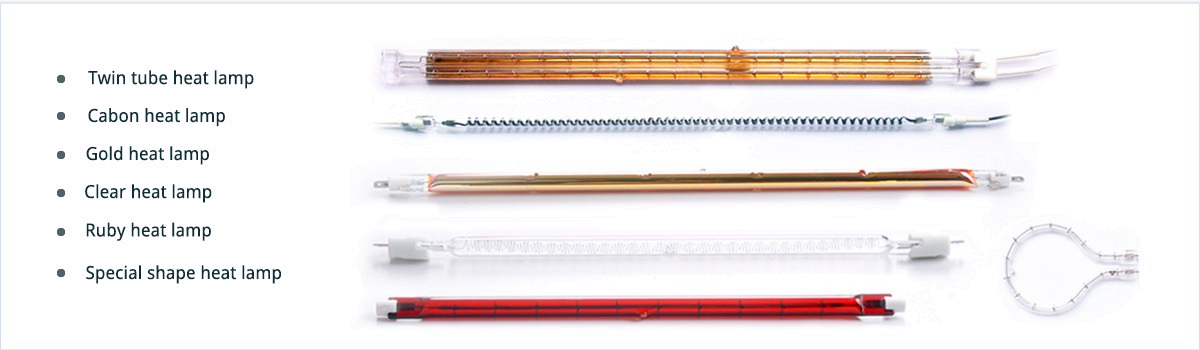
Quartz tube (short-wave)
Single or twin tube, clear or coated, very fast response, high power density.
Ideal for PET chip pre-crystallization and high-throughput drying zones.
Fast medium-wave quartz
Carbon or tungsten filament in a quartz envelope; slightly longer wavelength.
Better for applications where surface temperature control is critical or where specific PET grades show better absorption in the 2–3 µm range.
Ceramic or metal-foil panels
Medium/long-wave, slower response, lower power density.
More typical in surface heating or curing than in PET chip drying, but can be used in low-throughput or gentle heating stages.
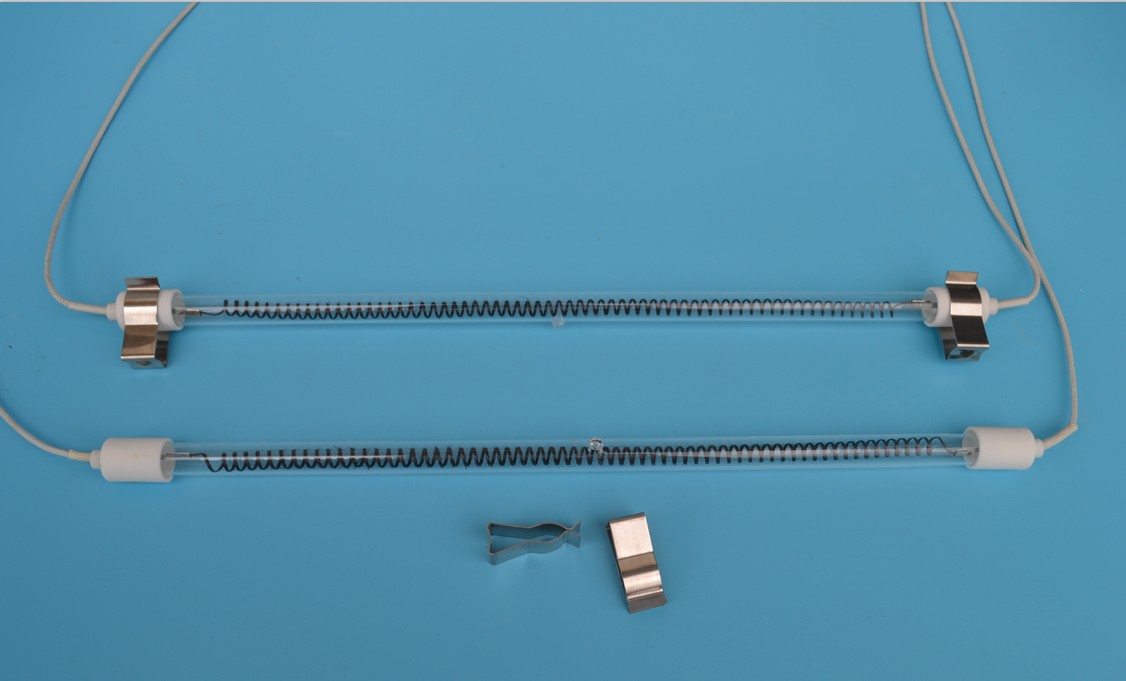
Cassette modules
Mechanical packages combining several lamps, reflectors, thermocouples, and wiring into one unit to simplify installation and maintenance.
Why it matters
Length and zoning determine how uniformly the chip bed sees radiation across the width and along the conveying direction.
Shorter zones with independent control (inlet / mid / outlet) allow fine-tuning of the temperature profile and moisture curve.
Surface temperature
Short-wave emitters typically run at filament temperatures above 2000 °C, but what matters for the process is chip temperature (for example 140–180 °C).
Good reflector and shielding design keeps surrounding structures within safe limits.
Response time
Short-wave IR: milliseconds to reach operating output.
Fast medium-wave IR: typically less than 1 second.
Enables rapid setpoint changes for grade changes or line stops.
Definition
Gap between emitter face and top of chip bed or plate.
Why it matters
Strongly affects irradiance; shorter distance increases power density but may reduce uniformity and enlarge the hot spots if chips are not well mixed.
Adjusting distance and inlet or outlet speed is often key to achieving target moisture without sticking.
Typical practice
For PET chips: distances from about 80–300 mm are common, depending on lamp type, power, and whether chips are in a drum, on a tray, or on a conveyor.
On/off or step control
Simple, low cost; suitable for small systems or where thermal inertia is high.
SSR/SCR phase-angle or burst firing
Allows continuous modulation of lamp power, used with PID controllers for stable chip temperature and moisture.
PLC/fieldbus integration
Power setpoints, interlocks, recipes, and trending integrated into the main line control.
Dust-tight enclosures are recommended to keep PET fines away from hot surfaces and wiring.
External insulation minimizes heat loss to the environment and improves energy efficiency.
IP rating should fit the plant environment (for example dusty fiber spinning halls versus clean packaging lines).
| Infrared Solution Type | Wavelength Band | Typical Power Density | Response Time | Recommended Applications | Control Options |
|---|---|---|---|---|---|
| Short-wave quartz IR lamps | 0.8–2 µm | High (40–80 kW/m²) | Milliseconds | Pre-crystallization, high-rate chip drying, rotary drums | SCR/SSR plus PID, PLC |
| Fast medium-wave IR heaters | 2–3 µm | Medium–High | <1 s | Gentle drying, PET grades sensitive to surface overheating | SSR, multi-zone PID |
| Modular IR heater cassettes | Mixed (short / FMW) | Medium–High | ms to 1 s | Retrofitting existing dryers, vibratory trays, chutes | PLC-controlled multi-zone |
| Infrared chip-drying ovens (drum/belt) | Mainly short-wave | System-level design | Minutes overall | Full-line crystallization and drying of PET chips/flakes | Integrated PLC/fieldbus |
If/then rule set
If you need maximum throughput and shortest drying time at relatively high moisture load, then prioritize short-wave quartz IR lamps with high power density in a drum or cascading bed.
If your chips are prone to sticking or you process specialty PET grades, then consider fast medium-wave emitters or slightly lower power density with more residence time.
If floor space is constrained but you have an existing hot-air dryer, then add an IR pre-heating zone upstream rather than replacing the whole system.
If you need tight and repeatable control of low final moisture (for example below 50 ppm), then specify multi-zone control with SCR plus PLC and integrate inline moisture measurement if available.
Mini decision flow
Start
 ├─ Is your main goal higher throughput on an existing line?
 │    ├─ Yes → Add short-wave IR preheater ahead of current dryer.
 │    └─ No → Go to next question.
 ├─ Do you handle high rPET content or highly variable moisture?
 │    ├─ Yes → Choose IR drum / tower with strong mixing and multi-zone control.
 │    └─ No → Go to next question.
 ├─ Is product sensitive to surface overheating or sticking?
 │    ├─ Yes → Use fast medium-wave IR with moderate power density and longer dwell.
 │    └─ No → Use high-density short-wave IR for maximum compactness.
 └─ Integrate all IR zones with PLC/fieldbus and safety interlocks.
Mains voltage and phase
IR chip dryers are typically supplied from three-phase power (for example 380–480 V AC).
Partition total load across several SCR or SSR channels to ease wiring and maintenance.
Wiring, load balancing, and protections
Group lamps into logical zones (inlet, middle, outlet) and balance phases across cabinets.
Provide appropriate fusing, circuit breakers, and residual-current protection as per local electrical codes.
Use high-temperature cables and terminals inside IR enclosures; route cables away from high radiant flux.
Control strategies
PID control loops on zone temperatures using thermocouples or IR pyrometers on the chip bed or drum wall.
PLC coordinates lamp power with feed rate, chip level, and any moisture measurement.
Alarm logic for over-temperature, loss of airflow (if combined with hot air), door opening, or drum stoppage.
Typical control cabinet layout
Main isolator and safety contactor.
SCR or SSR stacks for each zone.
PLC or temperature controllers with HMI.
Terminals for field wiring to lamp cassettes, sensors, and safety devices.
Mounting options
Over-bed emitters mounted on adjustable frames above vibrating trays or belt conveyors.
Internal emitters inside a rotating drum, with lamps mounted outside a quartz cylinder or inside protective tubes.
Pre-engineered cassettes that bolt into cut-outs in existing dryer housings.
Distance from heater to product
Use adjustable brackets or jacking mechanisms to fine-tune distance during commissioning.
Closer distances increase power density but require careful uniformity checks to avoid localized overheating.
Line speed, dwell time, and power sizing
In continuous systems, throughput (kg/h) and dwell time (minutes) determine how much energy must be provided per unit mass.
Quick sizing method: estimate required specific energy (kWh/kg) based on moisture to be evaporated plus sensible heat; then size installed kW to achieve this energy within available dwell time with a safety margin.
Reflectors, shielding, and insulation
Gold or aluminum reflectors behind lamps increase effective irradiance and reduce losses.
Internal shields protect mechanical structures and sensors from direct radiation.
External insulation reduces shell temperature and improves operator safety.
Maintenance and access
Design front access doors or pull-out lamp cassettes.
Provide inspection windows or IR-safe viewing ports.
Plan routine cleaning of quartz surfaces and reflectors to prevent efficiency losses due to dust build-up.
Defining a heating profile
Target chip temperature at outlet (for example 150–180 °C).
Maximum allowable chip surface temperature to prevent yellowing or sticking.
Desired residual moisture (ppm) and allowable spread.
Instrumenting the process
Use thermocouples embedded in the chip bed or in drum walls to estimate material temperature.
IR pyrometers aimed at moving chips can provide non-contact temperature readings but should be calibrated against thermocouples.
Inline or offline moisture measurement validates drying performance.
From trial-and-error to structured testing
Start from conservative lamp power and increase gradually while monitoring chip temperature and stickiness.
Adjust zone powers and working distance to flatten temperature and moisture profiles.
Establish standard recipes for each resin grade and throughput, stored in the PLC.
Examples of tuning outcomes
Reduction in start-up scrap by reaching target moisture faster.
Lower incidence of filament breakage in fiber spinning or reduced shot and bubbles in film by stabilizing chip dryness.
Lab tests on samples
Use small IR test rigs to generate heating curves of PET chips at different power densities and distances.
Determine approximate time to reach target temperature and moisture for a given moisture load.
Pilot line or test zone
Install a pilot-scale IR module on a side stream or small dryer to validate throughput and drying performance under realistic conveying conditions.
Confirm that chips do not stick, yellow, or degrade under expected extremes.
Full-scale acceptance criteria
Throughput: kg/h of PET chips at specified inlet moisture and temperature.
Temperature uniformity: acceptable spread across the chip bed or drum (for example ±5–10 °C).
Specific energy consumption: kWh per kg of dried chips. Some commercial IR crystallizers report values on the order of 0.06 kWh/kg under optimized conditions; actual performance will depend on design and operating point.
Product quality metrics: intrinsic viscosity, color, mechanical properties in final fiber, film, or preforms.
Regulatory framework (examples)
In the EU, IR dryers are typically assessed under the Low Voltage Directive, EMC Directive, and Machinery Directive for complete systems.
In North America, components and systems may be evaluated against UL and CSA standards for industrial heating equipment and control panels.
RoHS and REACH considerations apply to lamp materials, insulation, and coatings.
Safety topics
Maintain clearances to combustible materials.
Over-temperature protection via independent limit controllers and thermal fuses.
Interlocks for doors, drum rotation, and airflow where applied.
High surface temperatures: guards or mesh screens around hot surfaces to prevent accidental contact; clear warning labels.
Fire prevention:
Electrical safety: proper earthing, short-circuit protection, and emergency stops; adherence to local electrical codes.
Where to provide more information
A technical support or compliance section on the company site should provide downloadable manuals, wiring diagrams, and standard declarations for modules and systems.
Engagement models
Turnkey IR chip-drying ovens or pre-crystallizers, including mechanical design, controls, and commissioning support.
Tailored lengths, powers, filament geometries, and connectors to fit existing dryers or new designs.
Spectral tuning and reflector optimization for specific PET grades or chip geometries.
Pre-defined short-wave quartz infrared lamps, fast medium-wave emitters, and cassette assemblies.
Ideal for OEMs who design their own housings or dryers and need reliable IR components.
Standard catalog heaters and modules
Customized emitters and panels
Complete infrared heating systems or retrofits
MOQ ranges and samples
Standard lamps: typically small minimum order quantities (for example tens of pieces per type) are common for industrial projects.
Custom modules or systems: MOQs linked to project scale; sample units and pilot modules can often be supplied for trials.
Typical lead times
Standard lamps and components: often several weeks, depending on stocking strategy.
Custom modules and systems: design plus manufacturing lead time may extend to a few months, depending on complexity and documentation requirements.
Private label and co-branding
For OEM dryer manufacturers, private-label engraving and labeling on emitters, modules, and control panels can support a unified brand image.
Documentation and support
3D models of lamps and cassettes for mechanical integration.
Electrical schematics and wiring diagrams.
Application notes on PET chip drying, tuning, and safety.
Assumptions (illustrative only, not a guarantee):
PET chip line capacity: 500 kg/h.
Operating: 6,000 h/year.
Electricity cost: 0.12 USD/kWh.
Conventional hot-air system: 0.18 kWh/kg.
IR system: 0.12 kWh/kg (approximately 30% reduction, within typical ranges reported for IR drying and crystallization systems).
| Item | Conventional Hot-Air Dryer | IR Chip-Drying System |
|---|---|---|
| Specific energy (kWh/kg) | 0.18 | 0.12 |
| Annual energy use (kWh) | 540,000 | 360,000 |
| Annual energy cost (USD) | 64,800 | 43,200 |
| Estimated annual energy savings (USD) | – | 21,600 |
| Maintenance effort | Higher (blowers, filters) | Lower (emitters, cleaning) |
| Indicative payback (if IR capex 50 kUSD) | – | About 2–3 years (indicative) |
Real-world results depend on detailed design, local energy prices, and operating conditions.
Wrong wavelength choice
Selecting medium-/long-wave emitters where short-wave or fast medium-wave is needed for volumetric chip heating.
Under-sizing power
Designing to average conditions instead of peak moisture and maximum throughput; leads to chronic under-drying.
Neglecting mixing and distance
Poor chip agitation or fixed lamp distance can cause hot spots and sticking, or cold areas with high residual moisture.
Ignoring insulation and reflector quality
Poor thermal design wastes energy and creates hot equipment surfaces.
Insufficient safety interlocks
Missing over-temperature protection, door switches, or emergency stops exposes operators and equipment to unnecessary risk.
No structured commissioning plan
Skipping systematic ramp testing and recipe creation, resulting in unstable operation and inconsistent product quality.
Heat-up time
Well-designed IR chip dryers can heat PET chips from ambient to processing temperature in the order of minutes instead of tens of minutes in conventional systems.
Temperature uniformity
Aim for chip temperature spread at outlet within about ±5–10 °C across the bed or drum for stable processing.
Specific energy consumption
IR crystallizer case studies report specific energy in the range of roughly 0.06–0.12 kWh/kg for PET, depending on configuration and target moisture; actual values vary by design.
Incoming inspection of lamp materials and components.
Electrical testing and burn-in of emitters and modules to screen early failures.
Functional testing of complete IR chip-drying ovens at agreed power levels and interlock checks before shipment.
Support for on-site commissioning, data logging, and recipe tuning to reach stable, repeatable operation.
1. How do I size infrared heating lamps for drying polyester chips?
Start from your required throughput (kg/h), inlet moisture, and target outlet moisture. Estimate the energy needed to heat chips to the desired temperature and evaporate water, then translate this into installed kW with an appropriate safety margin and dwell time. Huai’an Yinfrared can provide preliminary sizing based on a short process questionnaire.
2. What energy savings can I expect compared with my existing hot-air dryer?
Depending on your current system and operating conditions, IR-based PET chip dryers in the market report time reductions of around 80% and energy savings in the range of roughly 20–50% compared with conventional drying methods. Actual savings for your plant will depend on configuration, insulation, and operating strategy.
3. Will infrared drying affect PET mechanical properties or intrinsic viscosity?
Studies comparing IR ovens with convection ovens have found that, when drying is properly controlled, final mechanical properties and intrinsic viscosity can be equivalent, while total process time is significantly reduced. The key is to maintain appropriate chip temperatures and avoid local overheating.
4. What is the typical lifetime of quartz infrared lamps in this application?
Emitter lifetime depends on operating temperature, switching regime, and environmental conditions. In typical industrial installations, quartz IR lamps are treated as consumables with lifetimes measured in thousands of operating hours. Designing for proper cooling, clean air, and clean reflectors helps maximize lifetime.
5. What information do you need from us to propose a system?
At minimum: PET grade and form (chips, flakes), inlet and target moisture, throughput (kg/h), existing dryer setup, allowable footprint and height, available power, and any constraints on temperature or intrinsic viscosity. Photos or layouts of the current line also help.
6. Can you support OEM/ODM and private-label infrared chip dryers?
Yes. Huai’an Yinfrared supports OEMs with customized emitters, modular heating cassettes, and fully engineered IR chip-drying ovens that can be branded and integrated into your product portfolio, including documentation, 3D models, and wiring diagrams.
7. Do you offer global support and after-sales service?
Huai’an Yinfrared works with engineering partners and distributors in key industrial regions to provide local support. Remote commissioning and troubleshooting are also available for OEMs and end-users, subject to project scope.
If you are planning a new PET line or trying to debottleneck an existing dryer, an infrared-based solution may be the most compact and energy-efficient path forward. Share your basic process data—throughput, moisture levels, and layout constraints—and Huai’an Yinfrared Heating Technology can prepare a preliminary sizing and feasibility evaluation.
To discuss a project or OEM collaboration around infrared heating lamps for drying polyester chips, contact the engineering team via the inquiry form or email on the Huai’an Yinfrared Heating Technology website and reference this PET chip drying guide.
Review YFR industrial infrared heating lamps and heating modules and controls. Confirm wavelength, geometry, mounting and controls through representative trials.
Send YFR your material, dimensions, target, cycle time and current equipment details for an application-specific review.