


Author: Site Editor Publish Time: 2025-12-10 Origin: Site


Last updated: August 30, 2026
Industrial production lines in coatings, building materials, wood processing, and food all share one quiet bottleneck: getting moisture out of products fast, uniformly, and repeatably. Whether you are drying a water-based coating, reducing moisture in panels, or controlling surface moisture on food, drying is often what defines line speed, oven length, and overall energy consumption.
Quartz infrared heat lamps offer a compact, controllable way to remove moisture at specific locations in the process—either as an add-on to existing convection dryers or as a standalone solution for certain products. This article looks at moisture drying from a process engineer’s perspective and shows where and how infrared (IR) can be integrated effectively.
We will focus on practical parameters: power density, lamp distance, dwell time, and line speeds, and we will highlight both suitable and unsuitable applications.
Although every plant is different, most industrial moisture drying processes follow a similar structure:
Application or forming
Spray or dip coating of water-based paints, lacquers, or clear coats.
Application of water-based adhesives or sealants.
Printing of water-based inks on paper, films, or labels.
Forming or cutting of moisture-containing substrates (wood panels, gypsum boards, food products).
Flash-off / initial moisture release
Short, relatively mild heating or ambient dwell.
Objective: allow the first portion of water to evaporate and avoid defects such as bubbling, foaming, or runs.
Main drying / moisture removal
Larger oven section, typically hot air or gas-fired convection.
Objective: drive the bulk of the moisture out of the layer or substrate until reaching a target moisture content or “ready for next step” condition.
Final drying / curing or conditioning
For coatings: may combine final moisture removal with film formation or crosslinking.
For wood or building materials: approach target internal moisture to minimize warping or cracking downstream.
For food: achieve a specific surface dryness or internal moisture for shelf life and texture.
Cooling and downstream handling
Cooling zone or open conveyor section.
Product must be dry and stable enough for stacking, packaging, machining, or overcoating.
Across different segments, moisture drying has a few recurring problems:
Limited oven space vs. required dwell time for thicker or highly absorbent products.
Non-uniform drying across width (edges vs. center, thick vs. thin sections).
Inflexibility when changing products or recipes (new coating, different thickness, new substrate).
Quality risks: blistering, poor adhesion, cracking, warping, or microbial risk in food processing.
These are precisely the zones where targeted energy input—such as quartz infrared heat lamps—can be useful: at the start of drying, in booster sections, or for local correction.
Most moisture drying systems rely on convection:
Hot-air recirculation ovens
Gas-fired tunnels or radiant panels with strong convective flow
Steam coils with forced air
These are well-understood technologies, but they have intrinsic limitations in moisture drying:
Low energy density at the product surface
A large volume of air must be heated.
Only a fraction of the energy is transferred into the product and the water at any given moment.
To compensate, ovens must be longer or temperatures higher, both of which cost space and energy.
Slow thermal response
Changing setpoint temperature or airflow takes time.
When increasing line speed or switching from a light to a heavy product, process adapts slowly, often leading to temporary quality issues.
Non-uniform airflow
Complex airflow patterns can cause over-drying in some areas and under-drying in others.
Shadowed areas (corners, recesses, dense stacking) may remain moist.
Energy inefficiency
Significant losses through exhaust, leaks, and heating of oven structure.
High exhaust rates needed to remove moist air, further increasing thermal losses.
Product-limited temperature
Many products cannot tolerate high ambient temperatures (plastics, composites, food, certain coatings).
This caps the usable convective oven temperature and therefore the achievable drying rate.
These constraints often lead engineers to either increase oven length, reduce line speed, or accept a narrower product portfolio. Quartz infrared heat lamps provide an additional tool that can be layered onto these existing systems.
Infrared heating delivers energy by radiation rather than by heating a large air volume. Quartz IR lamps (short-wave and medium-wave) can achieve high power density at the product surface, with fast response and compact hardware.
In industrial moisture drying lines, IR is rarely used as a “one size fits all” replacement. Instead, it is often integrated in one of the following ways:
A short IR section positioned directly after application (or after a brief flash-off zone) can:
Rapidly remove surface moisture.
Reduce the moisture load entering the main convection dryer.
Allow a shorter convection section or higher line speed for the same final dryness.
Typical use cases:
Water-based coatings on metal parts or profiles.
Waterborne paints on plastic components.
Printed webs with relatively thin wet layers.
Where the existing convection oven is at its limit (e.g., during capacity increase or recipe change), IR modules can be inserted:
Between two hot-air zones.
On top of a conveyor in an open section.
Over high-demand areas (thicker sections, edges).
These booster modules add incremental drying capacity without rebuilding the entire oven.
Quartz IR lamps can be built into compact, focused modules for:
Edge drying of wide boards or panels (wood, gypsum, fiber cement).
Corner or joint drying where coating or adhesive accumulates.
Drying around openings, recesses, or weld seams.
Local IR modules provide high energy density exactly where it is needed, reducing the risk of global overheating or unnecessary energy use.
For certain products and thickness ranges, complete drying can be done purely by IR:
Small parts in trays, racks, or on mesh belts.
Thin coatings, inks, or adhesives with modest moisture load.
Food products requiring mainly surface moisture reduction or crusting.
In these cases, quartz IR heat lamps can be built into multi-zone tunnels with controlled product temperature and exhaust. The overall footprint is often significantly smaller than an equivalent hot-air dryer.
Short-wave quartz IR (SWIR)
Very high power density.
Fast response.
Strong interaction with many water-based coatings and some food surfaces.
Useful where short dwell times and compact equipment are critical.
Medium-wave quartz IR (MWIR, including fast-response variants)
Better penetration into some porous substrates (wood, some building materials, certain foods).
Often more forgiving for temperature-sensitive surfaces.
Well-suited for thicker or more absorbent materials where energy needs to penetrate deeper than just the extreme surface.
In practice, Huai’an Yinfrared typically selects the wavelength and lamp type based on substrate, layer thickness, target moisture, and allowable surface temperature.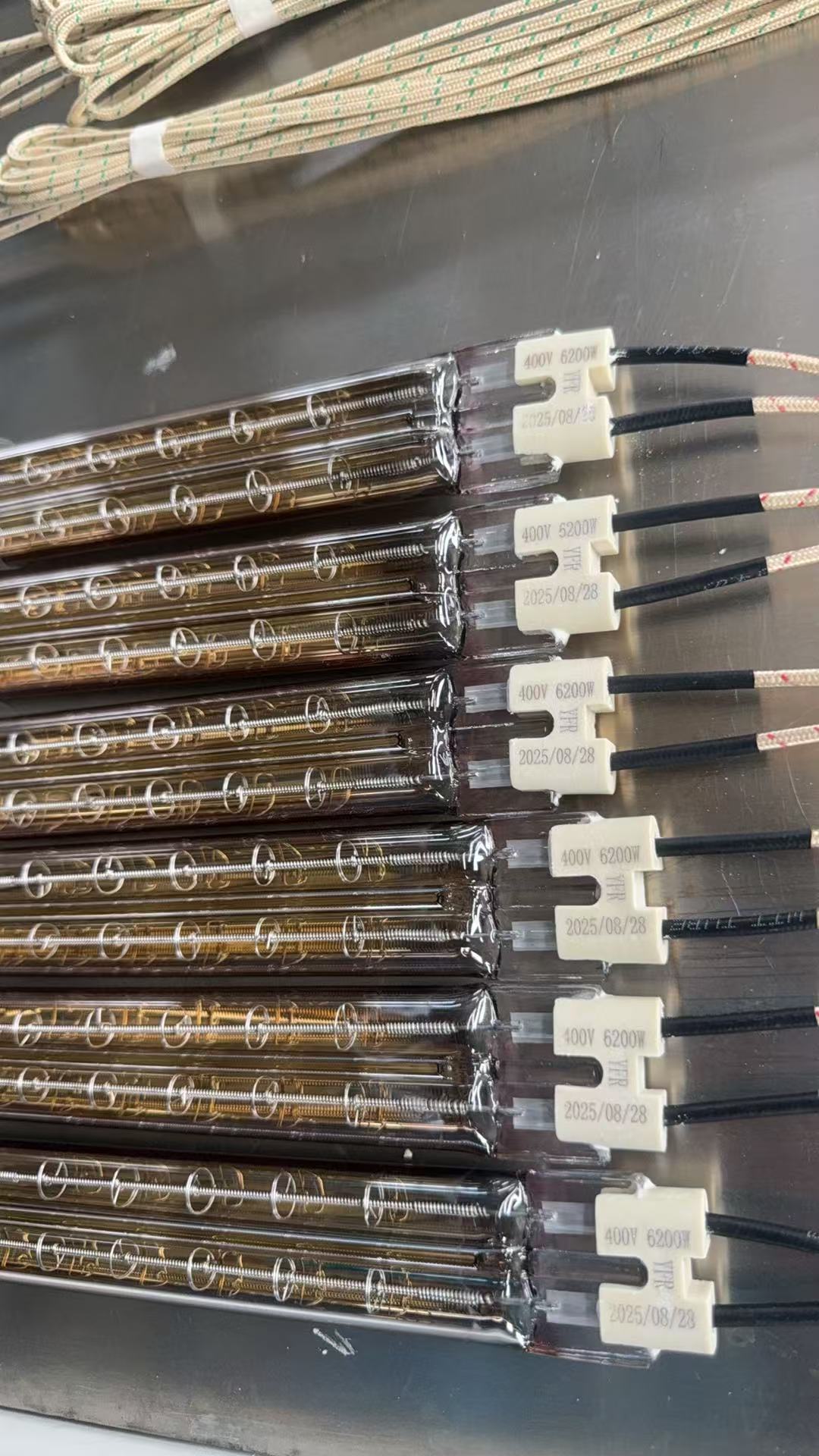
The following examples are indicative ranges for engineering discussions. Final designs are always validated with trials and process data.
Application: painted or coated metal parts on a conveyor or overhead chain.
IR type:
Fast-response medium-wave twin-tube quartz lamps, or
Short-wave quartz lamps for compact booths.
Power density at product surface:
Approx. 20–35 kW/m².
Lamp-to-product distance:
Typically 150–300 mm.
Shorter distance for focused, high-intensity drying; longer for uniformity over larger parts.
Dwell time:
Roughly 30–120 seconds, depending on coating thickness and solvent/water content.
Line speeds:
For overhead conveyors, typically 2–8 m/min, with dwell achieved via loop length or multiple passes.
Used as a pre-dryer or booster, this configuration can significantly reduce the load on downstream convection ovens.
Application: MDF, particleboard, solid wood panels, gypsum boards, fiber cement boards.
IR type:
Medium-wave quartz IR for deeper penetration into porous substrates.
Power density at surface:
Approx. 10–25 kW/m².
Lamp-to-product distance:
Typically 200–400 mm.
Larger distances help achieve better uniformity over wide boards and handle thickness variation.
Dwell time:
Initial moisture content (e.g., 8–20%).
Target moisture (for example, 4–10% depending on product and process).
Board thickness and density.
2–6 minutes depending on:
Line speeds:
In continuous lines, typical speeds in the range of 1–5 m/min, possibly combined with multiple IR zones.
IR is often applied as an additional stage—either before a final conditioning step or after primary drying—to fine-tune moisture profiles and reduce surface moisture.
Application: bakery products, snacks, coated foods where surface moisture, texture, and appearance are critical.
IR type:
Fast-response medium-wave or short-wave quartz IR in hygienic modules.
Power density at product surface:
Approx. 8–18 kW/m².
Lamp-to-product distance:
Typically 150–350 mm, with stainless steel or special reflectors to control intensity and cleanability.
Dwell time:
1–5 minutes, often split across multiple IR zones to match product heating profile.
Line speeds:
Typically 3–15 m/min, depending on product size, thickness, and recipe.
IR helps in quickly removing surface moisture, setting coatings, and improving crust formation, while deeper drying is often complemented by hot-air sections.
Application: water-based adhesives on assemblies, primer layers before lamination, printing lines with water-based inks.
IR type:
Short-wave or fast-response medium-wave quartz IR with high controllability.
Power density:
Approx. 15–30 kW/m², depending on layer thickness and line speed.
Lamp-to-product distance:
100–250 mm, often with tailored reflectors to match the geometry of parts or webs.
Dwell time & speeds:
From 10–60 seconds for small parts or indexing systems.
For webs, line speeds can range from 50–200 m/min with appropriately sized IR zones.
IR boosters in such lines often enable the use of more environmentally friendly water-based systems without sacrificing productivity.
When correctly specified and integrated, quartz infrared heat lamps for moisture drying influence four key performance dimensions:
More uniform drying
Zoning and focused IR allow engineers to “shape” the drying profile across the width and length of the product.
Reduced defects
Controlled IR pre-drying reduces blistering, bubbling, and pinholes in coatings.
Better surface control minimizes warping or cracking in panels and boards.
Improved adhesion and appearance
Drying coatings and adhesives to the right residual moisture improves adhesion and reduces rework.
Higher line speeds
By removing part of the moisture load in IR pre- or booster zones, the same final dryness can be achieved at faster throughput.
Higher capacity without rebuilding ovens
IR modules added to existing lines can deliver additional drying capacity with minimal civil work.
Compact modules
IR sections achieve high power density in short lengths.
In some cases, entire convection sections can be shortened or reconfigured, freeing floor space.
Better energy targeting
Infrared radiation is directed at the product and water rather than heating large air volumes.
Lower exhaust losses
IR modules require exhaust to remove moisture, but air mass and temperature can be lower than in large convection ovens.
Fast start/stop
Quartz IR lamps respond quickly to power changes, helping reduce energy waste during stoppages or when running at lower speeds.
Infrared is not a universal replacement. Examples where caution is needed:
Very thick or heavily loaded products with deep internal moisture where surface heating cannot effectively drive moisture from the core without overheating the surface.
Extremely IR-sensitive surfaces (gloss-sensitive finishes, some plastics) where even moderate surface temperature increase is unacceptable.
Geometries with severe shadowing where IR cannot reach key areas and cannot be compensated with reflector design.
In these cases, IR might still be used as a partial solution (e.g., mild preheating or edge drying) but not as the main drying method.
Successful IR implementation depends on careful engineering rather than just adding heaters.
Use surface and, where possible, internal temperature measurement (IR pyrometers, embedded thermocouples).
Monitor residual moisture with offline or inline methods (gravimetric tests, moisture sensors).
Correlate these measurements to line speed, IR power, and convection settings.
Divide IR modules into independent zones along the line, each with separate power control.
For wide products, consider zones across the width to correct for edge vs. center differences.
Implement control strategies:
Manual recipes for different products.
PLC- or SCADA-based control with line speed input.
SCR or solid-state relays for fine power modulation.
Select reflector materials based on the wavelength and environment:
Gold or special coatings for high reflectivity in short-wave applications.
Ceramic or polished metal for medium-wave, balancing cost and performance.
Design housings to:
Avoid dust accumulation and allow easy cleaning (critical in food and building-materials environments).
Provide adequate ventilation for lamp cooling.
Provide sufficient exhaust near the IR zone to remove evaporated moisture and prevent condensation downstream.
Avoid excessive airflow that cools the product too much or disturbs lightweight products.
In food and building materials, consider humidity control to avoid rapid surface drying that traps moisture inside.
Ensure accessible mounting for lamp replacement and maintenance.
Design for easy removal of IR cassettes for cleaning and service.
Consider shielding and guarding to meet safety standards (thermal shields, mesh guards, interlocks).
During start-up:
Start with conservative power levels and gradually increase while monitoring temperatures and moisture.
Adjust zone powers and line speed iteratively.
Develop standard operating procedures and recipe tables for operators to ensure consistent performance.
If lamps are too close or power is too high:
Coating or surface may blister or discolor.
Wood or food products may crack or scorch while internal moisture remains high.
Mitigation:
Increase lamp-to-product distance.
Reduce power density.
Use staged IR zones with moderate power rather than a single very intense zone.
Edges and corners often dry faster; recesses and internal corners dry more slowly.
Mitigation:
Design separate edge zones with lower power.
Use adjustable baffles or reflectors for geometry compensation.
Perform thermal imaging or mapping during commissioning.
Evaporated moisture, if not removed, can:
Condense on cooler surfaces downstream.
Slow further drying by increasing local humidity.
Mitigation:
Position exhaust hoods near the IR zone outlet.
Balance extraction rate with heat retention.
In food applications, consider hygienic design and filtration.
Exposed IR sources can:
Create operator discomfort or safety risks.
Affect nearby equipment (sensors, cabling) if not shielded.
Mitigation:
Use proper guarding and thermal shields.
Include interlocks to switch off IR when doors are opened.
Protect sensitive components with reflective or insulating barriers.
Dust and dirt on lamps and reflectors reduce efficiency and uniformity.
Mitigation:
Define cleaning intervals and procedures.
Keep spare lamps and critical components in stock.
Include reflectors and housing in regular inspection checklists.
Implementing quartz infrared heat lamps for moisture drying is not just a hardware decision; it is a process engineering task. Huai’an Yinfrared typically supports projects in the following way:
Product dimensions, materials, and geometry.
Initial and target moisture contents.
Current line layout, heating method, and bottlenecks.
Target line speeds and any planned capacity increases.
Constraints: maximum allowable surface temperature, hygiene or regulatory requirements.
Use test rigs with controllable IR wavelength, power density, and distance.
Run sample products at different dwell times and power settings.
Build drying curves: moisture vs. time, temperature vs. time.
Identify safe operating windows that achieve the required dryness without quality issues.
Select short-wave or medium-wave quartz lamps and module layout.
Define:
Lamp type and length.
Number of lamps and arrangement.
Reflector design and housing type.
Zoning concept and power control method.
Provide estimated power consumption and required electrical specifications.
Propose mechanical mounting concepts compatible with existing conveyors or ovens.
Provide guidelines for:
Exhaust and ventilation.
Shielding and safety interlocks.
Cabling, power distribution, and control interfaces.
Assist during commissioning with tuning of zone powers and recipes.
Help correlate product temperature, moisture data, and visual quality to process parameters.
Suggest optimization steps for:
Energy reduction.
Throughput increase.
Product changeover procedures.
Support adjustments when new products or coatings are introduced.
Provide design updates if line speeds or layouts change.
Offer spare parts and retrofit options for future expansions.
Review YFR industrial infrared heating lamps and heating modules and controls. Confirm emitter choice, mounting, sensing and recipes with representative product trials.
Send YFR your material, dimensions, target, cycle time and current equipment details for an application-specific review.


