Author: Site Editor Publish Time: 2025-11-27 Origin: Site
Last updated: August 30, 2026
Coil coating engineers, OEM/ODM oven designers, and system integrators are under pressure to deliver higher line speeds, lower energy consumption, and better coating quality. Quartz infrared heating lamps for coil coating curing give you a compact, controllable heat source that can turn long gas-fired ovens into fast, energy-efficient coil coating infrared curing solutions.
This article explains where quartz infrared lamps make the most sense in coil coating lines, how to select the right infrared heating modules for steel and aluminum coils, and what to watch out for during design, installation, and tuning.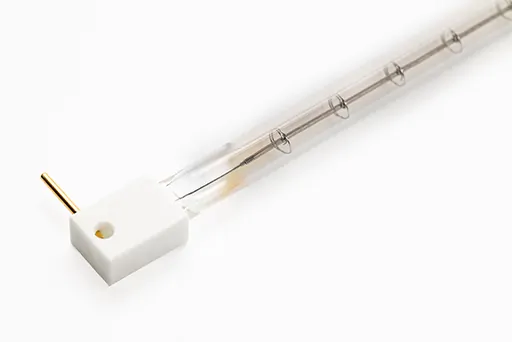
Opportunity: Conventional gas ovens in coil coating lines are long, slow to ramp, and energy-intensive. High infrared radiation curing technology using quartz IR lamps can cut curing times from minutes to tens of seconds in suitable coating systems, while shrinking oven length and improving temperature control.
Best fit: Infrared coil coating curing ovens are particularly effective for thin-gauge steel and aluminum coils with solvent-borne or powder coatings, especially where line speeds are high, space is limited, or rapid color changes are required.
Impact: Industry analyses of energy-curable technologies for coil coatings indicate that switching from gas ovens to electric energy-curable solutions (including IR, UV, EB) can significantly reduce curing-stage energy use in many cases, depending on chemistry and line design.
Key technical levers: Wavelength (short- vs medium-wave), power density (kW/m²), emitter length and zoning, working distance, and control strategy (SCR/SSR plus PLC) determine heating rate, temperature uniformity, and energy efficiency.
How Huai’an Yinfrared Heating Technology helps: We support coil coaters, OEMs, and integrators with short-wave quartz infrared lamps, fast medium-wave modules, and complete infrared coil coating curing oven designs—from early feasibility and lab tests through pilot zones and full-scale retrofits.
Key takeaway: Treat infrared coil coating curing as a thermal process design problem, not just a heater selection task. Material, coating chemistry, line speed, and layout all drive the right wavelength, lamp geometry, and control concept.
Many building and construction panel lines run galvanized steel or pre-painted aluminum coils in thicknesses of 0.3–1.0 mm, at line speeds of 50–200 m/min. Conventional convection ovens for primer and topcoat curing can be 30–60 m long to achieve metal and coating temperatures in the 200–260 °C range.
Pain points of conventional heating
Long ovens consume valuable floor space and limit line layout options.
Slow thermal response makes it hard to change setpoints and recipes quickly.
Uneven heating can lead to gloss variation, under-cure in shielded areas, or over-bake at edges.
Rising gas prices and decarbonization targets make fuel-fired ovens a strategic liability.
How quartz infrared curing helps
A practical retrofit approach is to insert short-wave quartz infrared heating lamps in modular cassettes at the oven entrance, exit, or within specific zones:
Faster heat-up: Short-wave quartz emitters can ramp to operating power in one to two seconds. They deliver high power density directly to the coil surface, shortening time-to-cure from many minutes to tens of seconds in suitable coating systems.
Space savings: Higher heat flux allows shorter effective curing lengths, which can free space for inspection, cooling, or additional coating stations.
Better control: Zoning across strip width and along line direction allows independent adjustment of edge versus center power, helping to reduce color and gloss variation.
Recommended Huai’an Yinfrared solutions
Short-wave quartz infrared lamps in robust metal cassettes for preheating and final curing.
Infrared heating modules designed to drop into existing oven openings or replace sections of convection zones.
Optional reflectors (gold or polished aluminum) to direct radiation to the strip and reduce stray losses.
High-speed continuous lines for appliance, HVAC, and façade materials often push speeds above 200 m/min, with thin coatings that require tight control of cure and appearance.
Process overview
Substrate: cold-rolled steel or aluminum, 0.25–0.7 mm thick.
Coatings: high-solids or powder, with target peak metal temperatures (PMT) typically 200–260 °C.
Line: several coating stations with flash-off and curing sections.
Limitations of conventional systems
Flash-off zones may be too long, and convection-only curing can struggle to keep up at high speeds without extending oven length.
Higher gas firing rates can cause hot spots, VOC management challenges, and higher NOx emissions.
Process engineers may struggle to keep PMT in a narrow window when line speed varies.
Infrared-driven performance boost
Designing a coil coating infrared curing oven with quartz and fast medium-wave IR allows:
High power density zones (for example, 40–80 kW/m²) to rapidly bring the coating and skin of the metal to temperature.
Fine power modulation via SCRs and PLC logic to track line speed and coil gauge in real time.
Hybrid configurations where IR provides the initial “force cure” and a shorter convection zone completes crosslinking and homogenizes temperature.
Recommended Huai’an Yinfrared solutions
Mixed modules: short-wave quartz emitters for rapid surface heating, fast medium-wave quartz modules for more penetrative, yet still surface-focused heating.
Custom emitter lengths matched to strip width and line mechanical design.
Multi-zone control cabinets with fieldbus integration to the line PLC.
Not every coil coating line is ready to replace or radically shorten the main oven. For many operators, the first step is targeted preheating or edge/strip curing.
Typical scenario
Edge under-cure due to airflow patterns or coating thickness variation.
Localized defects behind stiffeners or embossing patterns where convection air cannot reach effectively.
Need for mild preheating of the strip before coating (for example, to stabilize viscosity or improve wetting).
How targeted IR solves it
Edge curing modules mounted above and below the strip edges can deliver additional radiant energy where convection is weakest.
Preheat sections using medium-wave quartz IR can bring the strip from roughly 40 °C to 80–100 °C before coating, stabilizing film formation.
Spot or strip modules allow focused treatment of high-defect regions, without redesigning the full oven.
Recommended Huai’an Yinfrared solutions
Narrow, modular infrared heating modules for steel and aluminum coils, with adjustable angle and distance.
Small, independently controlled edge zones with fast response to minimize risk of over-bake.
Pro tip for plant engineers: When you cannot change the whole oven, start with a small IR module on the “worst” defect area. Measure before/after PMT and defect rates—this builds a clear ROI case for broader infrared upgrades.
Designing quartz infrared lamps for coil coating curing starts with understanding a few key parameters.
Short-wave infrared (SWIR): roughly 0.78–1.5 μm, typical of quartz halogen lamps. High radiance and deep penetration into thin metal substrates.
Fast medium-wave (FMWIR): roughly 1.5–3 μm, still using quartz tubes but at lower filament temperature. Good match for many organic coatings and water or solvent content.
Why it matters:
Metals like steel and aluminum reflect much of the IR, but thin gauge absorbs enough via multiple reflections and conduction to heat quickly.
Coating layers, especially pigmented or filled systems, often absorb strongly in medium-wave bands, which helps flash-off and surface cure.
Trade-offs:
Short-wave: very fast response, high power density, excellent for high-speed lines but can create steep temperature gradients if not controlled.
Fast medium-wave: slightly slower but often more forgiving for sensitive coatings or thinner films.
Power (kW): total electrical power per lamp or module.
Power density (kW/m²): power delivered per irradiated area of coil strip.
Why it matters:
Power density determines how quickly the strip surface temperature rises for a given line speed and coil thickness.
Higher density allows shorter ovens but demands more careful control to avoid over-bake.
Typical ranges for coil coating:
Preheat or flash-off: around 10–30 kW/m².
Main curing zones: around 30–80 kW/m², depending on speed, thickness, and coating chemistry.
Quartz tube lamps (short-wave, fast medium-wave): primary choice for high-intensity coil coating curing.
Ceramic or metal foil panels: more common in lower-temperature applications; typically not the first choice for high-speed coil coating lines.
Lengths are typically matched to strip width, often 1–2 m with overlapping zones for wide coils.
Cross-web zoning (for example, left/center/right) allows compensation for edge cooling and airflow non-uniformity.
Machine direction zoning (for example, 3–6 zones per oven) enables ramp, soak, and controlled cool-down.
Quartz IR emitters reach operating temperature within seconds.
Surface temperatures of emitters can exceed 1000 °C for short-wave lamps, which is acceptable because energy is delivered radiatively; the strip itself is held within its design PMT.
Typical distance from emitter to strip: 150–400 mm, depending on power density and uniformity needs.
Shorter distances give higher flux but smaller “sweet spot,” requiring careful alignment and strip tracking.
Reflectors and side shielding help shape the radiation pattern and protect other components.
On/off or step control: simple but often insufficient for high-speed lines.
SSR/SCR phase-angle or burst-fire control: allows smooth power modulation.
PID loops with PLC/fieldbus: integrate IR power with line speed, strip gauge, and measured PMT.
Modules should be enclosed to protect emitters from overspray, dust, and mechanical damage.
Insulation behind reflectors reduces heat losses and improves energy efficiency.
IP rating is chosen according to ambient conditions and cleaning practices.
| Infrared Solution Type | Wavelength Band | Typical Power Density | Response Time | Recommended Applications | Control Options |
|---|---|---|---|---|---|
| Short-wave quartz IR lamp module | 0.78–1.5 μm | 30–80 kW/m² | ~1–2 seconds | High-speed coil coating curing, preheat, edge curing | SCR/SSR plus PLC, PID closed-loop |
| Fast medium-wave quartz IR lamp module | ~1.5–3 μm | 15–50 kW/m² | ~2–5 seconds | Flash-off, gentle curing of sensitive coatings | SCR/SSR plus PLC, temperature loops |
| Ceramic panel IR heater | ~2–10 μm (long-wave) | 5–20 kW/m² | Tens of seconds | Low-temperature drying, non-metal substrates | On/off or basic SSR |
| Hybrid IR plus convection coil coating oven | Mixed (SW plus FMW plus air) | 20–60 kW/m² (effective) | Seconds to minutes | Retrofit of existing lines, improved uniformity | Integrated PLC/fieldbus |
If line speeds exceed around 150 m/min and space is limited, then prioritize short-wave quartz IR modules with high power density.
If coatings are sensitive to surface overheating or discoloration, then consider fast medium-wave quartz IR as a primary or hybrid solution.
If you mainly need to support existing gas ovens, then start with IR preheating or edge curing modules rather than full oven replacement.
If power quality and grid capacity are concerns, then design staged roll-out and ensure balanced three-phase loading and soft-start strategies.
What is your primary goal?
→ Access to renewable electricity? → All-electric IR curing oven
→ Limited capacity? → IR preheat plus optimized gas oven
→ Edge defects? → Add edge IR modules
→ General non-uniformity? → Multi-zone IR plus air recirculation
→ High line speed?
→ Yes → Short-wave quartz IR modules
→ No → Fast medium-wave plus convection hybrid
→ Reduce oven length
→ Improve cure uniformity
→ Energy-efficient coil coating curing
Mains and phase: Most coil coating IR modules will be supplied at three-phase 380–480 V, depending on the site. Balance loads across phases to avoid neutral issues and harmonics.
Protection: Use appropriately rated breakers, fuses, and residual-current devices; include over-temperature protection in modules and cabinets.
Control strategy:
SCR or SSR modules for each zone, driven by analog or fieldbus setpoints from the PLC.
PID controllers using PMT or surface temperature as feedback to maintain consistent cure despite line speed variations.
Control cabinet layout:
Separate power and control compartments.
Adequate cooling or ventilation; IR systems can generate high ambient temperatures around cabinets.
Clear labelling for zones to support maintenance and troubleshooting.
Mounting: Rigid frames or cassette rails above and below the strip, allowing quick lamp replacement from the aisle side.
Distance and angle: Adjustable brackets to fine-tune working distance and angle relative to the strip for best uniformity.
Line speed and dwell time:
Effective exposure time = heated length ÷ line speed.
Sizing power should consider minimum and maximum line speeds; design usually targets worst-case (highest speed).
Reflectors and shielding:
Polished metal or gold-coated reflectors increase useful radiation to the strip and reduce back losses.
Side shielding protects bearings, seals, and instrumentation from stray radiation.
Maintenance:
Access doors or sliding cassettes to change lamps without dismantling the oven.
Cleaning procedures for quartz tubes and reflectors to maintain efficiency.
Defining the heating profile:
Target: peak metal temperature and minimum curing temperature/time for the coating.
Profile: ramp zone (fast IR heating), soak zone (combined IR plus convection), controlled cool-down.
Instrumentation:
Contact thermocouples on the strip where possible.
Non-contact IR pyrometers focused on representative strip areas (center and edge).
From trial-and-error to recipes:
Start with calculated power based on energy balance (mass flow × specific heat × temperature rise plus latent heat for solvents).
Use step tests and line trials to adjust zone setpoints and confirm that temperature and cure targets are met.
Defect reduction examples:
Reducing orange peel by increasing early IR power to move quickly through the critical viscosity range.
Avoiding blistering by tuning IR power/time and allowing sufficient flash-off before peak heating.
Lab tests:
Bench-top IR modules to expose small coil samples and measure heating curves.
Differential scanning calorimetry or solvent rub tests to evaluate cure.
Pilot line tests:
Temporary IR zone installed in a real line or pilot facility.
Variation of line speed and zone power to map the operating window.
Full-scale acceptance criteria:
Throughput at target quality (m/min at specified coating performance).
Temperature uniformity across strip width and length (for example, ±5–10 °C band).
Specific energy consumption, such as kWh per square metre of coated coil.
Coating metrics: gloss, adhesion, hardness, flexibility, corrosion resistance.
When introducing high infrared radiation curing technology into coil coating lines, compliance and safety considerations must be built into the design.
Regulatory frameworks (examples):
CE marking under applicable European directives such as the Low Voltage Directive, EMC Directive, and Machinery Directive.
UL, CSA, or equivalent standards for electrical safety in North America and other regions.
RoHS and REACH for materials in lamps, wiring, and housings, covering restricted substances and safe disposal.
Safety topics:
High surface temperatures: guards, covers, and warning labels to prevent accidental contact with hot modules.
Fire prevention: correct clearances to combustible materials, thermal cut-outs, and interlocks to shut down IR if the strip stops or doors open.
Electrical safety: proper earthing or grounding, short-circuit and overload protection, safe cable routing and strain relief.
Optical safety: shielding or filtered inspection windows to reduce direct view of very bright IR sources.
A dedicated compliance and application support section is useful for engineering teams to verify which standards apply to their region and industry.
For OEM oven builders and integrators, a clear engagement model with Huai’an Yinfrared Heating Technology simplifies project planning.
Standard catalog modules:
Off-the-shelf short-wave and fast medium-wave quartz IR modules in common lengths and power ratings.
Suitable for small retrofits, lab rigs, and standard coil widths.
Customized emitters and panels:
Tailored lamp lengths, filament geometries, reflectors, and housings to match line layout.
Mechanical interfaces designed around your oven structure and coil handling equipment.
Complete infrared curing systems or retrofits:
Turnkey infrared coil coating curing oven sections, including modules, frames, control cabinets, and commissioning support.
MOQ and samples (typical patterns):
Small quantities for lab or pilot tests (for example, a few modules) are often available with shorter lead times.
Higher MOQs for custom emitter geometries or private-label products.
Lead times (indicative and project-dependent):
Samples: typically on the order of a few weeks, depending on configuration.
Custom designs: design and prototyping phase measured in weeks to a few months.
Mass production: ramp-up agreed in framework orders.
Private label and co-branding:
Labelling, documentation, and packaging can be adapted to OEM branding where required.
Documentation and support:
3D models and 2D drawings for mechanical integration.
Wiring diagrams, recommended protection and control schemes.
Application notes for coil coating infrared curing oven design and tuning.
Assumptions:
Existing gas oven energy use: index 100 (baseline).
IR-assisted or all-IR system energy reduction: assume roughly 30–50 percent depending on design.
Energy price: generic industrial electricity and gas blend.
Maintenance: IR system designed with fewer moving parts compared with a large gas oven.
| Item | Conventional Gas Oven | IR-Assisted / IR Curing |
|---|---|---|
| Relative energy use (curing stage) | 100 | 50–70 |
| Annual energy cost (indexed) | 100 | 50–70 |
| Maintenance effort (qualitative) | Higher (burners, ducts, fans) | Lower (lamps, reflectors) |
| Typical payback range* | – | About 2–5 years |
*Actual payback depends on operating hours, local energy prices, baseline oven condition, and the extent of IR integration. This table is for directional discussion only, not a guaranteed result.
Wrong wavelength choice: Selecting only long-wave heaters because they are familiar, even though they cannot deliver the required power density or penetration for high-speed coil lines.
Under-sizing power: Designing to average load rather than peak conditions, leading to insufficient PMT at maximum line speed.
Neglecting insulation and reflectors: Poor enclosure and reflector design increases losses and reduces effective power at the strip.
Poor mounting and alignment: Misaligned modules cause hot spots, cold zones, and strip tracking issues.
Ignoring safety interlocks: Failing to integrate line stop signals, over-temperature trips, and door switches into the IR control system.
Insufficient testing: Going straight to full-scale installation without lab or pilot data, resulting in extended commissioning and rework.
Heat-up time:
Many coil coating systems target reaching PMT in tens of seconds rather than minutes when using quartz IR lamps for coil coating.
Temperature uniformity:
A practical target is often within ±5–10 °C across the strip width and along the heated length for a given recipe.
Specific energy consumption:
Energy-curable solutions (including IR) for coil coatings can substantially reduce curing-stage energy use compared with traditional gas ovens, particularly when combined with process optimization and improved insulation.
Component testing: Each batch of quartz emitters is electrically and visually inspected; key parameters such as resistance and dimensions are checked.
Burn-in where appropriate: Selected lamps or modules are run at power to confirm stable operation.
System validation: For integrated modules and oven sections, thermal tests and uniformity checks are carried out against agreed specifications.
Traceability: Documentation of components and test results supports OEM quality systems and audits.
Sizing starts from your line data: substrate (steel or aluminum), thickness range, coating type, target PMT, and line speed range. From this, you can estimate the required energy per square metre and translate it into power density and heated length. A typical design then defines the number of zones, lamp power per zone, and required control range.
Savings depend on your baseline oven, operating hours, and how aggressively you redesign the system. Public case studies for energy-curable coil coatings, including IR-based solutions, show that curing-stage energy consumption can often be reduced significantly compared with traditional gas-fired ovens, especially when combined with better insulation and optimized line operation.
Lamp lifetime depends on filament design, operating temperature, power cycling, and cooling. Well-designed short-wave quartz IR lamps often achieve several thousand operating hours; fast medium-wave lamps can also offer long service life under correct operating conditions. Planned preventive replacement is typically aligned with scheduled line shutdowns.
Yes. OEM and ODM collaborations can include custom emitter geometries, housings, reflector designs, mounting interfaces, and private-label branding. Engineering support can also include 3D models, wiring diagrams, and application notes to accelerate your design and documentation process.
At minimum, you should prepare:
Coil material and thickness range.
Coating type or chemistry and required curing conditions (PMT, time-at-temperature).
Line speed range and existing oven layout.
Available electrical supply and control system architecture.
Any constraints on space, access, or ambient conditions.
Infrared modules and systems can be shipped globally, with remote engineering support for integration and commissioning. Depending on project size and location, on-site assistance can be arranged with local partners or directly, including training for operators and maintenance teams.
If you are planning a new coil coating line or looking to upgrade an existing gas oven, quartz infrared heating lamps for coil coating curing can unlock higher line speeds, lower energy use, and more stable coating quality.
Share your basic process data—coil material and thickness, coating type, line speed, and current oven layout—and Huai’an Yinfrared Heating Technology can provide an initial feasibility check and sizing concept. From there, we can help you plan lab tests, pilot zones, or full-scale infrared curing retrofits tailored to your business and energy goals.
Review YFR industrial infrared heating lamps and heating modules and controls. Confirm emitter choice, mounting, sensing and recipes with representative product trials.
Send YFR your material, dimensions, target, cycle time and current equipment details for an application-specific review.


