


In continuous drying and curing lines, conveyor belt dryers are a workhorse across printing, textiles, food processing, and many coated industrial products. Integrating quartz infrared (IR) heating lamps into these systems has become a proven way to increase throughput, improve uniformity, and reduce energy consumption, especially where moisture or solvents must be removed quickly from moving products.
This article looks at conveyor belt dryers from a process engineer’s perspective: how the line is built, where heat is really needed, where quartz IR makes sense, how to configure it in practice, and what to watch out for in design and operation.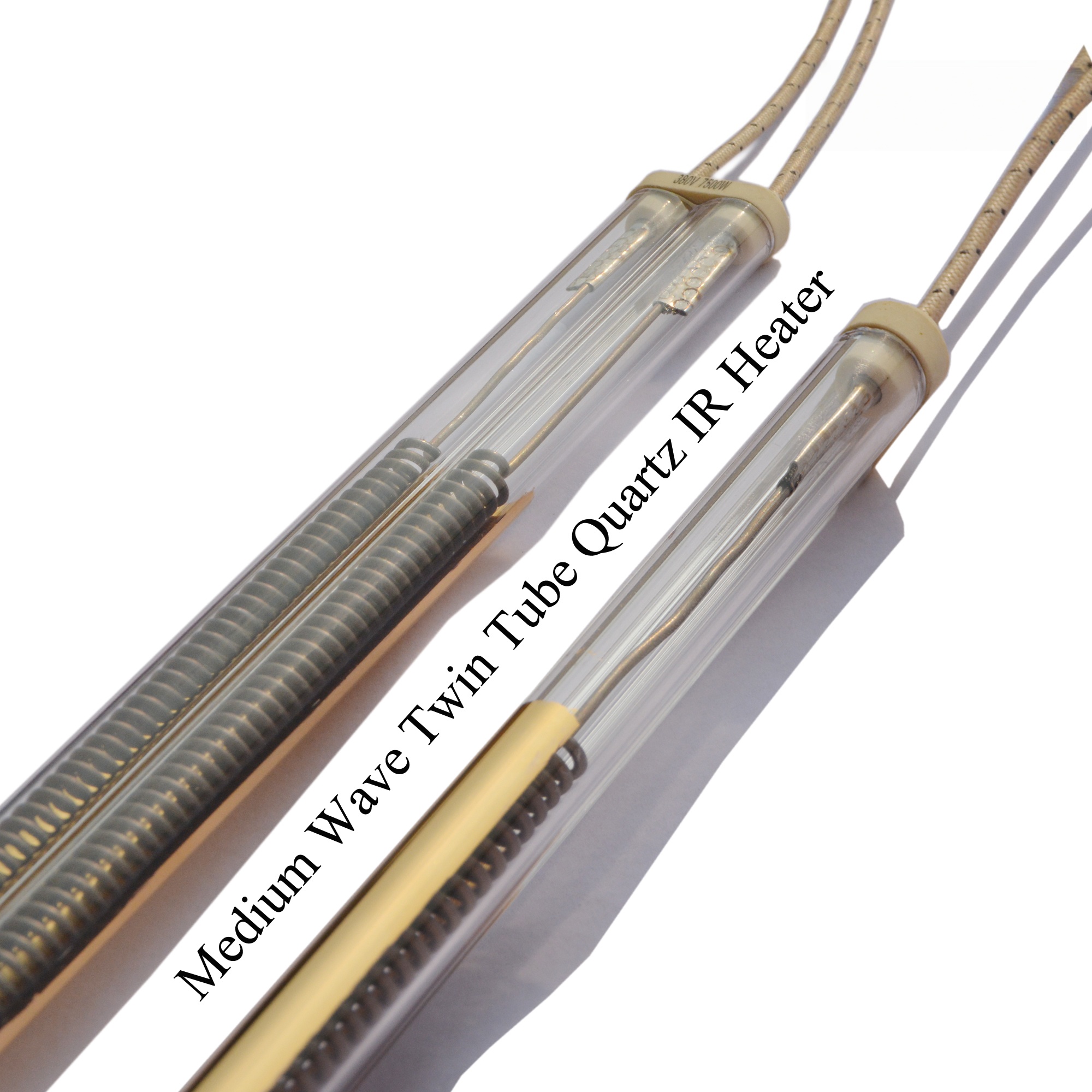
1. Process overview: conveyor belt dryers and where heat is needed
Although designs vary by industry, most conveyor belt dryers share a similar process structure.
1.1 Typical layout
Infeed section
Screen-printed garments or panels
Textile webs or nonwovens
Food products on trays or mesh belts
Metal, glass, or plastic parts with wet coatings or adhesives
Products are loaded from upstream processes, such as:
The belt (PTFE/glass, metal mesh, or solid belt) transfers products into the heated tunnel.
Preheating / flash-off zone
The goal is to bring the product surface quickly above the evaporation temperature of water or solvents.
For printing and coated products, this is where surface moisture and low-boiling solvents are flashed off to stabilize the ink or coating before deeper drying and final cure.
Main drying / curing zones
Multiple zones in series, each with its own temperature and airflow profile.
In conventional dryers, these are typically hot-air or gas-fired zones that heat large air volumes and the steel structure of the dryer.
Moisture or solvent is removed by a combination of conduction, convection, and evaporation, with ventilation to exhaust saturated air.
Cooling / setting zone
Reduces product temperature to a handleable or packable level.
For textiles and printed items, cooling ensures that inks or coatings do not block or stick when stacked or rolled.
Outfeed and downstream handling
Products move to stacking, rolling, cutting, packaging, or further processing.
1.2 Where heating is most critical
Across these industries, heating demands are concentrated in:
Surface flash-off
Rapid removal of surface water or solvents from thin layers (inks, coatings, glazes, adhesive films).Bulk drying / cure
Driving moisture or solvent from the interior of porous materials (textiles, food, nonwovens) or through thicker coatings.Temperature-sensitive substrates
Many conveyor lines handle polymer films, synthetic fabrics, or food products that can degrade, deform, or discolor if exposed to high bulk temperatures for too long.
Because of these requirements, there is strong value in a heating technology that:
Puts energy directly into the product rather than the whole air volume,
Reacts quickly to starts/stops and product changes,
Can be zoned precisely along both the line length and belt width.
Quartz infrared heating lamps fit well into these constraints when properly engineered.
2. Limitations of conventional heating in conveyor belt dryers
Most installed conveyor belt dryers rely primarily on hot air, gas burners, or steam coils. While robust and familiar, these methods face structural limitations in modern production environments.
2.1 Long warm-up and cool-down times
Large steel enclosures and huge air volumes must be heated before production can start.
During breaks or short stops, systems often stay hot to avoid long restart times, wasting energy and stressing components.
2.2 Limited heat transfer rate
Convective systems rely on high air temperature and velocity to transfer heat into the product.
For dense, thick, or low-conductivity products, surface temperature may rise slowly, limiting drying rate.
To compensate, lines may use longer tunnels, slower belt speeds, or higher air temperatures that risk overheating sensitive substrates.
2.3 Non-uniform drying across the belt
Air distribution is difficult to make perfectly uniform over wide belts and varying product loading patterns.
Edge effects, shadowing from product stacks, and poor recirculation design can cause:
Wet patches or under-dried zones,
Overdried edges or hot spots,
Inconsistent cure of inks or adhesives.
2.4 High energy losses
A significant portion of input energy heats:
The air volume,
The metal structure,
Ducting and exhaust air.
Even with insulation, standby losses are large, and energy is lost in warm exhaust streams.
2.5 Limited dynamic control
Changing setpoints, recipes, or zone temperatures has thermal inertia.
Reacting to product changes (color, thickness, moisture, ink load) is slow, which can lead to scrap during transitions.
Infrared systems, particularly quartz IR lamps, address several of these root issues by delivering radiant energy directly to the product surface with very fast response.
3. Where and how quartz infrared can be integrated
Integrating IR into conveyor belt dryers does not have to be an all-or-nothing decision. In practice, plant engineers typically add quartz IR in one of three ways: preheating, boosting, or full replacement.
3.1 IR as a preheating / flash-off stage
Objective: Quickly heat the product surface to evaporate free moisture or low-boiling solvents before the hot-air zones.
Placement: One IR zone near the entrance of the dryer, above (and sometimes below) the belt.
Benefits:
Reduces moisture load entering the main dryer.
Stabilizes inks and coatings early, improving print edge definition and reducing smearing.
Allows lower temperatures or shorter residence times in subsequent convection zones.
Common applications:
Textile screen printing conveyor dryers for T-shirts and fabrics.
Lines for paper, films, and foil where thin coatings must be flashed before bulk drying.
3.2 IR as a booster zone
Objective: Increase line speed or production capacity without lengthening the dryer.
Placement: IR modules inserted between existing hot-air zones, or at the most critical drying bottleneck.
Benefits:
Raises product surface temperature quickly at key points.
Frees up convective zones to handle deeper moisture removal rather than initial flash-off.
Can be retrofitted into existing tunnels with minimal structural change.
Typical use cases:
Existing dryers that are throughput-limited at a given quality level.
New product introductions with heavier ink loads or more demanding coatings.
3.3 IR as the primary heating method
Objective: Use quartz IR lamps as the main heating source, with convection only for support and ventilation.
Placement: Multiple IR zones along the tunnel length, usually combined with controlled ventilation for moisture removal.
When suitable:
Products with relatively thin, IR-absorbing layers (inks, coatings, thin textiles).
Processes where precise zoning and fast on/off control are important.
Situations requiring compact equipment with small footprint.
Examples include:
Compact garment dryers for small and mid-size print shops.
Laboratory and pilot dryers for product development.
Certain food and snack drying steps when surface water removal is dominant and product surfaces can be directly exposed to IR.
4. Example IR configurations for conveyor belt dryers
The following examples are indicative; actual designs must be based on testing and detailed process data. They illustrate realistic ranges and trade-offs.
4.1 Screen-printed textile conveyor dryer (garments, panels)
Typical process
Products: Cotton or polyester T-shirts, hoodies, flat panels with plastisol or water-based inks.
Belt width: Approximately 0.7–1.0 m.
Speed: Around 1–5 m/min for small and medium dryers, adjustable to match ink type and garment loading.
IR configuration
Heater type: Short-wave or fast medium-wave quartz halogen lamps in single-tube format.
Installed power:
6–12 kW total in a compact dryer with 1–1.5 m heated length.
Equivalent to roughly 10–25 kW/m² at the product plane, depending on reflector design and lamp spacing.
Mounting distance:
150–250 mm from lamp to garment surface.
Shorter distance yields higher intensity and faster drying but requires careful uniformity tuning.
Dwell time:
At 3 m/min through a 2 m heating zone, dwell time is about 40 s.
This is typically sufficient to gel plastisol inks and fully dry many water-based inks when ventilated correctly.
Control:
Zones along the belt length (for example, “flash” and “main cure”) with individual power control.
Optionally, zones across the belt width (left/center/right) for fine uniformity adjustment.
4.2 Textile web or nonwoven dryer (finishing/coating line)
Typical process
Products: Woven fabrics, nonwovens, technical textiles with coatings, binders, or functional finishes.
Belt width: 1.6–2.4 m or more.
Speeds: Often 10–40 m/min, depending on basis weight and moisture load.
IR configuration
Heater type:
Fast medium-wave twin-tube quartz emitters for good efficiency and strip coverage.
Reflectors designed to overlap radiation patterns across the full width.
Installed power:
60–120 kW across a 2 m width, giving approximately 15–30 kW/m² at the web.
Mounting distance:
200–350 mm from emitters to web surface, balancing uniformity and peak intensity.
Dwell time / zone length:
At 20 m/min line speed, a 3 m IR zone provides about 9 s residence time.
Often used as a pre-dryer or booster before a longer convection section.
Ventilation:
Directed exhaust over the web to remove evaporated moisture and prevent condensation.
4.3 Food and tray dryers (baked goods, snacks, coated products)
Typical process
Products: Bakery items, snack foods, coated nuts, or trays with wet surface layers.
Constraints: Strict product quality and safety requirements; limited maximum surface temperature; need to avoid scorching or excessive weight loss.
IR configuration
Heater type:
Medium-wave quartz emitters for gentler surface heating and better penetration into moist organic materials.
Power density:
Typically 5–15 kW/m² at the product, lower than for printing and coating applications.
Mounting distance:
200–400 mm, sometimes with top and bottom IR to improve overall drying without overheating the surface.
Dwell time:
Depending on moisture load, 1–3 IR zones each providing 15–60 s can significantly reduce total oven length or support existing convection zones.
4.4 Typical lamp characteristics
Standard T3 short-wave quartz halogen lamps, commonly used in industrial IR drying, offer:
High filament temperatures and very high radiant power density,
Power ratings typically in the range of roughly 100–200 W per linear inch of lamp length,
Very fast response, with output changing in seconds when power is adjusted.
From a conveyor dryer design perspective, this allows:
High power density in compact zones,
Rapid start/stop and easy adaptation to intermittent production,
Flexible sizing by selecting lamp length, number of lamps, and zoning.
5. Impact on quality, throughput, footprint, and energy
When quartz IR heating is correctly integrated into conveyor belt dryers, several performance dimensions typically improve.
5.1 Product quality
More uniform drying across the belt width
Well-designed IR arrays with correctly aligned reflectors can produce highly uniform radiant flux, reducing wet patches and under-cured areas that stem from uneven airflow.Cleaner print and coating definition
Fast surface flash-off reduces ink bleed on textiles and paper, stabilizes edges, and improves color consistency.Reduced risk of thermal damage
Because energy is delivered selectively and can be turned down or off quickly, maximum substrate temperatures can be controlled more tightly than with high-inertia hot-air systems.
5.2 Throughput and line speed
Higher line speeds at existing dryer length
By shifting the most demanding flash-off or early drying load to IR, convective zones can focus on finishing and leveling, allowing higher belt speeds.Compact system design for new lines
New conveyor dryers using IR as primary heat source can be shorter for the same throughput, freeing floor space or enabling modular, mobile designs.
5.3 Energy and operating costs
Infrared drying offers significant advantages in energy use compared to purely convective methods, primarily because it delivers heat directly to the product, with less waste heating the surrounding air.
Key drivers include:
Less energy needed to raise air and metal temperatures.
Fast response enables genuine standby or low-load modes during pauses.
Zoning allows under-loaded belt areas to be operated at reduced power.
Actual savings depend on product mix, operating schedule, and ventilation needs, but many plants see noticeable reductions in energy per unit produced once the IR system is tuned.
6. Practical design and tuning tips for conveyor belt dryers
To realize these benefits consistently, the IR system must be engineered around the specific process, not just the lamp catalog.
6.1 Match wavelength to product and moisture
Moisture has strong absorption bands in the mid-IR region.
Organic substrates (textiles, food) and polymeric coatings have their own characteristic absorption spectra.
In practice:
Short-wave IR is ideal for very high power density and surface heating, particularly for dark, strongly absorbing inks and coatings.
Fast medium-wave IR often provides a better balance of penetration and surface control for textiles and coatings.
Medium-wave IR can be gentler for food and sensitive substrates.
6.2 Consider belt material and transparency
PTFE/glass belts may transmit part of the IR spectrum, allowing under-belt heaters to contribute directly to product heating.
Metal mesh belts reflect and absorb IR; they can heat and re-radiate, but direct transmission is lower.
The choice of belt material affects:
Required power density,
Effective lamp-to-product distance,
Cleanability and hygiene in food lines.
6.3 Use reflectors to control intensity and uniformity
Highly reflective aluminum or stainless steel reflectors behind lamps significantly increase useful radiant flux at the product.
Geometry (parabolic, elliptical, or flat with angles) determines:
Beam focus and uniformity,
Edge effects across the belt,
Sensitivity to lamp position and sag over time.
Regular cleaning is critical; dust and overspray can reduce reflectivity and change heating patterns.
6.4 Instrumentation and feedback
For commissioning and continuous optimization, a conveyor dryer with IR should include:
Product temperature measurement
Non-contact IR pyrometers targeted at the product surface, and/or
Contact thermocouples in representative test pieces.
Air temperature and humidity monitoring in critical zones.
Power and current monitoring for IR zones to track energy use and detect lamp failures.
These measurements enable recipe-based control rather than single-setpoint control, especially for multi-product lines.
6.5 Start-up, recipe management, and changeover
To handle different products and loads efficiently:
Define standard recipes linking:
Belt speed,
IR zone power levels,
Ventilation rates,
Setpoints for downstream convection.
Use ramp-up profiles for lamps and line speed to avoid thermal shocking products or equipment.
For small batches or frequent changeovers, leverage the fast response of quartz IR by:
Reducing power or switching off zones quickly during gaps,
Using “standby” settings ready for immediate ramp-up.
7. Common pitfalls and how to avoid them
Infrared integration is not risk-free. The most frequent issues arise when IR is treated as a simple “plug-in heater” rather than a process tool.
7.1 Overheating and scorching
Symptoms: Burned or discolored textiles, warped films, scorched food surfaces, blistering of coatings.
Causes:
Excessive power density at short lamp-to-product distances.
No feedback from actual product temperature.
Applying IR where deep moisture removal is still needed, causing surface skinning.
Mitigations:
Start with conservative power settings and gradually ramp up based on measured product temperature.
Use multiple shorter zones rather than one extremely intense zone.
Combine IR with adequate ventilation to remove steam and avoid skin formation.
7.2 Non-uniform heating pattern
Symptoms: Localized under-cure or over-cure, stripes or bands across belt width, uneven drying along the line.
Causes:
Inconsistent lamp spacing, aged lamps with different output, or degraded reflectors.
Shadowing from fixtures or poorly designed support structures.
Mitigations:
Simulate or measure irradiance distribution during design.
Use overlapping patterns and adjustable mounting brackets.
Establish preventive maintenance for lamp replacement and reflector cleaning.
7.3 Ignoring product absorptivity and color
Symptoms: Light-colored products heating more slowly than dark ones; mixed product streams with uneven results.
Causes:
Assuming uniform absorption across all colors and materials.
Mitigations:
Validate IR response for each major product family (light/dark colors, glossy/matte, different substrates).
Use recipes with adjusted power and speed for each product mix.
Consider wavelength selection to reduce sensitivity to color differences where possible.
7.4 Inadequate exhaust and ventilation
Symptoms: Condensation in the dryer, solvent odor, inconsistent drying, potential safety issues.
Causes:
Misunderstanding that IR “does not need air” — while IR supplies heat, vapor still must be removed.
Mitigations:
Provide sufficient exhaust capacity and controlled make-up air.
Design airflow patterns to sweep vapors away from the product surface without cooling it excessively.
Verify ventilation performance under worst-case loading.
7.5 Maintenance oversights
Symptoms: Gradual loss of capacity, slow increase in energy use, frequent lamp failures.
Causes:
Contamination of lamps and reflectors by dust, fibers, overspray.
Operating lamps beyond rated life or with frequent thermal shock cycles.
Mitigations:
Implement routine inspection and cleaning schedules.
Monitor lamp operating hours and replace as a set when output drops below acceptable levels.
Ensure correct handling and cooling conditions per lamp specification.
8. How Huai’an Yinfrared supports conveyor belt dryer projects
Integrating quartz IR heating into conveyor belt dryers is ultimately a system engineering challenge. Huai’an Yinfrared typically supports customers through several stages.
8.1 Feasibility testing and thermal characterization
Evaluate real customer samples (textiles, printed items, coated parts, food) in lab or pilot IR setups.
Measure:
Heating curves (temperature versus time at given power densities),
Moisture or weight loss versus dwell time,
Visual and functional quality (color, adhesion, surface finish).
This data reveals whether IR is suitable as preheating, boosting, or main heating for the specific process.
8.2 Process and system design
Based on test results and line requirements, Huai’an Yinfrared can:
Estimate required power density, zone length, and belt speed for target throughput.
Recommend heater type (short-wave, fast medium-wave, medium-wave) and lamp arrangement.
Define zoning along and across the belt, including:
Number of zones,
Individual power control ranges,
Integration with existing PLCs or temperature controllers.
Provide guidance on ventilation and exhaust to match evaporation rates.
8.3 Custom lamp and module engineering
For new equipment or retrofits, the company can:
Design custom quartz IR lamps (length, wattage, filament design, end terminations) matched to the dryer geometry.
Engineer IR modules with:
Optimized reflector shapes,
Quick-mount frames and adjustment features,
Protection for lamps against mechanical impact and contamination.
8.4 Integration and commissioning support
During installation and start-up, Huai’an Yinfrared helps:
Verify mechanical fit, electrical connections, and safety interlocks.
Assist with initial recipe setup for key products (belt speed, zone setpoints, ventilation).
Train production and maintenance teams on:
Routine cleaning and inspection,
Basic troubleshooting and tuning.
8.5 Long-term optimization
After the system is in production, ongoing support can include:
Reviewing performance data (throughput, energy per unit, quality metrics).
Helping adapt IR settings for new products or inks/coatings.
Providing replacement lamps and upgrade options as requirements evolve.


