Home » News » Industry News » Quartz Infrared Lamps: The Critical Role of Precision Heating in Photovoltaic Manufacturing

Quartz Infrared Lamps: The Critical Role of Precision Heating in Photovoltaic Manufacturing

Author: Site Editor     Publish Time: 2025-09-11      Origin: Site

Inquire

facebook sharing button
twitter sharing button
line sharing button
wechat sharing button
linkedin sharing button
pinterest sharing button
whatsapp sharing button
sharethis sharing button

Why Quartz Infrared Lamps Are the Unseen Engine of the Photovoltaic Industry

Why Quartz Infrared Lamps Are the Unseen Engine of the Photovoltaic Industry

As a professional deeply entrenched in the world of advanced thermal processing, I have witnessed a technological evolution across numerous manufacturing sectors. Few, however, are as dynamic and critical to our global future as the photovoltaic (PV) industry. The relentless drive for higher efficiency, greater durability, and lower costs in solar cell production is a complex dance of chemistry, physics, and engineering. And in this dance, one component consistently plays a pivotal, yet often underappreciated, role: the quartz infrared lamp.

In my years of working with manufacturers and research institutions, I’ve moved from seeing these lamps as simple heating elements to understanding them as precision instruments. They are not merely sources of heat; they are catalysts for transformation, enabling the processes that turn raw materials into the powerful cells that harness the sun's energy. This blog post will delve into the reasons why quartz infrared lamps have become so indispensable to modern PV manufacturing, exploring the science behind their operation, their key applications, and the tangible benefits they deliver.


The Fundamental Synergy: Understanding Infrared Heating

To appreciate the value of quartz infrared lamps, we must first understand the principle of infrared (IR) heating. Unlike convection heating, which warms the air around an object, infrared radiation transfers thermal energy directly to a target object through electromagnetic waves. This is a profoundly efficient method, as it eliminates the intermediary (air) and its associated thermal inertia and inefficiencies.

IR radiation is categorized by wavelength:

  • Short-Wave (NIR): Wavelengths from 0.76 to 1.5 µm. High power, high temperature, immediate effect.

  • Medium-Wave: Wavelengths from 1.5 to 4 µm.

  • Long-Wave (FIR): Wavelengths from 4 µm to 1 mm. Lower temperature, gentler, surface heating.

Quartz infrared lamps are premier emitters of short-wave near-infrared (NIR) radiation. This is where the synergy with photovoltaic manufacturing begins. The materials used in solar cells—especially silicon wafers and the thin films deposited on them—are exceptionally efficient at absorbing these specific wavelengths. This allows for rapid, direct, and highly controllable heating.


The Anatomy of a Superior Heating Element: Why Quartz?

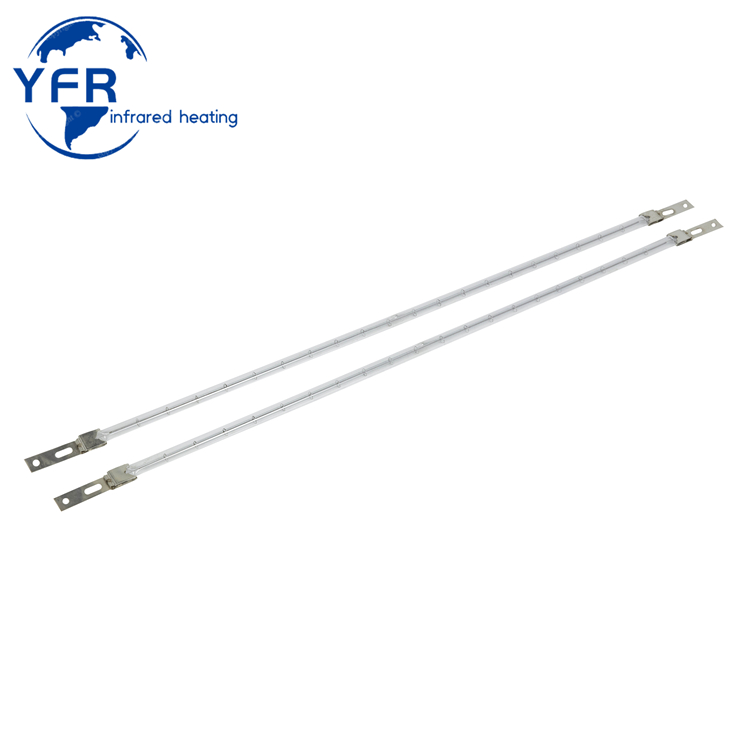
Not all lamps are created equal. The construction of a quartz infrared lamp is a marvel of material science tailored for extreme performance.

  1. The Quartz Tube: This is the heart of the lamp. Fused quartz, primarily made from silicon dioxide (SiO₂), is chosen for its exceptional properties:

    • High-Temperature Resistance: It can withstand operating temperatures exceeding 900°C (1652°F) without softening or degrading.

    • Low Thermal Expansion: It is highly resistant to thermal shock, preventing cracking from rapid heating and cooling cycles—a necessity in industrial processing.

    • Optical Transparency: Crucially, fused quartz is remarkably transparent to both visible and infrared radiation. Unlike other glasses that can absorb and re-radiate IR energy inefficiently, quartz allows approximately 93% of the generated IR energy to pass through unimpeded, directly to the target. Some processes use "gold-coated" quartz tubes to reflect heat backward, increasing efficiency further.

  2. The Tungsten Filament: coiled within the quartz tube, this filament is heated resistively to extreme temperatures, typically between 1,500°C and 2,200°C (2,732°F - 3,992°F). At these temperatures, according to Planck's law of black-body radiation, the peak wavelength of emitted energy falls squarely within the short-wave infrared spectrum.

  3. Inert Gas or Halogen Cycle: The tube is filled with an inert gas like argon or nitrogen, or more commonly, a halogen gas (iodine or bromine) in a halogen cycle lamp. The halogen cycle is critical for longevity. It causes evaporated tungsten to redeposit back onto the filament, preventing the blackening of the quartz tube and maintaining nearly 100% light output throughout the lamp's life.

This combination results in a heater that offers:

  • Instant On/Off Response: No warm-up or cool-down time.

  • Precise Zonal Control: Lamps can be arranged in arrays for targeted heating zones.

  • High Power Density: Delivering intense heat in a compact form factor.

  • Maximized Efficiency: Minimal energy is wasted heating the surroundings.


Critical Applications in Photovoltaic Manufacturing

The properties of quartz IR lamps make them ideal for several high-throughput, precision-driven stages of solar cell production.

1. Diffusion: Creating the Semiconductor Heart

The formation of the p-n junction is the fundamental step that gives a solar cell its ability to convert sunlight into electricity. This is typically achieved through phosphorus diffusion for n-type silicon wafers.

The Process: Wafers are heated to precisely 800-900°C in a quartz tube furnace in the presence of a phosphorus-containing gas (e.g., POCL₃). At this temperature, phosphorus atoms diffuse into the silicon crystal lattice, creating the essential n-type layer.

Why Quartz IR Lamps? Traditional resistive heating elements have significant thermal mass, leading to slow ramp-up and cool-down times. This limits throughput and consumes more energy. IR lamp-heated diffusion furnaces, often using arrays of lamps in a reflective chamber, offer:

  • Rapid Thermal Processing (RTP): Wafers can be heated to the target temperature in seconds, not minutes. A study published in the Journal of Applied Physics demonstrated that RTP using IR lamps could achieve superior junction quality with reduced thermal budget, minimizing unwanted dopant diffusion and defects.

  • Unmatched Temperature Uniformity: Precise control over the lamp array ensures every part of the wafer sees the exact same temperature, which is critical for uniform junction depth and cell performance.

  • Reduced Energy Consumption: The "heat on demand" nature of IR lamps, with no standby losses, significantly cuts energy use compared to maintaining a constantly hot furnace.

2. Drying and Firing of Metallic Pastes: Forging the Electrical Connections

Screen printing is the standard method for applying the intricate front-side and rear-side electrical contacts to a solar cell. This involves depositing a metallic paste (typically silver for the front, aluminum for the back) and then processing it through a drying and firing furnace.

This is arguably the most common and vital application of quartz infrared lamps in PV manufacturing. The process is a continuous conveyor-belt system where cells pass through precisely controlled heating zones.

  • Drying Stage: Initial zones, heated by lower-temperature medium-wave IR, gently evaporate the solvents from the paste without causing violent outgassing that could disrupt the pattern.

  • Firing Stage: Subsequent zones, heated by high-intensity short-wave quartz IR lamps, rapidly raise the temperature of the wafer to a peak of 700-800°C. This peak temperature is held for only a few seconds—a "thermal spike." During this brief window, several critical events occur simultaneously:

    1. The glass frit in the silver paste melts, etching through the silicon nitride anti-reflective coating (ARC).

    2. Silver nanoparticles sinter together and form a strong ohmic contact with the underlying silicon.

    3. On the rear, the aluminum paste sinters and, upon cooling, forms a p+ doped layer (Back Surface Field, BSF) that passivates the rear surface and improves voltage.

Why Quartz IR Lamps are Indispensable Here: The success of this entire process hinges on the ability to achieve an extremely rapid and precisely controlled thermal profile. As noted in a report from the National Renewable Energy Laboratory (NREL), the peak temperature and time-at-temperature are the most critical parameters for contact formation and cell efficiency. Quartz IR lamps provide the necessary:

  • Speed: The rapid thermal response allows for the essential short thermal spike, preventing excessive driving-in of metals that can shunt the junction or damage the delicate silicon wafer.

  • Precision: Modern furnaces use pyrometers for closed-loop feedback, dynamically adjusting lamp power hundreds of times per second to maintain a perfect temperature profile across every wafer, regardless of minor variations in mass or line speed.

3. Annealing and Curing: Healing and Perfecting

Various layers in advanced cell architectures, such as heterojunction (HJT) or back-contact cells, require careful thermal treatment.

  • Annealing: This process uses controlled heat to relieve stresses in thin films, crystallize amorphous layers, or activate dopants. The precise and gentle nature of IR heating prevents damaging sensitive underlying layers.

  • Curing: Polymer-based coatings and adhesives used in module assembly (e.g., for backsheets) can be rapidly and uniformly cured using IR ovens, speeding up the lamination process.

4. Silicon Nitride (SiNx) Deposition via PECVD

While not the heater inside the chamber, quartz IR lamps are often used in Plasma-Enhanced Chemical Vapor Deposition (PECVD) systems to pre-heat the wafer carriers (susceptors) and the wafers themselves to a stable, uniform temperature (400-500°C) before deposition begins. This pre-heating is crucial for achieving a high-quality, uniform silicon nitride anti-reflective coating with excellent passivation properties.


The Tangible Benefits: A Summary of Value

The widespread adoption of quartz infrared lamps is not arbitrary; it is a decision driven by hard metrics and bottom-line benefits:

  1. Unmatched Process Efficiency: The direct transfer of energy and instant control drastically reduce cycle times, increasing manufacturing throughput and capacity.

  2. Superior Energy Efficiency: By heating the product, not the air or the furnace structure, and by eliminating standby losses, IR systems can reduce energy consumption in thermal processes by 30-50% compared to conventional methods.

  3. Enhanced Product Quality and Yield: Precise temperature control and uniformity translate to more consistent cell performance (efficiency and voltage), higher mechanical yield due to reduced thermal stress, and better overall product quality.

  4. Reduced Footprint: IR heating systems are typically more compact than traditional convection ovens, saving valuable cleanroom floor space.

  5. Process Flexibility and Control: Digital controls allow for instant recipe changes, making it easy to switch between different cell architectures or pastes without physical hardware changes.


    Frequently Asked Questions (FAQ)

    Q1: Aren't quartz infrared lamps just fancy light bulbs? How are they different?
    A: While they share a filament-based ancestry with incandescent bulbs, the differences are profound. Quartz IR lamps are engineered for extreme temperatures and power densities. The use of fused quartz instead of glass allows for higher operating temperatures and superior IR transmission. They are precision tools designed for industrial process heating, not illumination.

    Q2: With the rise of LED and other solid-state lighting, is IR lamp technology becoming obsolete?
    A: Not in industrial thermal processing. The application is completely different. LEDs are superb for visible light but cannot currently compete with the sheer power density and broad-spectrum IR output of a tungsten filament heated to over 2000°C. For rapidly transferring large amounts of thermal energy, quartz IR technology remains unmatched in its efficiency and cost-effectiveness.

    Q3: What is the typical lifespan of a quartz infrared lamp in a PV production setting?
    A: Lifespan is highly dependent on the specific process (peak temperature, cycling frequency) and operating voltage (undervolting can extend life). In a demanding application like a belt furnace, high-quality halogen-cycle quartz IR lamps can typically last for 5,000 to 10,000 operating hours. Proper maintenance of the reflectors and ensuring good electrical connections are key to maximizing lifespan.

    Q4: How significant is the energy savings compared to conventional ovens?
    A: The savings are very significant. Multiple case studies from system integrators and manufacturers report reductions in energy consumption for thermal processes ranging from 30% to 50%. This is primarily because IR heating eliminates the need to heat a large thermal mass (the oven walls and air) and provides heat only when and where it is needed.

    Q5: Can quartz IR lamps be used for all heating steps in PV manufacturing?
    A: While incredibly versatile, they are not a universal solution. They excel in processes requiring rapid heating, precise temperature control, and high throughput (e.g., diffusion, firing, drying). Slower, gentler processes like the curing of certain encapsulants or long-duration crystal growth annealing might still use convection or other heating methods more suited to those specific thermal profiles. The choice of technology is always dictated by the process requirements.


Conclusion

From my perspective, the quartz infrared lamp is a testament to how a well-understood technology can be perfected to become a cornerstone of a modern industrial revolution. It is the unseen engine that enables the high-speed, high-precision, and high-efficiency manufacturing that has driven down the cost of solar energy and made it a mainstream power source. It is not an exaggeration to state that without the unique capabilities of quartz infrared heating, the scale, speed, and economic viability of today's photovoltaic industry would look vastly different. As we continue to push the boundaries of solar cell performance, this remarkable technology will undoubtedly continue to evolve and illuminate the path forward.

Due to its remarkable qualities of temperature resistance, thermal shock resistance, low impurity content, high resistance to chemical agent corrosion, and exceptional clarity, quartz glass is one of the most used materials in the solar industry. In addition to PV solar, Yinfrared has extensive expertise in serving the demands of many different sectors.


Huai’an Infrared Heating Technology is a manufacturer of Quartz IR emitters.

Product Category

Quick Links

Contact Us

Copyright © 2022 Huai'an Infrared Heating Technology. All Rights Reserved.| Sitemap  Supported By Leadong