


Author: Site Editor Publish Time: 2025-11-27 Origin: Site


Modern aluminum profile coaters are under pressure to deliver flawless finishes, faster line speeds, and lower energy use at the same time. For plant engineers, OEM/ODM system builders, and line integrators, quartz infrared heating lamps provide a compact, controllable way to cure powder coated aluminum profiles while improving throughput and reducing operating cost.
This article explains where quartz infrared modules fit best in aluminum profile coating lines, how to select the right wavelength and power density, and what to watch out for during integration and commissioning.
Process overview
A typical aluminum profile coating line for building and architectural extrusions includes pretreatment, drying, powder application, curing, and cooling. Profiles usually have wall thicknesses of around 1–3 mm, with lengths up to 6–7 m and line speeds often between 1–3 m/min. Powder suppliers typically specify a cure schedule within 180–220 °C for 10–20 minutes, measured at metal temperature.
Pain points of conventional heating
Older gas-fired or electric convection ovens often exhibit:
Long warm-up and standby times.
Non-uniform temperatures across complex profile cross-sections.
Limited ability to increase line speed without extending oven length.
High energy consumption, as the entire oven air volume and surrounding structure must be heated continuously.
These constraints limit the ability of coaters to respond to growing aluminum demand while controlling costs.
How quartz infrared modules change the game
By installing quartz infrared modules for aluminum extrusion coating at the oven entrance, in mid-zones, or in a dedicated boost section, the line can:
Pre-heat the profile skin rapidly before entering the convection zone.
Reduce ramp-up time to curing temperature.
Improve film flow and leveling, reducing defects such as orange peel or pinholes.
Increase line speed or allow a shorter oven length for the same cure schedule.
Electric infrared systems can also be switched off quickly during breaks and product changes, reducing idle losses compared with continuously fired ovens.
Recommended Huai’an Yinfrared solutions
Short-wave quartz infrared heating lamps in cassette-style modules for high power density boost zones.
Fast medium-wave quartz IR lamps where slightly deeper penetration into the coating is desired.
Modular quartz infrared heating modules engineered to bolt into existing oven walls or ceiling frames, ideal for retrofitting gas-fired coating ovens with infrared heaters.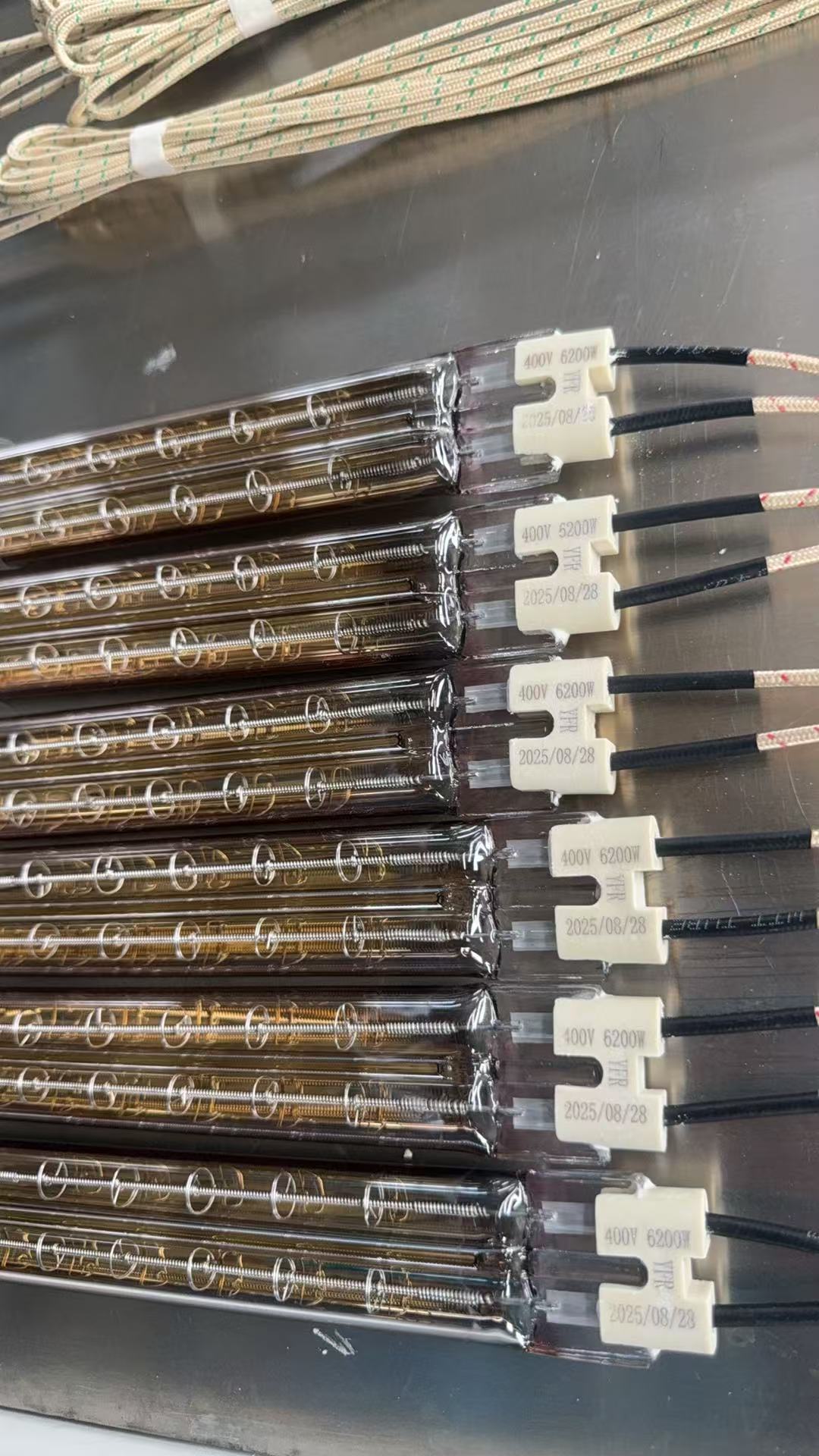
Process overview
Architectural profiles for windows, façade systems, and curtain walls are often coated in large volumes with tight color and gloss requirements. OEM finishing lines may target:
Line speeds above 3 m/min for standard colors.
High repeatability of film thickness and appearance.
Quick color change capability and minimal work-in-process inventory.
Challenges without IR support
For high-speed lines relying on convection alone:
Achieving the required time-at-temperature in limited floor space becomes difficult.
Convection transfer coefficients may not be sufficient to heat thin edges and thicker sections uniformly.
Cycle time extensions to ensure full cure can reduce productivity and increase gas or power consumption.
Infrared heating solution for aluminum profile coating lines
Integrating quartz infrared heating lamps for aluminum profile coating directly above and below the conveyor allows:
Direct radiant heating of the powder layer and profile surface.
Fast skin-temperature rise that supports fast curing of powder coated aluminum profiles without extending oven length.
Zoned control to adapt heating intensity to profile color (dark colors absorb more IR), shape, and coating thickness.
Recommended Huai’an Yinfrared solutions
Short-wave quartz IR lamps for maximum throughput where surface quality is critical.
Fast medium-wave lamps for powders formulated for medium-wave absorption.
Custom infrared curing ovens for aluminum profiles combining IR boost zones with convection holding zones.
Pro tip for plant engineers: When redesigning a high-speed line, define your maximum acceptable oven length and then size IR power density to hit cure targets at that line speed, rather than sizing line speed around an inherited oven.
Process overview
Even with a stable process, occasional defects appear during handling, masking, or assembly. Re-coating and local repair of aluminum extrusions is common in:
Fabrication workshops and cut-to-length operations.
OEM assembly plants needing touch-up after machining, drilling, or transport.
Pain points of conventional rework
Rework is often handled by:
Small convection cabinets, which heat slowly and sometimes over-bake adjacent areas.
Portable hot-air tools that can disturb powder before it gels.
Long rework cycles, delaying assembly or shipment.
Benefits of localized IR heating
Portable or small-area infrared heating solution for aluminum profile coating lines enables:
Local gel and cure of touch-up areas without reheating entire profiles.
Faster turnaround time for repairs.
Reduced risk of color shift or gloss changes in surrounding areas, thanks to controlled exposure.
Recommended Huai’an Yinfrared solutions
Compact quartz IR modules with focused reflectors for localized heating.
Small bench-top IR cure stations for shop-floor repair.
Customized emitters that can be integrated into OEM rework cells.
Infrared curing success starts with the right technical choices. This section explains the main parameters to consider when using quartz infrared heating lamps on aluminum profile coating lines.
Definition
Infrared wavelength band describes the predominant emission range of the heater:
Short-wave: roughly 0.8–1.5 µm
Fast medium-wave: roughly 1.4–2.0 µm
Long-wave: above about 2.5 µm
Why it matters
Bare aluminum is highly reflective in many IR bands.
The powder coating (and any conversion layer beneath) absorbs IR; its absorption spectrum varies with formulation and color.
Matching heater wavelength with coating absorption improves efficiency and reduces the risk of overheating the substrate.
Typical choices for aluminum profile coating
Short-wave quartz IR: excellent for high line speeds and thin powder layers.
Fast medium-wave quartz IR: often well matched to organic coating absorption, providing efficient cure with slightly gentler surface impact.
Definition
Power: total rated electrical power of the emitter or zone (kW).
Power density: installed power per unit area of product exposure (kW/m²).
Why it matters
Higher power density gives faster heating and shorter required dwell times.
Oversizing power density without proper control can cause surface defects or yellowing.
Typical ranges for aluminum profiles
Around 20–60 kW/m² in boost zones for high-speed lines.
Around 10–30 kW/m² for mixed-product lines or gentler curing.
Quartz tube lamp
Tungsten filament inside quartz glass, often with gold or ceramic coating for directional output. Very fast response time (seconds), well suited for on/off or phased control.
Quartz IR heating module
One or more lamps mounted with reflectors and insulation inside a cassette or panel. Simplifies mounting, wiring, and replacement; ideal for retrofitting convection curing ovens.
Long-wave ceramic IR heater
Slower response, more suited to low-temperature drying of non-metal substrates; usually not the first choice for aluminum profile curing.
Emitter length / panel size
Should align with typical profile lengths and conveyor layout. Standard emitter lengths often range from about 0.5 m up to 2 m; multiple emitters can be arranged end-to-end to cover longer zones.
Zoning
Dividing the IR oven into independently controlled zones along length and across width allows power reduction for small profiles, reduced loading, or heat-sensitive accessories. It also enables recipe-based operation per product family.
Surface temperature
Quartz lamps can reach very high envelope temperatures, but the critical parameter is aluminum and coating temperature. Control strategy should focus on achieving and maintaining the specified cure window, not on lamp temperature alone.
Response time
Short-wave and fast medium-wave quartz IR lamps typically reach operating output within seconds after energizing. This enables start/stop operation and reduces standby energy.
Working distance
Distance from emitter surface to profile surface is often in the 150–400 mm range.
Too close: risk of hot spots and non-uniformity.
Too far: reduced intensity and more sensitivity to misalignment.
Layout constraints
Profile hanging patterns, rotation, and shielding must be reviewed so that all critical surfaces “see” enough IR power. Reflectors and side emitters can improve coverage of complex shapes such as multi-chamber window profiles.
On/off control
Simplest approach; may be acceptable for small zones or batch ovens but offers limited fine tuning.
Solid-state relays (SSR) / SCR control
Phase-angle or burst-firing control provides smooth power modulation. SCRs are common for higher power zones and allow power proportional to line speed or product temperature.
PID and PLC/fieldbus control
Temperature or power-based PID loops allow stable cure despite throughput variations. Integration via common industrial networks enables recipe-based control, data logging, and alarms.
Enclosure design
IR modules must be protected from powder overspray, dust, and mechanical damage. Access panels and viewing ports support inspection and cleaning.
Insulation
Proper insulation behind modules reduces heat loss and keeps oven outer surfaces within acceptable temperature limits.
IP rating
Depending on environment, modules and junction boxes may need enhanced protection against dust and overspray. This is usually addressed through enclosure design and sealing rather than bare component rating alone.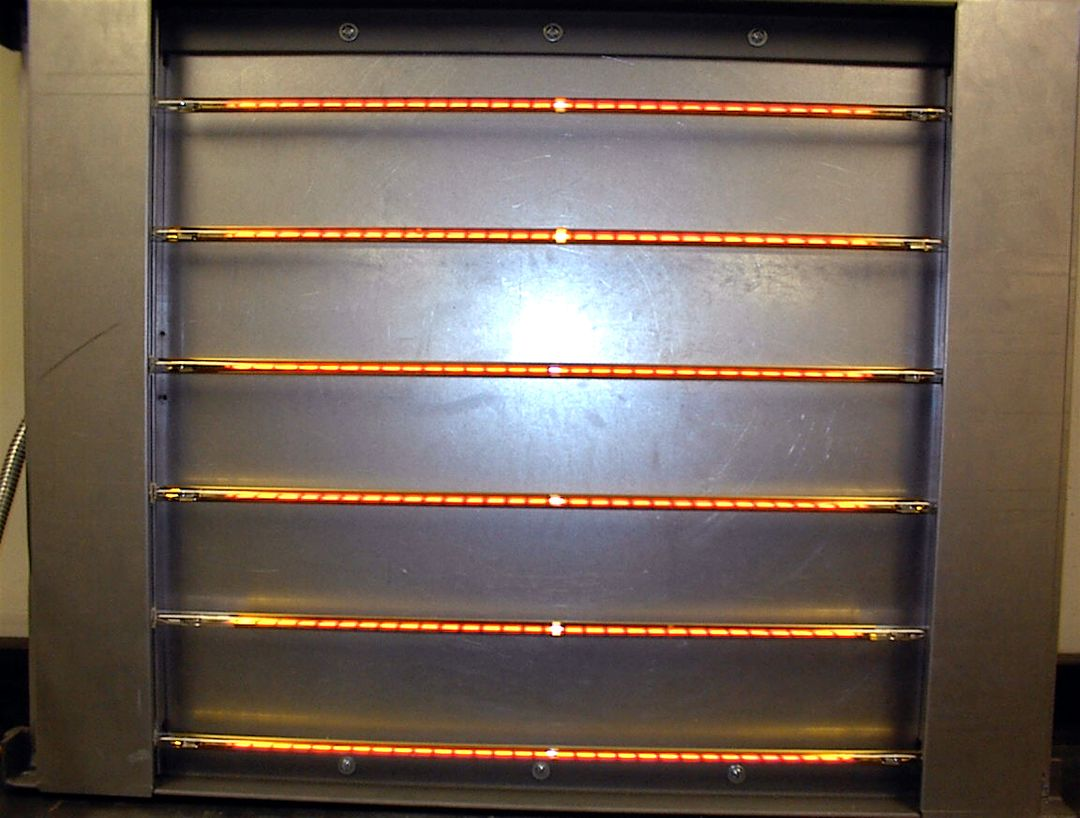
| Infrared Solution Type | Wavelength Band | Typical Power Density | Response Time | Recommended Applications | Control Options |
|---|---|---|---|---|---|
| Short-wave quartz IR lamp | Short-wave | High | Very fast | High-speed aluminum profile coating and curing | On/off, SSR, SCR, PLC |
| Fast medium-wave quartz IR lamp | Medium-wave | Medium–high | Fast | Powder coating on aluminum extrusions, mixed product lines | On/off, SSR, SCR, PLC |
| Quartz IR heating module | Short/medium | Medium–high | Fast | Retrofits into existing convection curing ovens | On/off, SSR, SCR, PLC |
| Long-wave ceramic IR heater | Long-wave | Low–medium | Slow | Gentle drying for non-metal substrates | On/off, PID, PLC |
If/then rules
If your main goal is maximum line speed on aluminum profiles with standard powder coatings, choose short-wave quartz IR lamps or modules with high power density.
If you run mixed product types and want a balance between aggressiveness and control, consider fast medium-wave quartz IR lamps.
If you want to retrofit a gas convection oven without major civil work, use modular quartz infrared heating modules fitted into existing openings.
If the process is dominated by low-temperature drying of non-metal substrates, long-wave ceramic IR may still have a role, but it is rarely first choice for aluminum profile curing.
Mini decision flow (simplified)
Start: Aluminum profile with powder coating
Yes → modular quartz IR panels sized to existing oven geometry
No → design new hybrid IR + convection curing oven
Yes → short-wave quartz IR boost zone + convection
No →
Yes → fast medium-wave quartz IR modules with zoned control
No → short-wave quartz IR with moderate power density
Do you run multiple product types/colors daily?
Is line speed ≥ 3 m/min or floor space limited?
Is retrofit into existing convection oven required?
Mains voltage and phase
Define available voltage levels (for example, 380–480 V, 3-phase) and maximum feeder capacity early in the project. Balance IR loads across phases and sections to avoid local overloads and nuisance trips.
Wiring and protections
Use appropriately rated cables and terminals in high-temperature areas. Provide individual protection (fuses or breakers) for groups of lamps to simplify troubleshooting and isolate faults.
Control strategies
Combine digital on/off for zone enable/disable with analog power setpoints via SCR drives. Use temperature feedback (from workpiece or air) and/or line speed feedback to adjust IR power automatically.
Control cabinet layout hints
Keep SCR modules in ventilated cabinets, separated from powder and dust. Provide clear terminal labeling, spare cores, and diagnostics so maintenance technicians can quickly identify problems.
Mounting options
Frames attached to oven roof or walls.
Cassette systems that slide in and out for quick lamp replacement.
Stand-alone IR tunnels upstream or downstream from existing ovens.
Distance from heater to product
Keep within the recommended working distance band; a 150–300 mm range is a typical starting point. Ensure profiles cannot swing into emitters; use stabilizing guides or fixtures where needed.
Line speed and dwell time
Calculate available dwell time:
dwell time = heated length / line speed
Size IR power density so the target cure schedule is achieved within this dwell time, with some margin for cold start and product variation.
Reflectors, shielding, and insulation
Use specular reflectors behind lamps to direct IR toward profiles and improve efficiency. Add shields to protect sensitive regions (bearings, seals, sensors, conveyor chains) from radiant heat.
Maintenance and access
Design easy front access to lamps and reflectors. Plan for regular cleaning of quartz tubes and reflectors to maintain efficiency and avoid localized overheating.
Defining the heating profile
Specify target metal temperature, allowable ramp rate, and minimum time-at-temperature per powder supplier guidance. Decide whether IR is used as a pre-heat boost, for full cure, or in combination with convection.
Sensors and feedback
Use thermocouples on profile surfaces and in the oven atmosphere to validate initial setup. Infrared pyrometers can provide non-contact surface temperature readings during operation and help tune zone outputs.
From trial-and-error to structured testing
Start with conservative power settings and gradually increase until the metal temperature profile matches the cure window. Record recipes (IR power, line speed, zone setpoints) for each product family and lock them in the PLC.
Tuning examples
Reduce orange peel by moderating initial power to avoid skinning the surface before full melt.
Prevent over-drying or discoloration by lowering final zone power once the required time-at-temperature is reached.
Use profiling runs during hot and cold ambient conditions to confirm robustness.
Lab tests on samples
Use small IR rigs to measure heating curves of representative profiles and powders. Determine approximate power density and exposure time needed to reach the specified cure temperature.
Pilot line or test zone
Implement one IR zone or a short test tunnel in parallel or within the main line. Validate adhesion, gloss, hardness, and color according to your QA standards before committing to full-scale hardware.
Full-scale acceptance criteria
Throughput: target units per hour or meters per minute at specified product mix.
Temperature uniformity: deviation across profile and between batches within defined limits.
Specific energy consumption: kWh per kg or per square meter of coated aluminum, compared to baseline.
Product quality metrics: cross-hatch adhesion, impact resistance, salt-spray performance, appearance criteria agreed with end customers.
Standards and directives (examples)
In many markets, infrared ovens fall under general electrical and machinery safety frameworks such as low-voltage and electromagnetic compatibility requirements and machinery safety principles. In other regions, equipment may be evaluated against national or regional industrial heating standards. Material selection should consider restrictions on hazardous substances in insulators, cables, and coatings.
Thermal safety
High external surface temperatures require guards, warning labels, and safe access routes. Implement interlocks on access doors and over-temperature protection to shut down IR zones if cooling or conveyor movement fails.
Fire prevention
Maintain clearances to combustible materials and overhead structures. Use temperature limiters on critical zones and ensure emergency stop functions cut power safely to both heaters and conveyor.
Electrical safety
Provide proper grounding, short-circuit protection, and earth-fault protection. Conduct regular inspections of cables, junction boxes, and terminals in hot areas, and include these checks in your preventive maintenance plans.
Huai’an Yinfrared Heating Technology can support you with generic guidance on integrating IR systems into your overall safety and compliance framework and provide documentation required for your local conformity assessments.
Engagement models
Supply of standard catalog heaters and modules for system integrators and OEMs.
Customized emitters and panels tailored to specific profile geometries or line layouts.
Complete infrared heating systems or retrofits, including IR tunnels, hybrid IR+convection ovens, and control cabinets.
MOQ and samples
Practical MOQs for standard lamps and modules to support spare-parts stocking.
Sample units or small pilot batches for validation before large-scale adoption.
Lead times (indicative)
Standard products: typically shorter lead times driven by existing designs and components.
Customized modules and ovens: additional engineering time for thermal design, mechanical integration, and documentation.
Private label / co-branding
Branding options are available for OEMs that integrate Huai’an Yinfrared modules into their own coating lines or ovens and prefer a unified product nameplate.
Documentation and support
3D models, dimensional drawings, and wiring diagrams.
Application notes covering best practices for aluminum profile curing, tuning, and maintenance.
Remote application support for sizing, layout, and commissioning.
Assumptions:
Baseline gas-fired convection oven: 100 kWh equivalent energy per hour.
IR-enabled hybrid oven: 40% lower net energy consumption, mainly by reducing warm-up and idle losses and improving heat transfer.
5,000 operating hours per year.
Energy cost: 0.12 USD/kWh (electric or equivalent).
Additional IR investment versus baseline: 60,000 USD.
| Item | Conventional Convection Oven | Hybrid Oven with Quartz IR |
|---|---|---|
| Energy use (kWh per hour, assumed) | 100 | 60 |
| Annual energy use (kWh/year) | 500,000 | 300,000 |
| Annual energy cost (USD/year) | 60,000 | 36,000 |
| Estimated annual energy cost saving | – | 24,000 |
| Simple payback on additional IR (years) | – | ~2.5 |
Actual savings will depend on load factor, energy prices, maintenance practices, and how aggressively you use the IR system (for example, switching off during breaks and optimizing recipes).
Common pitfalls to avoid
Choosing the wrong wavelength band for the coating, reducing absorption efficiency.
Under-sizing power density, resulting in a system that cannot achieve cure at target line speed.
Neglecting insulation and reflectors, which wastes energy heating oven internals instead of product.
Poor mounting and alignment, creating hot and cold spots due to uneven distance from emitters to profiles.
Insufficient process instrumentation, making it hard to diagnose issues or prove cure quality.
Ignoring maintenance, allowing dust and overspray to accumulate on quartz tubes and reflectors.
Overlooking safety integration with conveyor, access doors, and emergency stop circuits.
Practical benchmarks
Heat-up time
IR boost zones should bring profiles from ambient to near cure temperature within a controlled portion of the total oven length, leaving time for uniform soak.
Temperature uniformity
Aim for a profile-to-profile and within-profile temperature variation consistent with coating supplier recommendations, often within a narrow band around the target cure temperature.
Specific energy consumption
Track kWh per square meter or per kilogram of coated aluminum as a KPI before and after IR integration to quantify gains and support investment decisions.
Huai’an Yinfrared QA philosophy
Huai’an Yinfrared Heating Technology typically emphasizes:
Incoming inspection of critical components such as quartz tubes, filaments, and ceramics.
Functional testing of lamps and modules prior to shipment.
Burn-in and thermal cycling tests on representative units.
Traceability for key parts and clear documentation packages for OEM and integrator partners.
Start from your required line speed and the powder supplier’s cure schedule (temperature and time at metal). Then estimate the necessary power density based on initial lab or pilot trials. For many aluminum profile lines, a starting range of 20–60 kW/m² in IR boost zones is common, but final sizing should always be based on measured heating curves.
In many cases, yes. Because infrared systems heat the coated profile surface directly and can be switched off during idle periods, they often reduce warm-up and standby losses compared with continuously fired gas ovens. The exact saving will depend on your baseline system, operating schedule, and how the IR system is controlled.
For a preliminary design, Huai’an Yinfrared typically needs:
Profile geometry and aluminum alloy type.
Coating type, color, and cure schedule.
Line speed, loading patterns, and expected product mix.
Existing oven dimensions and available footprint.
Local mains voltage, frequency, and available electrical capacity.
Lamp life depends on filament temperature, switching frequency, and environmental conditions such as dust and overspray. With appropriate design, control, and maintenance, lamps can provide long service life. Designing for easy access and quick replacement is part of the overall system philosophy.
Yes. Huai’an Yinfrared can work with OEMs and system integrators to design custom modules, mounting frames, and control concepts, and can supply products under the OEM’s branding where required.
Support options can include remote engineering assistance, documentation packages, and coordination with local partners for installation and commissioning. The detailed support model is defined project by project to match local needs.
If you operate or build aluminum profile coating lines and are evaluating quartz infrared heating lamps, the fastest path forward is a data-driven feasibility check. Share your basic process data—profile dimensions, coating type, cure schedule, and line speed—and Huai’an Yinfrared Heating Technology can propose an initial sizing concept or retrofit outline.
From there, the team can help you define lab or pilot tests, refine the IR system design, and estimate potential energy and throughput benefits before you commit to full-scale investment.
Last modified: 2025-11-26


