


Author: Process Heating Engineer Publish Time: 2026-03-11 Origin: Site


When buyers search for a red heat lamp manufacturer, the term itself can already push the discussion in the wrong direction. In industrial sourcing, “red” is often an appearance-based label, while the real purchasing variables are wavelength suitability, power density, reflector direction, mounting geometry, and repeat-order fit. Industrial infrared standards and process-heating guidance classify emitters by operating characteristics and application conditions, not by casual color wording alone. The UK government’s recent infrared-heating review also distinguishes industrial IR emitters from household heaters by temperature range and standards context, which is a useful reminder that industrial heating should not be evaluated through consumer-style product assumptions.
That distinction matters for YFR Heating because this article is strictly about industrial heating. It is not about food-warming lamps, animal-heating lamps, bathroom heaters, or therapeutic devices. In industrial process heating, the lamp is judged by how it performs in drying, curing, forming, shrinking, preheating, or other production tasks, and by how reliably the same configuration can be reproduced later for OEM supply or replacement orders. DOE guidance describes electric infrared systems as tools for precise surface heating, coating cure, and drying, with performance tied to how emitted radiation matches the workpiece and the process.
From a real industrial manufacturer perspective, the question is therefore not “Does the lamp glow red?” The question is “Can the manufacturer match the process, the structure, and the repeat-order requirements of the installed system?” That is the evaluation standard serious buyers should use when they source an industrial red heat lamp rather than a consumer-style heat lamp product.
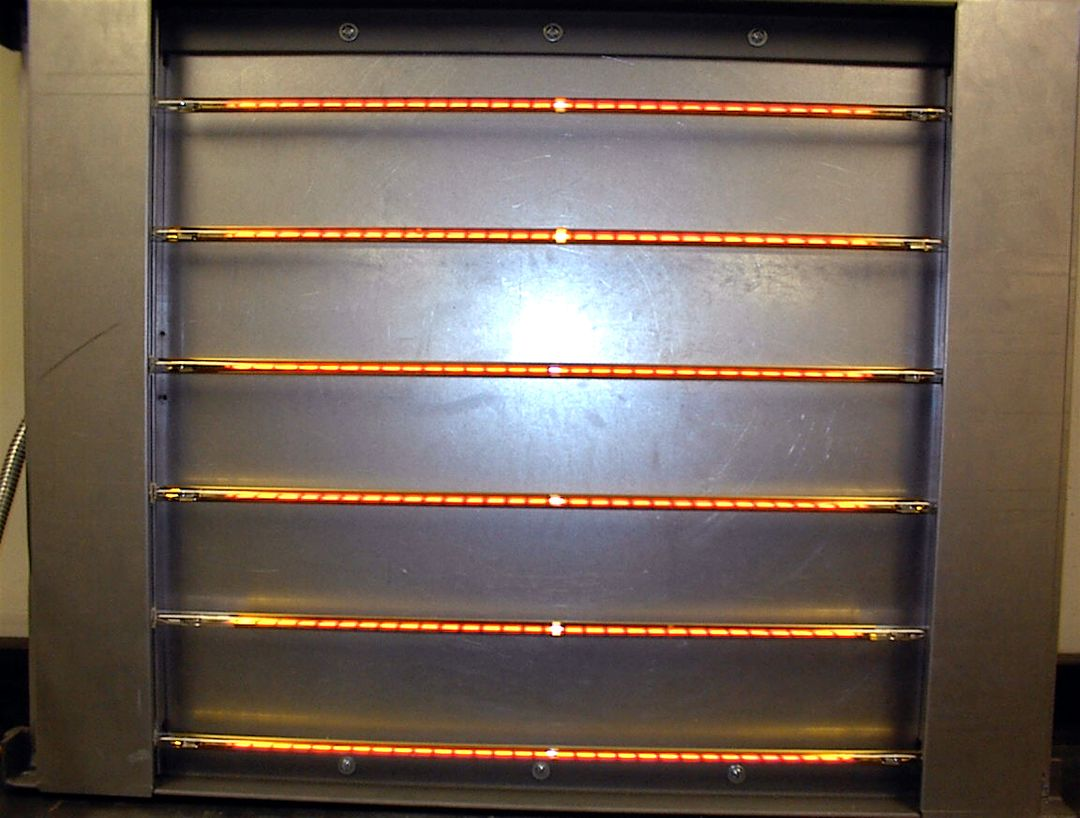
The first sourcing mistake is to assume that the visible red appearance of a lamp tells you enough about its industrial suitability. It does not. Infrared process-heating guidance states that the energy absorbed by the target depends on emitter temperature, the target material’s absorptivity or emissivity, and the geometric relationship between emitter and target. DOE makes the same point in a different way: the workpiece must have reasonable absorption to infrared, and that helps determine whether short-, medium-, or long-wave infrared is the better fit. In other words, visible red appearance does not replace application-based evaluation.
This is exactly where industrial buyers can be misled by language. “Red heat lamp” sounds like a familiar product name, but in factory purchasing it can hide critical differences. Two lamps may both show a visible red glow and still behave differently on a line because their heated length, reflector relationship, emitter temperature, or effective wavelength profile differ. That is why an appearance-based search term should never be allowed to define the specification on its own. This is an inference from process-heating guidance, but it is a sound one: industrial performance is governed by process fit, not by visible glow alone.
The confusion becomes more serious when buyers move straight from a search phrase to a quotation table. Voltage, wattage, and overall length are easy to compare, but they are rarely the first things that fail in service. Heated-zone location, terminal orientation, coating position, reflector-facing direction, and mounting-distance assumptions are often what expose the difference between a lamp that looks similar and a lamp that actually matches the installed heating logic. DOE’s line-of-sight discussion and Gen Less’s emphasis on angle of incidence both support this point.
For industrial projects, this is why the application boundary must be locked first. If the buyer means an industrial emitter used in process heating, the inquiry should say so clearly. If visible red light is functionally required for the process, that should also be stated explicitly. If it is only incidental to the emitter design, that should be made clear as well. Otherwise, the term “red heat lamp” risks mixing industrial process-heating requirements with irrelevant consumer associations.
Buyers usually see the lamp only after production is complete. By then, most of the important decisions have already been made inside the factory. Quartz tube consistency, filament configuration, coating or reflector treatment, end connection stability, dimensional tolerance, electrical testing, aging logic where applicable, packaging protection, batch traceability, and repeat-order documentation all influence the delivered result. That is why industrial buyers should evaluate the manufacturer, not just the lamp drawing.
Quartz properties are a useful example. QSIL’s published fused-quartz data lists a coefficient of thermal expansion of about 5.5 × 10⁻⁷ K⁻¹ between 20°C and 300°C, with maximum usable temperatures around 1100°C for long-term use and 1300°C for short-term use. Those properties help explain why quartz is widely used in demanding thermal applications. They do not, however, eliminate the need for careful processing, sealing, handling, and protection during manufacture. Material capability and factory capability are not the same thing.
From a factory-side standpoint, small variations quickly become field problems. A slight drift in heated length can change zone coverage. A small change in terminal angle can slow OEM assembly. A coating-position difference can move useful energy away from the target area. A weak packaging method can turn a good production batch into a breakage problem during export transit. These are not theoretical issues. They are exactly the kinds of problems that show up when a replacement order reaches the machine floor.
A serious industrial red heat lamp manufacturer should therefore be able to explain what is checked before shipment and what is locked for future orders. At minimum, buyers should expect controlled dimensional verification, electrical confirmation, connection checks, and a clear method for linking later orders to an approved drawing, sample, or internal reference. A first acceptable sample is useful. Repeatability is what makes it commercially reliable.
One of the biggest industrial sourcing mistakes is to let visible red appearance stand in for technical selection. In process heating, what matters is the heating effect on the material, not whether the lamp “looks red enough.” Gen Less states that absorbed energy depends on emitter temperature, target-material absorptivity, and geometry, and that the emitter should be placed as close as practical to the target and near a 90-degree angle of incidence for high efficiency. DOE similarly ties emitter choice to the material’s absorption characteristics and the relevant short-, medium-, or long-wave range.
This is where expertise matters. A lamp that produces visible red light may still be the wrong industrial choice if the process needs a different thermal response, a different wavelength fit, or a different reflector strategy. Gen Less notes that short- and medium-wave infrared can be applied and removed almost instantly by switching the emitter on or off, which matters in variable-duty industrial heating. It also notes that external reflectors are commonly used to increase efficiency and concentrate energy on specific areas of the target. These are process decisions, not visual ones.
The same point applies to “red infrared heat lamp manufacturer” language in procurement. Buyers may use that phrase because the installed lamp has a visible red appearance, but the technically useful inquiry must go further. The manufacturer needs to know the material type, line speed, target surface temperature or process effect, installation distance, mounting space, power conditions, duty cycle, and whether visible red light is actually required or merely incidental to the existing lamp design. Without those details, the quotation may be fast, but the recommendation is still incomplete.
In many OEM production cases, buyers discover that the correct industrial lamp was never defined by color in the first place. It was defined by the process window. Once that is understood, the visible red characteristic becomes either a secondary requirement or a by-product of the selected emitter design rather than the main selection criterion. That is the point where industrial sourcing starts becoming more accurate.
Not every project needs a custom lamp. In many replacement programs, a standard or previously locked design is the right commercial answer. If the machine layout is unchanged, the installed lamp has already been proven, and the buyer can provide a reliable drawing or a real sample, then the main job is controlled reproduction. In that case, the manufacturer’s value lies in preserving the known design and making future reorders easier to manage.
The situation changes when the machine geometry is tight, the original design was only a compromise, or the project involves OEM development, retrofit work, or a non-standard heater assembly. Gen Less explicitly notes that infrared process-heating systems can range from off-the-shelf units to customized oven units made to fit specific situations, and that designs can be as simple as bench heating or as complex as major continuous-process systems. That is a useful framework for industrial buyers deciding whether standard stock is enough.
In industrial work, customization is usually driven by structural or process constraints rather than by color alone. The real variables are custom length, voltage, wattage, tube diameter, ceramic end caps, cable or connector type, reflector direction, heating-zone distribution, and, where genuinely relevant, glass or coating characteristics related to process needs. A capable quartz red heat lamp manufacturer should be able to separate what can be customized directly from what still requires process validation or pilot testing. Gen Less recommends establishing variable parameters such as power density, wavelength absorption characteristics, residence time, emitter distance, and heating profile through pilot-scale tests before finalizing design.
That distinction matters because a standard lamp is not always the lower-cost option. A stock lamp can become expensive if it forces bracket changes, awkward wiring, reflector compromise, or unstable process output. A controlled custom quartz heat lamp can be the safer choice when it reduces installation risk and protects later replacement compatibility. In industrial procurement, the lower unit price is not always the lower total cost.
New projects usually begin with technical discussion. Replacement orders often do not. The buyer assumes the lamp is already understood, so the inquiry becomes shorter and more price-driven. That is exactly why replacement work reveals the real level of a manufacturer faster than new development work.
A replacement lamp must do more than fit inside the holder. It has to preserve mounting compatibility, heated-zone coverage, electrical behavior, and the service logic of the machine. Hidden dimensional differences often show up only after the first replacement cycle, not during the original sample stage. This is a recurring pattern in industrial sourcing, and it matches the general process-heating principle that small changes in emitter geometry or placement can alter heating results.
In one replacement project, the buyer requested a lamp that matched the earlier wattage and overall size and had the same visible red operating appearance. The replacement could be installed, but the heater zone did not behave like the earlier version during normal production. From a factory-side standpoint, the problem was not the visible glow. The problem was that the effective heating configuration was not fully matched. The case illustrates a common industrial lesson: a lamp can look right and still be wrong for the process. This is an inference from the cited process-heating principles, but it is a grounded one.
For OEM buyers and technical distributors, this is why batch consistency matters more than first-sample appearance. Repeatability, dimensional consistency, electrical consistency, replacement stability, drawing control, and repeat-order reliability are what determine whether the manufacturer can actually support the installed base. The first sample proves that manufacturing is possible. The second and third orders prove whether the factory is under control.
If the goal is a quotation that can actually support production, the buyer should provide enough information for both lamp matching and application review. A short approval framework is usually more useful than another round of price-only comparison.
Send the current lamp drawing, or a physical sample, whenever possible.
State the industrial application clearly: drying, curing, forming, shrinking, preheating, or another process.
Confirm the material type and the target heating result.
Provide voltage, target wattage if known, and duty-cycle expectations.
Confirm mounting space, installation distance, and reflector direction where relevant.
Clarify whether this is an OEM project, a replacement order, or a retrofit.
State whether visible red light is functionally required or only incidental to the existing lamp design.
Ask what the manufacturer will test before shipment.
Ask which dimensions and connection details are treated as critical.
Ask how future orders will be tied to the same drawing or sample reference.
A checklist like this does not slow the project down. It makes manufacturer comparison more meaningful because it exposes whether the factory is thinking in terms of process fit and repeatability or only in terms of quoting speed. In industrial sourcing, the right red heat lamp manufacturer is usually not the one that answers the fastest generic inquiry. It is the one that can review the application, confirm the structure, validate the sample, and keep later production aligned with the approved reference.
Usually yes, but matching is more reliable when the manufacturer receives a physical sample or a detailed drawing rather than only a photo or a wattage note.
Send the lamp drawing or sample, the industrial application, material type, target heating result, voltage, installation distance, mounting limits, and whether visible red light is functionally required or merely incidental.
You usually need customization when the project involves non-standard length, voltage, wattage, tube diameter, connector structure, reflector direction, heating-zone distribution, or other installation constraints that a stock lamp cannot match cleanly.
Key factors include dimensional tolerance, filament configuration, connection stability, coating position, electrical testing, packaging protection, batch traceability, and how the manufacturer controls drawings and reorder references.
Yes. In many industrial projects, samples and drawings are the clearest way to confirm replacement fit and reduce ambiguity in future orders.
Usually no. Process conditions, absorber behavior, emitter geometry, and installation arrangement are the primary selection factors. Visible red appearance may matter in some projects, but it should not replace application-based evaluation.
[Application Review]
If your project involves industrial drying, curing, shrinking, forming, preheating, or another process-heating step, YFR Heating can review the operating conditions before final lamp confirmation.
[Parameter Confirmation]
If the current inquiry is based only on wattage, size, and visible red appearance, it is worth confirming the material, installation distance, control logic, duty cycle, and whether visible red light is actually a process requirement.
[Drawing or Sample Evaluation]
For replacement and retrofit work, we can evaluate an existing drawing or physical sample to check connection structure, heated length, replacement compatibility, and practical fit inside the installed machine.
[Custom Design Discussion]
For OEM projects and non-standard heater assemblies, we can discuss custom quartz heat lamp options, sample validation, and repeat-order control so later batches stay aligned with the approved reference.


