Views: 0 Author: Site Editor Publish Time: 2025-10-27 Origin: Site


In today’s advanced manufacturing landscape, drying high-polymer materials is a critical process step that determines final product quality, efficiency, and cost performance. Whether processing thermoplastic resins, polymer films, coatings, or composite laminates, precise control over moisture removal and heating uniformity ensures consistent outcomes and long equipment life.
This technical guide explains how infrared (IR) drying—particularly when using quartz/tungsten infrared lamps—provides a high-efficiency, controllable, and compact solution for drying high-polymer materials. We’ll explore working principles, lamp selection criteria, wavelength optimization, and application examples that demonstrate engineering expertise and reliability.
High-polymer materials such as PET, PA, PBT, and other engineering plastics often require controlled drying before forming or coating processes. Proper drying:
Removes absorbed moisture or residual solvents to prevent hydrolysis, bubbles, and voids.
Improves molecular integrity and prevents chain scission or surface defects.
Ensures uniform heating to avoid uneven shrinkage, internal stresses, or warping.
Enhances process efficiency, allowing shorter cycle times and consistent results.
Improves downstream adhesion and finishing for coated or laminated polymer products.
Traditional hot-air ovens can struggle with slow heat transfer, large footprints, and energy loss. In contrast, infrared drying directly heats the material through radiation absorption, providing rapid and efficient moisture removal with excellent controllability.

Infrared (IR) drying uses radiant energy emitted by IR lamps. This energy is absorbed by the polymer and the water or solvent molecules within it, raising their temperature and accelerating evaporation.
Key advantages include:
Direct and uniform energy transfer — IR waves penetrate the material’s surface and heat internally, not just the outer layer.
Fast response — Quartz IR lamps can reach full output in seconds and switch off instantly, reducing standby energy loss.
Wavelength tuning — Medium-wave IR (2.4–3.5 µm) matches the absorption bands of water, maximizing drying efficiency.
Compact system design — IR modules require less space than convection ovens.
Clean operation — No contact heating or hot-air contamination.
Infrared drying therefore offers high throughput, reduced footprint, and precise control, ideal for high-polymer materials that demand thermal uniformity.
When selecting IR lamps for drying polymer materials, engineers must consider multiple factors:
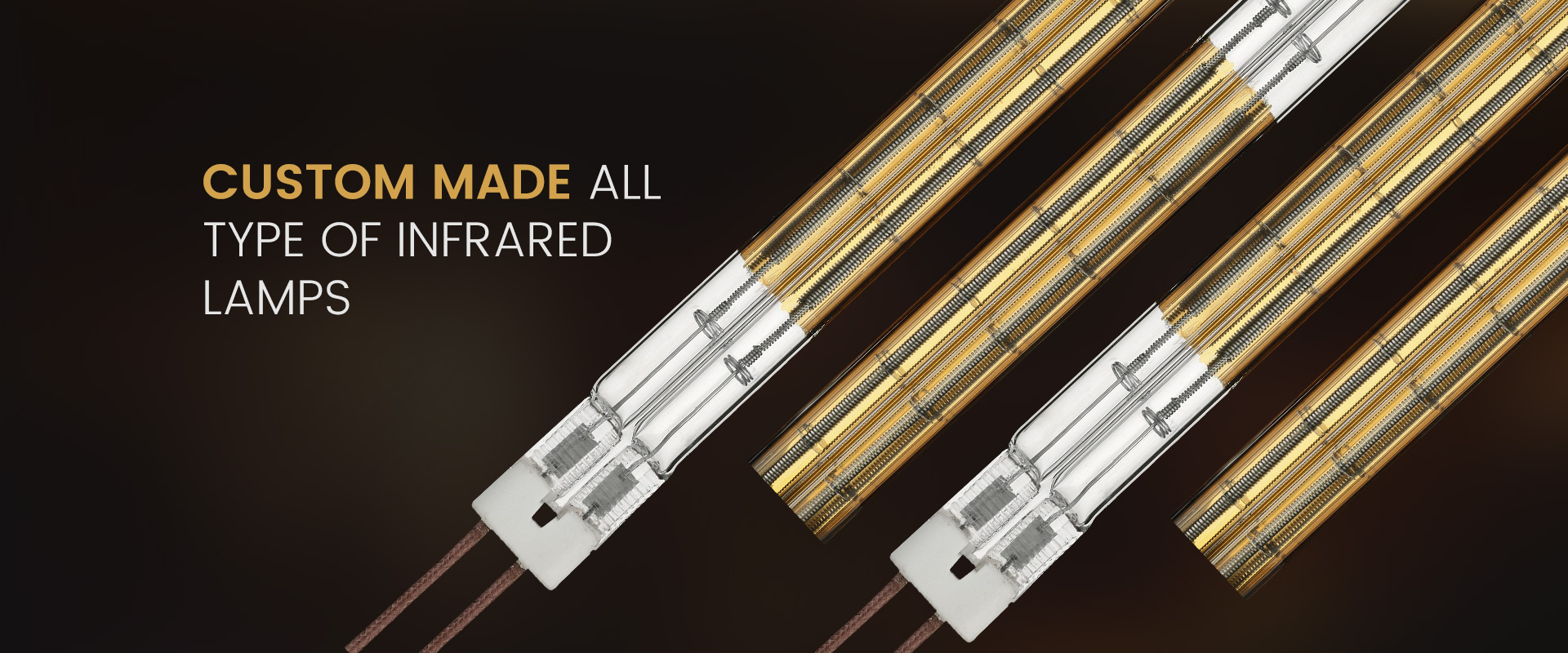
Quartz glass tubes: Made of high-purity fused silica, capable of transmitting over 90% of infrared radiation while withstanding high operating temperatures and thermal shock.
Tungsten filaments: Provide high radiant intensity and fast response times. They operate efficiently in short- and medium-wave IR regions, ideal for polymer drying applications.
| Wave-Band Type | Typical Wavelength Range (µm) | Penetration & Heating Characteristics | Best-Fit Applications for High-Polymer Materials | Notes / Advantages |
|---|---|---|---|---|
| Short-Wave IR | 0.7 – 1.4 µm | Deep penetration, rapid internal heating | Thick polymer parts, granules, or dense molded components | Very fast heating; requires careful control to prevent surface overheating |
| Medium-Wave IR | 2.4 – 3.5 µm | Moderate penetration, strong absorption by moisture and most polymers | Film, sheet, coating drying, water-based systems | Excellent match to moisture absorption band; efficient for drying |
| Fast-Medium or Hybrid Wave | 1.5 – 2.2 µm | Balanced between short and medium wave, quick response | High-speed production lines, continuous web drying | Combines faster response with moisture-optimized absorption |
| Long-Wave IR | 3.5 – 10 µm | Surface heating only, low penetration | Thin coatings, adhesives, temperature-sensitive polymers | Gentle heating, prevents overheating delicate surfaces |
This table helps engineers align emission wavelength with polymer and moisture absorption properties, optimizing drying rate and minimizing defects.

Single-Tube Lamps: Suitable for smaller areas or targeted heating zones.
Twin-Tube Lamps: Offer higher power density and better mechanical stability; ideal for wide conveyor systems or continuous drying of films and sheets.
Gold Reflector: Reflects up to 95% of IR radiation toward the material for maximum efficiency.
White Ceramic or Quartz Reflector: Provides softer, diffused heating when uniform surface coverage is more important than intensity.
Power levels typically range from 50 W to 10 kW per lamp, depending on system size and material throughput.
Tube diameters (10 – 18 mm) and twin-tube profiles (11×23 mm or 15×33 mm) are selected to match installation geometry.
Fast on/off control and adjustable power modulation.
Integration with conveyor speed, zone heating, and temperature feedback systems.
Infrared sensors and moisture analyzers for real-time monitoring.
When designing an IR drying system, engineers should evaluate several critical parameters:
Identify polymer type and its hygroscopic behavior.
Define required residual moisture level and processing temperature.
Assess form factor: granules, film, or coating layer thickness.
Consider downstream limitations (e.g., deformation risk, optical clarity).
Calculate total energy needed for heating and evaporation.
Select IR wavelength that aligns with the absorption peak of moisture and the polymer.
Use medium-wave IR for water-based drying and short-wave IR for deep internal heating.
Match lamp spacing and reflector geometry to material width.
Ensure uniform irradiation without hot-spots or dark zones.
Choose twin-tube lamps for large-area uniform heating and single-tube for localized zones.
Implement zoning for different drying stages: pre-heat, main dry, finish dry.
Use IR sensors or thermocouples to monitor surface temperature.
Provide shielding and ventilation to handle high radiant temperatures.
Establish maintenance intervals for lamp replacement and calibration.
IR systems typically reduce energy use by 30–50% compared to convection ovens.
Power output can be modulated according to material load, reducing waste.
System design allows shorter dwell time and higher line speed, improving throughput.

A manufacturer processes polymer films coated with water-based adhesives. Traditional convection ovens caused uneven drying and energy waste.
Infrared Solution:
Medium-wave quartz IR lamps with gold reflectors.
Multi-zone heating for pre-drying and finishing.
Uniform web temperature, reduced drying time by 40%.
No film distortion, improved lamination quality.
Recycled PET granules absorb moisture during washing and require drying before extrusion.
Infrared Solution:
Short-wave quartz/tungsten IR lamps for deep heat penetration.
Drum-type dryer with rotating granule bed ensures uniform exposure.
Rapid heating above glass transition temperature for effective moisture removal.
Energy consumption reduced to approximately 70–120 W/kg compared to traditional methods.
Injection-molded parts with solvent-based coatings need precise drying to avoid surface blisters or uneven gloss.
Infrared Solution:
Fast-medium-wave lamps arranged in customized reflectors.
Localized heating zones matching component geometry.
Infrared temperature sensors for real-time feedback.
Drying cycle time reduced by 50% without affecting dimensional stability.
| Best Practice | Purpose / Benefit |
|---|---|
| Conduct wavelength absorption testing | Ensures energy efficiency and optimal heat transfer |
| Maintain even lamp spacing | Prevents over- or under-heating across material width |
| Use zoned power control | Matches drying profile to process requirements |
| Regular lamp maintenance | Keeps radiant intensity consistent over time |
| Thermal mapping and testing | Detects potential hot-spots or cold areas early |
| Proper ventilation and exhaust | Removes evaporated moisture and prevents condensation |
| Agitation or circulation (for granules) | Promotes uniform drying and prevents thermal degradation |
Selecting an incorrect wavelength that overheats or under-dries materials.
Ignoring the geometry or varying thickness of the material.
Over-powering lamps to compensate for design inefficiencies.
Lack of exhaust control, causing vapor condensation on surfaces.
Neglecting routine calibration and lamp aging effects.
High efficiency: Direct radiant transfer minimizes energy loss.
Fast response: Instant heating improves cycle time and control.
Precise wavelength tuning: Enables selective moisture or solvent evaporation.
Compact systems: Reduce floor space and maintenance.
Versatility: Suitable for films, granules, coatings, and complex parts.
With the right wavelength, reflector design, and control system, infrared drying with quartz/tungsten lamps can achieve rapid, uniform, and energy-efficient results for virtually all types of high-polymer materials.

As industries demand higher productivity and lower energy consumption, infrared drying stands out as the most efficient and controllable solution for high-polymer materials. Through proper wavelength selection, optimized lamp configuration, and intelligent control integration, manufacturers can achieve significant performance improvements over conventional methods.
For process engineers and production managers seeking to improve throughput and quality, upgrading to a quartz/tungsten infrared drying system offers a reliable path toward sustainable, high-performance polymer processing.