Author: Process Heating Engineer Publish Time: 2026-04-09 Origin: Site
Last updated: August 28, 2026
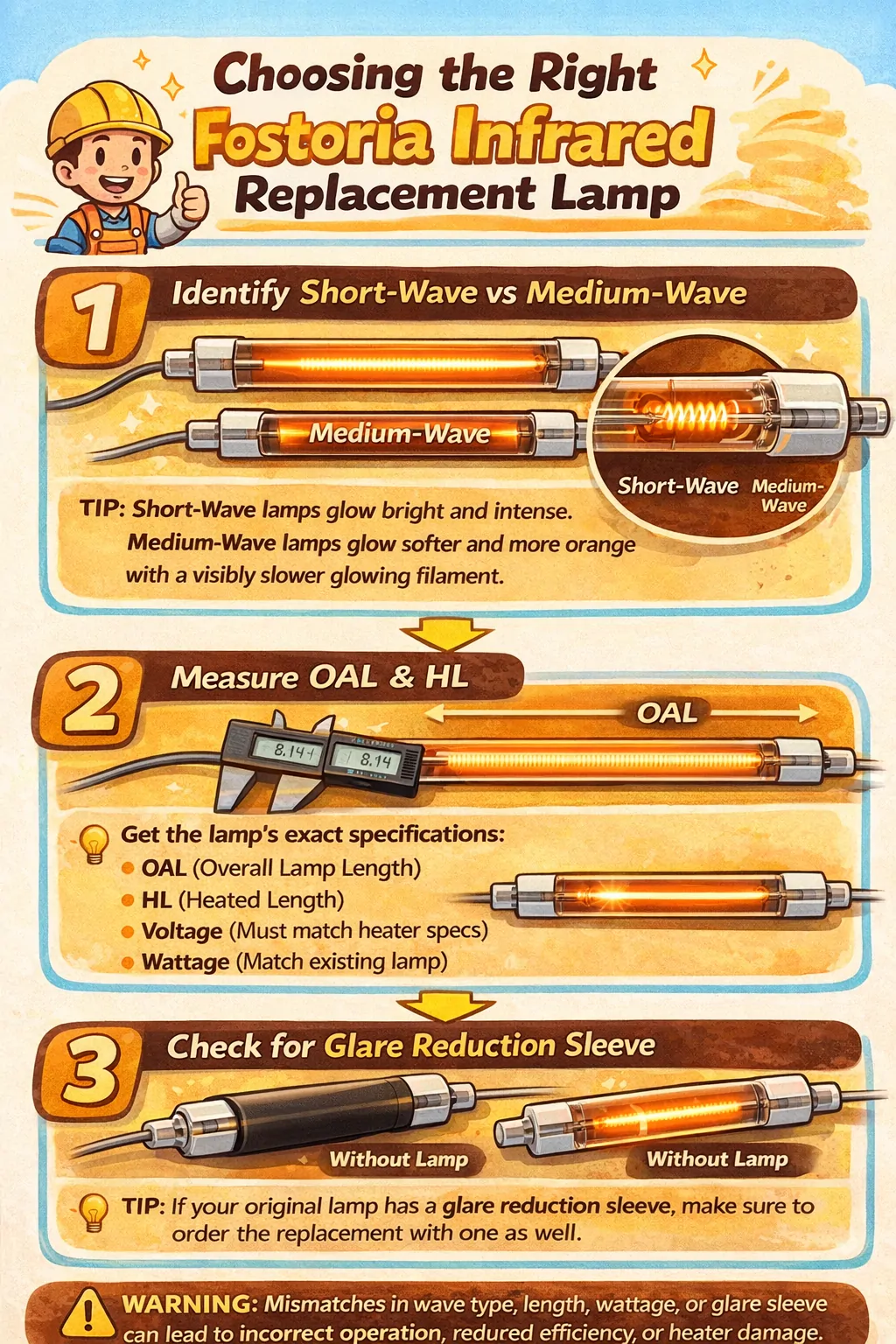
A Fostoria infrared heater replacement lamp should be matched from verified specifications, not from appearance alone. Two lamps can look similar and still differ in wavelength, voltage, heated length, connection or operating orientation. This guide explains the measurements and electrical data needed for a dependable replacement review.
────────────────────────────
Begin with the heater model, lamp marking and electrical nameplate. Photograph both ends of the lamp, its cable or connector and the way it is mounted. If the marking is unreadable, measurements and clear images become even more important.
────────────────────────────
Specification | Why it matters | How to check |
|---|---|---|
Voltage | Determines electrical compatibility and operating current | Read the lamp marking, heater nameplate or approved documentation |
Wattage | Affects heat output and electrical load | Use the marked rating; do not infer it from length |
OAL (overall length) | Determines whether the lamp fits the mounting | Measure between the defined physical end points shown in the drawing |
HL (heated length) | Determines the active heating pattern | Measure the visibly heated or specified filament section |
Wave type | Affects response and material absorption | Confirm short-wave, fast medium-wave or medium-wave construction |
End connection | Must match the holder, cable and installation space | Photograph and measure both ends, including leads and ceramics |
Operating orientation | Some lamp constructions have orientation limits | Record horizontal, vertical or angled installation |
────────────────────────────
Overall length describes the mechanical size of the lamp. Heated length describes the active section that produces useful radiation. A lamp may fit the heater but create cold edges or heat the wrong area if the heated length is different.
When measuring, use a clear sketch or photograph to show the reference points. “Total glass length,” “ceramic-to-ceramic length” and “tip-to-tip length” can produce different values, so the measuring convention must be explicit.
────────────────────────────
Short-wave lamps generally provide rapid response and high intensity. They are commonly selected when the heater must reach working output quickly or when the process needs responsive control.
Medium-wave designs provide a different spectral output and response characteristic. They may be used for applications that benefit from broader absorption or gentler heating. A medium-wave replacement should not be substituted with a short-wave lamp merely because the dimensions match.
────────────────────────────
Some heater assemblies use separate reflectors, protective parts or ruby glare-reduction sleeves. These accessories can affect clearances and delivered radiation. Inspect them for cracks, contamination, deformation and compatibility with the replacement lamp.
────────────────────────────
Ordering from a photograph without voltage and wattage
Using total length when the drawing requires ceramic-to-ceramic length
Matching overall length but ignoring heated length
Assuming the wave type from tube diameter or color
Changing wattage without checking the control circuit and reflector
Reusing damaged holders, cables or sleeves
────────────────────────────
Heater brand and model
All readable lamp markings
Voltage and wattage
Overall length with measurement reference points
Heated length
Tube style and diameter
Photographs of both ends and the installed assembly
Cable length, connector and mounting orientation
Required quantity and operating environment
────────────────────────────
A like-for-like replacement is appropriate when the original specification and installation are known and the heater previously met the process requirement. If lamps fail repeatedly, output is uneven or the process has changed, the heater, cooling, reflector and control conditions should be reviewed before simply ordering the same rating.
────────────────────────────
No. Voltage, overall length, heated length, wave type and connection details must also match.
The heated length, filament design, wavelength or reflector relationship may differ even when the overall length fits the holder.
Inspect holders, cables and contacts whenever a lamp is replaced. Heat damage, loose connections or contamination should be corrected by qualified personnel.
────────────────────────────
View YFR Fostoria replacement lamp options or send the checklist information above. Compatibility should always be confirmed against the actual heater and lamp data before installation.


