Author: Process Heating Engineer Publish Time: 2025-08-16 Origin: Site
Last updated: August 30, 2026
Infrared heating is mainly used when a glass-production process requires fast, targeted, or independently controlled thermal zones.
Typical applications include laminated glass cutting, PVB separation, interlayer preheating, glass coating drying, decorative ink curing, glass bending, forming, edge heating, oven preheating, and stress-relief processes.
No single infrared emitter is suitable for all of these applications. A narrow laminated-glass cutting zone may require a directional fast medium wave emitter, while a wide coating line may require several medium wave emitters arranged inside a controlled module.
The correct emitter should be selected according to the material that needs to absorb the infrared energy.
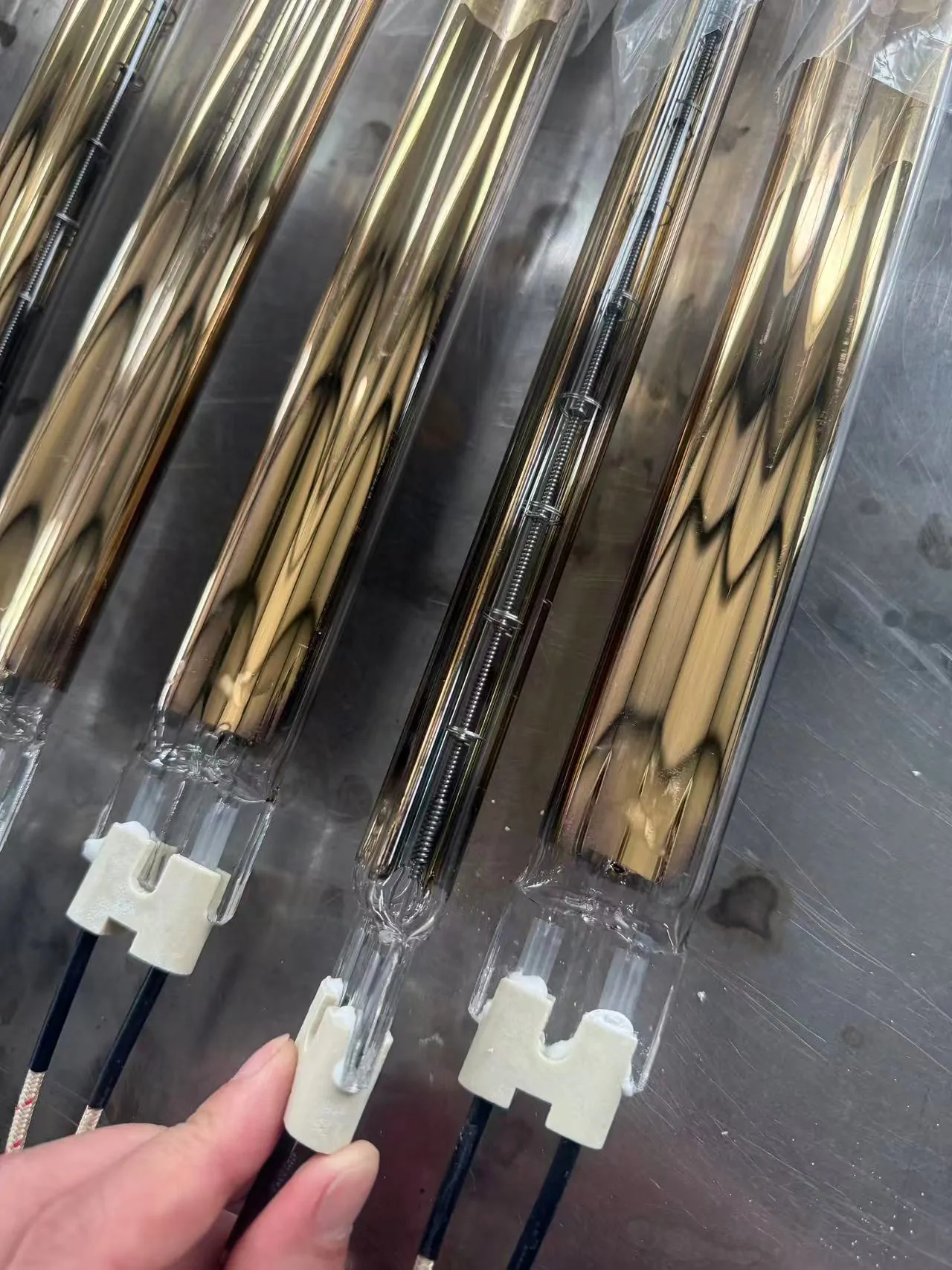
Infrared emitters transfer radiant energy toward the glass surface or toward materials associated with the glass, such as PVB, EVA, inks, coatings, adhesives, and sealants.
Clear glass does not absorb every infrared wavelength equally. In some processes, the main target is therefore not the glass body itself but an interlayer, printed coating, adhesive, or surface treatment.
This is why infrared selection should begin with three questions:
What material needs to be heated? How wide is the required heating zone? How quickly must the process respond?
The final heating result also depends on lamp distance, reflector direction, glass thickness, line speed, airflow, and power control. Wattage alone does not determine whether the process will work correctly.
Laminated glass commonly contains a PVB or similar polymer interlayer between two glass sheets. After the glass layers are scored or separated, the interlayer may still connect the two sections.
A narrow infrared heating zone can soften the exposed interlayer so it can be separated more efficiently. The heating area must be concentrated around the cutting line rather than distributed across the entire glass sheet.
For this application, a fast medium wave twin-tube IR emitter for glass cutting can provide controlled linear heating. A directional reflector helps focus radiant energy toward the PVB strip and reduces unnecessary heating of the surrounding glass.
Important design factors include the cutting-line width, emitter length, reflector angle, working distance, conveyor speed, and required interlayer temperature.
Excessive heating may affect the glass edge or surrounding laminate, while insufficient heating may leave the PVB difficult to separate. The system therefore needs stable and repeatable control.
In glass lamination, the interlayer must be heated under controlled conditions to support adhesion and reduce defects such as bubbles, incomplete bonding, or uneven optical appearance.
The objective is not simply to produce the highest possible temperature. The heating profile should be uniform across the working area and compatible with the interlayer material, glass thickness, pressure, and process cycle.
Fast medium wave IR emitters may be suitable where faster response is required, while medium wave infrared lamps can be considered for broader and more stable heating zones.
For wide laminated-glass sections, several emitters may need to be arranged inside a module. Lamp spacing and zone control are important because uneven heating can produce different interlayer temperatures across the glass width.
Glass products may contain ceramic inks, decorative printing, conductive coatings, mirror coatings, protective layers, adhesives, or sealants. Infrared heating can support drying or curing before the next production step.
The ideal emitter depends on the coating formulation and substrate tolerance. A fast-response emitter may be useful when the process needs short heating cycles, while medium wave heating may provide more stable surface drying across a larger area.
In coating and printing lines, the main engineering challenges are working-width uniformity and temperature repeatability. One section of the glass should not receive significantly more energy than another.
Directional gold reflector IR lamps can help direct radiant energy toward the coated surface. For wider production lines, integrated drying modules can provide better lamp spacing, reflector alignment, and maintenance access.
Glass bending and forming require a controlled temperature profile. The glass must reach the required forming condition without creating excessive temperature differences between adjacent areas.
Infrared heating can be used for local preheating, edge heating, zoned heating, or as part of a larger furnace or forming system. Separate lamps may be sufficient for a narrow area, but complex shapes usually require multiple independently controlled zones.
The system design should consider:
Glass type and thickness
Required bending area
Target temperature profile
Heating-zone width
Lamp-to-glass distance
Heating and cooling rates
Support or mold structure
For custom bending equipment, infrared heating modules may be more practical than installing individual emitters without a unified reflector and mounting design.
A module can combine lamps, reflector housings, brackets, wiring, protective structures, and separate control zones.
Infrared emitters can also be used to preheat glass before bonding, coating, sealing, printing, or another thermal process.
Preheating can reduce sudden temperature changes and help the following production stage start from a more stable condition. However, the required temperature and heating rate depend on the glass composition and downstream process.
Short wave infrared may be considered when rapid response is needed. Medium wave or fast medium wave emitters may be more appropriate when the process requires wider and more controlled heating.
Preheating should not be treated as a universal fixed-temperature operation. The correct setting must be established according to the glass type, thickness, surface treatment, process cycle, and equipment design.
Annealing and stress relief require controlled heating and cooling rather than aggressive local heating. The aim is to manage the temperature profile so that internal thermal stress is not increased by uneven treatment.
Infrared heating can form part of an annealing or stress-relief system, but the lamps must be arranged and controlled as multiple heating zones. A single high-intensity emitter is generally not enough for a large glass surface.
The system should consider gradual temperature transitions, glass thickness, furnace airflow, sensor positions, heating-zone overlap, and cooling conditions.
Infrared heating does not automatically make glass stronger. The final result depends on the complete thermal cycle and the glass-processing method.
The following table provides a practical starting point.
| Glass Process | Recommended Direction | Main Requirement |
|---|---|---|
| Laminated glass cutting | Fast medium wave twin-tube emitter with reflector | Narrow and directional PVB heating |
| PVB or EVA lamination | Medium wave or fast medium wave | Uniform interlayer temperature |
| Coating and ink drying | Medium wave, FMW, or reflector lamp | Stable surface drying |
| Rapid local preheating | Short wave infrared | Fast response |
| Glass bending and forming | Multi-emitter array or heating module | Controlled temperature profile |
| Annealing and stress relief | Multi-zone module with controller | Gradual and uniform heating |
| Oven or conveyor processing | Integrated IR module | Consistent heating across working width |
This table is not a fixed specification. The emitter must still be verified using the actual glass, interlayer, coating, working distance, and process speed.
Reflector design is especially important in glass processing because many applications require narrow or directional heating.
In laminated-glass cutting, the energy should reach the PVB cutting line instead of heating a large section of the glass. In coating drying, the reflector should help distribute heat evenly across the coated working width.
A reflector affects:
Heating-zone width
Energy direction
Lamp-to-target efficiency
Temperature uniformity
Heat loss toward surrounding machine parts
Gold reflector lamps are useful in systems where the emitter must direct energy primarily toward one side. External reflector housings can also be designed around the glass width and installation space.
The reflector must remain clean and correctly positioned. Contamination or deformation can change the heating pattern.
Glass processing requires repeatable heating. A lamp that operates only at full power may not provide enough flexibility for different glass thicknesses, coatings, line speeds, or production recipes.
An IR lamp power controller can help regulate emitter output and support staged heating or independent heating zones.
Temperature sensors should be positioned according to the actual process target. Measuring only the surrounding air may not represent the temperature of the glass, coating, or interlayer.
A complete control strategy may include:
Separate lamp zones
Surface-temperature monitoring
Conveyor-speed coordination
Overtemperature protection
Recipe settings for different glass products
The controller, sensor, and emitter should be considered as one process system.
A separate emitter is often suitable for replacement, laboratory testing, or a narrow heating zone. A complete module is more appropriate when the process requires wide-area uniformity, multiple lamp rows, protection, easier installation, or independent control zones.
An infrared heating module may include the emitters, reflector housing, lamp supports, wiring, cooling or ventilation provisions, mounting frame, and controller interface.
Module-based designs are useful for:
Glass coating lines
Lamination equipment
Bending and forming machines
Conveyor preheating
Industrial ovens
Multi-zone thermal processes
For machine builders, a module can reduce the risk of inconsistent lamp spacing and poor reflector alignment.
Glass equipment often uses non-standard infrared emitters. When the original lamp fails, the replacement must match the machine’s electrical and mechanical structure.
YFR provides custom replacement IR tubes for equipment where standard lamp dimensions or end structures are not suitable.
For replacement identification, provide:
Clear photos of the full lamp
Photos of both end caps
Voltage and wattage
Total length
Heated length
Tube diameter
Reflector type
Lead-wire length and direction
Original machine model
Glass-processing application
For new equipment, provide the glass type, heating-zone width, working distance, target temperature, line speed, available installation space, and control requirement.
The correct specification begins with the process rather than the lamp.
| Required Information | Why It Matters |
| Glass type and thickness | Influences heating profile and allowable temperature gradient |
| Interlayer, ink, or coating | Determines which material must absorb the infrared energy |
| Heating-zone width | Defines lamp length and reflector design |
| Working distance | Affects intensity and uniformity |
| Line or cycle speed | Determines emitter response requirement |
| Target temperature | Defines power and control strategy |
| Available installation space | Determines lamp or module structure |
| Electrical supply | Defines voltage, wattage, and controller selection |
When possible, testing with the actual glass and process material is recommended before finalizing a new system.
For laminated-glass cutting and PVB separation, start with the FMW twin-tube IR emitter for glass cutting.
For fast-response heating, review fast medium wave IR emitters. For wider or more stable process heating, review medium wave infrared lamps.
For directional heating zones, review gold reflector IR lamps. For new machines and multi-zone systems, review infrared heating modules.
For existing equipment with non-standard lamps, review custom replacement IR tubes.
Fast medium wave emitters with a directional reflector can be used to heat the exposed PVB interlayer along a narrow cutting line. The exact lamp length, reflector structure, power, and distance depend on the glass-cutting machine.
Yes. Infrared heating can support interlayer preheating and lamination, but uniform temperature control is important. Medium wave or fast medium wave emitters may be considered depending on the interlayer, glass thickness, and process speed.
The correct wavelength depends mainly on the coating or ink rather than the glass alone. Medium wave and fast medium wave emitters are often considered for controlled coating drying, while short wave emitters may be used when faster response is required.
Clear glass does not absorb all infrared wavelengths equally. In many applications, the main absorbing target is an interlayer, coating, ink, adhesive, or surface treatment. Testing should be based on the actual glass and material combination.
Infrared emitters can be used for local heating or as part of a multi-zone bending system. Controlled temperature distribution is essential to reduce uneven heating and thermal stress.
A module is more suitable when the system requires a wide heating area, multiple lamp zones, integrated reflectors, protective housings, easier installation, or coordinated control.
Provide the glass process, target material, heating width, working distance, voltage, power, target temperature, line speed, available space, machine drawing, and original lamp information if it is a replacement project.
Infrared heating for glass processing should be selected according to the specific material and process target.
Fast medium wave emitters with directional reflectors are useful for laminated-glass cutting and PVB separation. Medium wave or fast medium wave emitters can support interlayer heating and coating drying. Multi-emitter modules are more appropriate for glass bending, forming, annealing, and wide production lines.
The best result comes from matching the emitter wavelength, reflector design, heating distance, power control, and module structure to the glass, interlayer, coating, and production cycle.
YFR can support laminated-glass cutting, coating drying, glass preheating, custom machine integration, and replacement emitter projects based on the customer’s equipment and process requirements.
Compare the laminated-glass separation case with YFR industrial infrared heating lamps. Validate the final zone on representative glass.
Send YFR your material, dimensions, target, cycle time and current equipment details for an application-specific review.


