Author: Site Editor Publish Time: 2025-09-04 Origin: Site
Last updated: August 28, 2026
When an infrared tube fails early or a heating zone loses output, replacing the lamp without finding the cause can lead to repeated downtime. This troubleshooting checklist separates emitter defects from equipment, installation and process conditions.
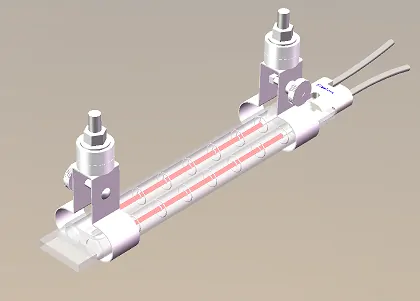
Disconnect and lock out the heating equipment according to the machine procedure. Allow the lamps, reflectors and terminals to cool before inspection. Qualified personnel should perform electrical testing. Never handle or measure an energised emitter.
Note the zone, operating hours, recipe, power setting, recent maintenance and whether the failure occurred during start-up, steady production or a line stop. Photograph the installed position, both ends, wiring and reflector. A repeated failure in the same position often points to the equipment rather than random lamp life.
| Observed condition | Possible causes to investigate |
|---|---|
| Open circuit with intact quartz | Normal element end of life, overvoltage, excessive switching or local hot spot |
| Cracked quartz | Impact, rigid mounting, contamination, thermal shock or vibration |
| Darkened end or damaged ceramic | Loose connection, high contact resistance, poor cooling or cable heating |
| Element sag or deformation | Incorrect orientation, over-power operation or mechanical shock |
| Uneven but electrically continuous output | Reflector contamination, ageing, zone-control fault or spacing problem |
| Several lamps fail together | Supply fault, controller problem, wiring event or cooling loss |
Compare the lamp rating with the actual supply and control configuration. Check terminals, crimp connections, connectors and cable temperature. A loose or oxidised contact can create local heat without changing the nominal lamp specification.
Review switching frequency, soft-start behaviour and power-controller settings. Fast-response emitters can impose different electrical demands from conventional resistance heaters.
The emitter should be supported in the approved orientation without rigidly loading the quartz. Check that clips, holders and reflector parts have not moved into contact with the active tube. Confirm that thermal expansion is not forcing the lamp against a fixed point.
Vibration from fans, conveyors or machine movement can also damage quartz or connections over time.
Lamp seals, ceramic ends, leads and nearby components may require controlled cooling. Blocked filters, failed fans or changed airflow can raise local temperature. At the same time, excessive cold airflow directed at hot quartz can create thermal stress.
Remove dust and process deposits using the approved maintenance method. Oils, coating overspray and fingerprints can create local absorption or reduce reflector performance.
A replacement should match voltage, wattage, overall length, heated length, diameter, ends, leads, connector, reflector and orientation. Two lamps with the same wattage can have different current, heat distribution or mechanical fit.
Use the infrared lamp range to compare constructions, and include a drawing or reference sample for customised replacements.
Inspect the installation before energising.
Start with a controlled recipe and observe current or zone status.
Measure the product temperature profile rather than judging brightness alone.
Check terminals, cooling and reflector temperature after a safe shutdown.
Record the lamp code, zone and installation date for traceability.
An infrared thermometer can support process checks when emissivity, distance and field of view are correctly considered.
No. Some change can occur with age or process contamination. Compare electrical continuity, output and the manufacturer’s acceptance criteria.
Inspect local voltage, contact resistance, cooling, vibration, mounting stress and reflector condition at that position.
No. Visible brightness varies by emitter type and does not prove the electrical rating or useful absorbed heat.
It depends on age, process uniformity and maintenance policy. If one lamp is changed, verify the complete temperature profile.
Send YFR the failed lamp data, photographs and operating conditions for a replacement and root-cause review.


