Author: Site Editor Publish Time: 2025-09-22 Origin: Site
Last updated: August 28, 2026
Choosing an infrared tube is not simply a matter of matching wattage and length. The correct emitter must deliver radiation that the product can absorb, at a controllable rate, across the required working width. This guide focuses on the engineering decisions that matter when specifying infrared tubes for industrial heating and drying.
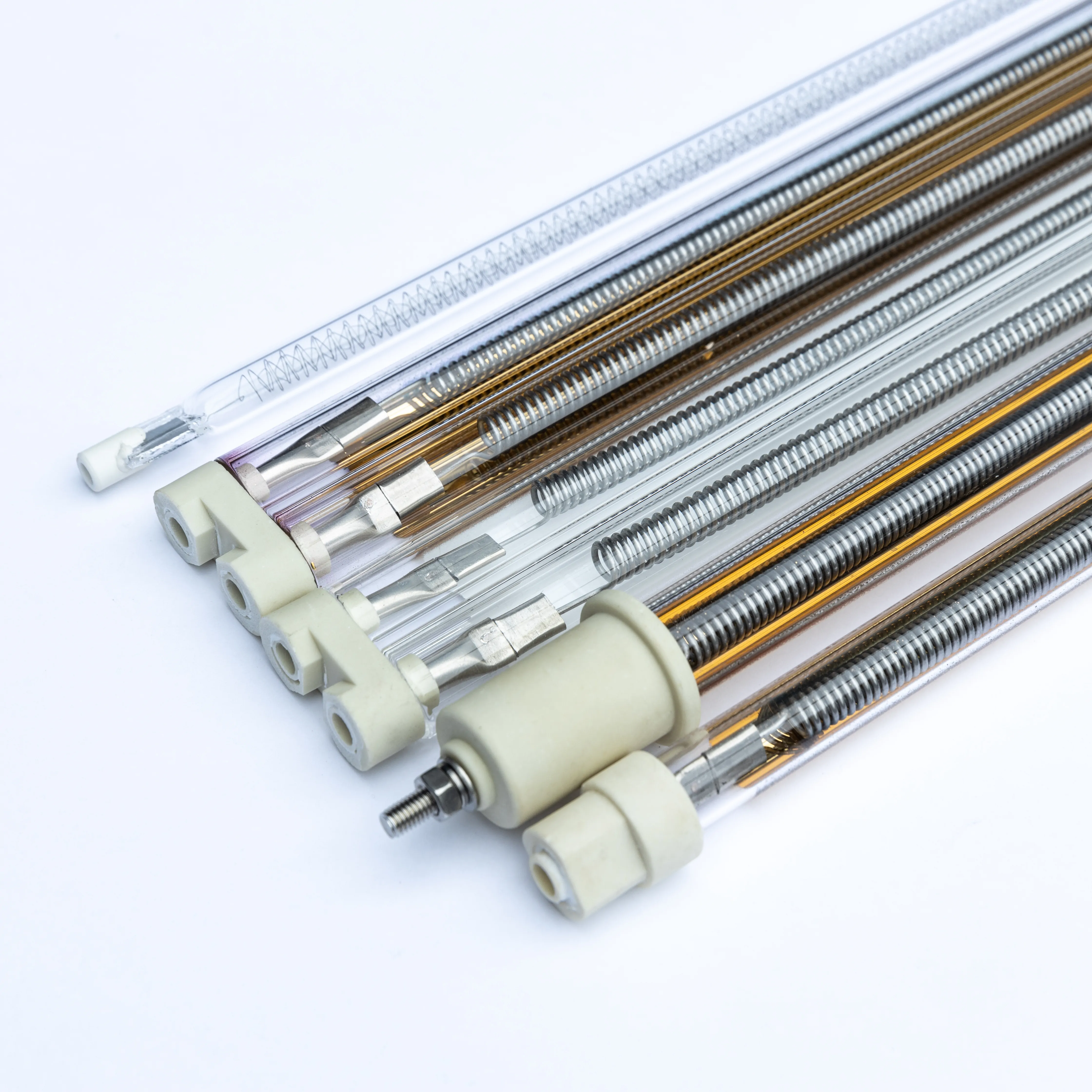
Before selecting an emitter, define the material, target temperature, available heating time and acceptable temperature variation. An infrared tube that performs well on a dark coating may behave very differently on clear film, polished metal or a thick composite.
Material and surface: color, reflectivity, thickness and moisture or solvent content influence absorption.
Process objective: preheating, drying, curing, softening, thermoforming and surface activation need different heating profiles.
Exposure time: conveyor speed and heater length determine how long the product remains in the active zone.
Geometry: flat sheets, tubes, profiles and three-dimensional parts require different emitter arrangements.
Temperature limit: the coating may need fast heating while the substrate must remain below its distortion temperature.
For plastics processing, review infrared emitter selection for plastics against the material and process requirements.
| Emitter type | Typical behavior | Often selected for |
|---|---|---|
| Short-wave infrared | Very fast response and high power density; easy to switch and zone | Rapid preheating, paint repair, plastics processing, metal and high-speed lines |
| Fast medium-wave infrared | Fast response with broader absorption for many industrial materials | Printing, coatings, film, textiles and mixed production |
| Medium-wave infrared | More gradual heating and strong interaction with many water-based layers | Drying inks, adhesives, coatings, paper, textiles and thicker films |
These are selection tendencies, not universal rules. A sample test with the actual material is the most reliable way to confirm wavelength, power density and exposure time.
Use the infrared lamp types and specification guide to compare tube constructions before specifying an emitter.
Single-tube quartz emitters are useful when the available space is narrow or the heating pattern must follow a specific shape. They are available with different filaments, end connections and reflector coatings.
Twin-tube construction provides additional mechanical rigidity and can support higher installed power across wider heating zones. It is frequently used in industrial modules and replacement systems.
Gold, white or other reflector coatings direct more radiation toward the workpiece and reduce energy sent toward the rear of the module. The best coating depends on operating temperature, wavelength and the surrounding environment.
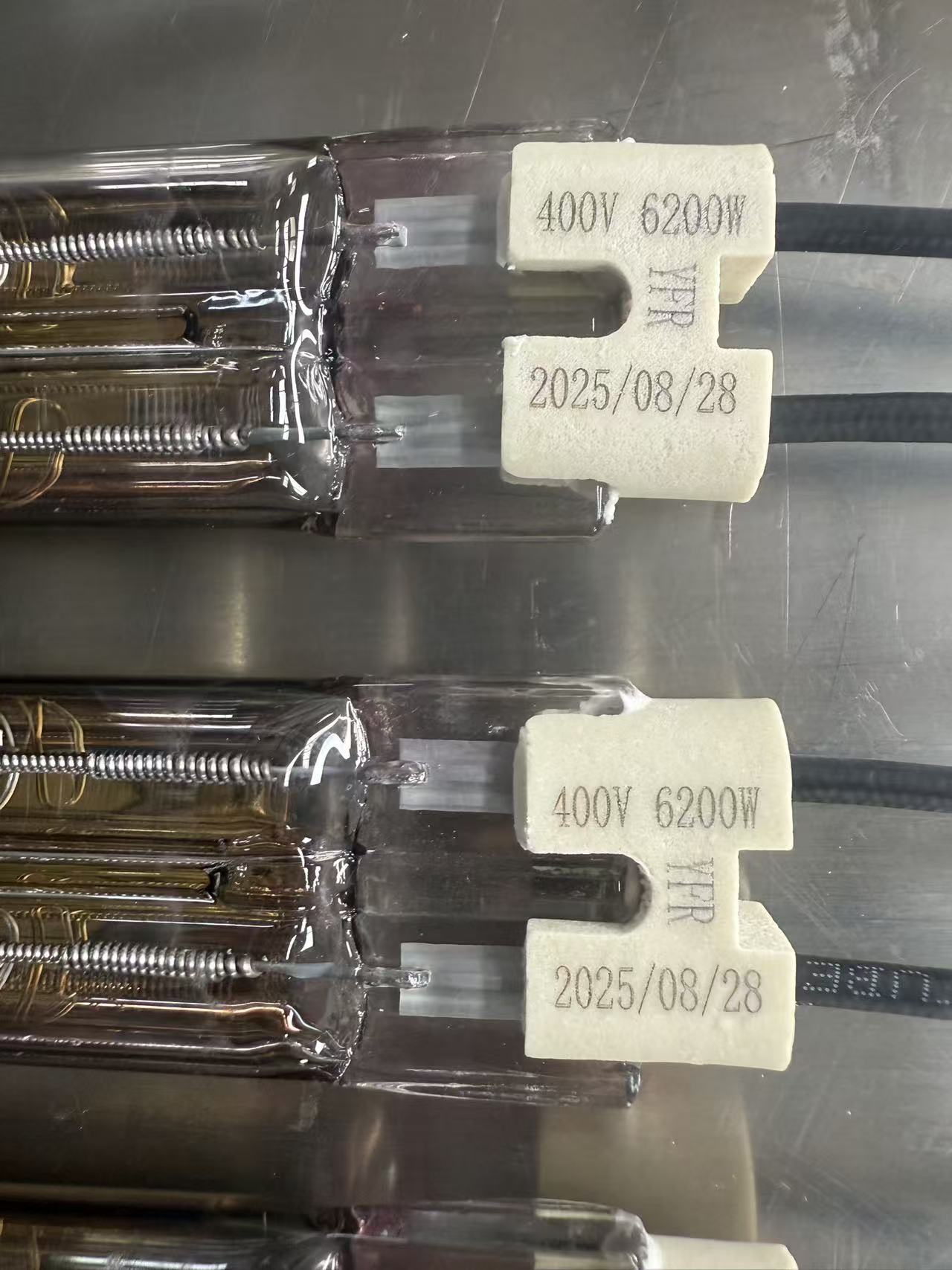
Voltage and electrical load. Confirm the real supply voltage at the installation and whether the control system switches complete lamps or individual zones.
Total length and heated length. Overall length determines mechanical fit; heated length determines the active pattern on the product.
Power density. Total wattage alone is not enough. The energy reaching each square centimetre of product affects heating speed and defect risk.
End connection and mounting. Cable length, ceramic ends, clips and operating orientation must match the equipment.
Control response. Fast emitters work well with closed-loop zoning, while slower processes may benefit from staged heating and longer dwell time.
For solid-material heating, the main task is normally to reach a target surface or bulk temperature without distortion. For drying, heat must also allow water or solvent to leave the layer. Excessive first-zone intensity can form a dry skin while moisture remains underneath, leading to blisters, pinholes or uneven cure.
A practical drying line often uses a gentler flash-off zone, a controlled ramp zone and a final equalisation or cure zone. Air movement can be combined with infrared to remove released moisture and stabilise the boundary layer.
Copying the wattage of an old lamp without checking heated length and voltage.
Selecting the shortest possible wavelength only because it heats faster.
Ignoring reflective or transparent materials that absorb little of the chosen spectrum.
Placing emitters too close and creating hot spots across complex parts.
Designing one large zone when the product needs separate edge, centre or entry control.
Comparing lamps without considering the reflector, airflow and distance used in the test.
For a useful recommendation, provide a material sample or description, product dimensions, target and maximum temperature, starting temperature, required cycle time or line speed, working distance, available voltage, heated width and any restrictions on glare or enclosure size. Photos or drawings of the existing mounting are especially helpful for replacement projects.
No. Materials absorb infrared energy differently. The emitter must be selected around the material and process rather than treated as a universal heat source.
Not necessarily. Absorption, distance, reflector design, heated length and temperature control determine how much useful energy reaches the product.
Use zoning when the product needs staged drying, edge compensation, different entry and exit temperatures or rapid adjustment between recipes.
Not always. Hybrid systems often use infrared for rapid, targeted energy transfer and airflow for moisture removal and temperature equalisation.
YFR supplies custom and replacement infrared tubes for industrial heating and drying. Review our custom replacement infrared tubes, or send your process data and existing lamp specifications for a selection review.


