


Author: Site Editor Publish Time: 2025-07-21 Origin: Site


Modern sheet-fed offset presses are expected to deliver fast turnaround, consistent quality, and controlled energy use. Infrared (IR) drying is central to that performance. When the IR system is not matched to the press and substrates, familiar problems appear: sheets that block or set-off in the pile, coatings that stay soft, heavy powder consumption, and unpredictable delivery times. When the lamp technology is chosen correctly, the same press can run faster, with cleaner piles and far fewer drying-related complaints.
This guide explains four practical IR heating lamp solutions commonly used on sheet-fed presses with water-based coatings and high ink coverage. The focus is on technical characteristics, typical use cases, and real-world trade-offs instead of brand names. The aim is to help print professionals and maintenance teams make confident, evidence-based choices when specifying, replacing, or upgrading IR lamps
The four solutions covered are:
Fast medium-wave infrared lamps
High-intensity short-wave infrared lamps
Twin-tube infrared lamps for robust industrial use
Quartz infrared replacement lamps tailored to specific press units
Fast medium-wave (FMW) lamps are widely used on sheet-fed presses because they offer a good balance between penetration depth and surface heating. Their emission typically falls in the 1.4–3.0 µm range, a band that is efficiently absorbed by many coatings, plastics, and paper substrates. This makes them suitable for general commercial work where substrate types and ink coverage vary from job to job.
From a technical perspective, a typical FMW lamp for printing applications is defined by:
Power ratings from a few hundred watts up to several kilowatts per lamp
“Fast” response times, with effective output reached in roughly 1–2 seconds
Filament temperatures in the 800–950 °C range, providing a true medium-wave spectrum
Reflectors made from gold, white oxide/ceramic, or clear quartz, depending on whether concentrated or broadly distributed heat is required
These characteristics allow the dryer to react quickly to press speed changes and standby modes, reducing unnecessary energy use during short runs and frequent job changes.
In daily production, fast medium-wave lamps are particularly useful when:
Running a mixture of coated and uncoated stocks
Printing on thinner substrates that should not be exposed to extreme surface temperatures
Targeting consistent drying with moderate energy consumption
Retrofitting older dryers that previously used long-wave or basic medium-wave emitters
For many plants, fast medium-wave lamps are the default choice for general commercial and light packaging work.
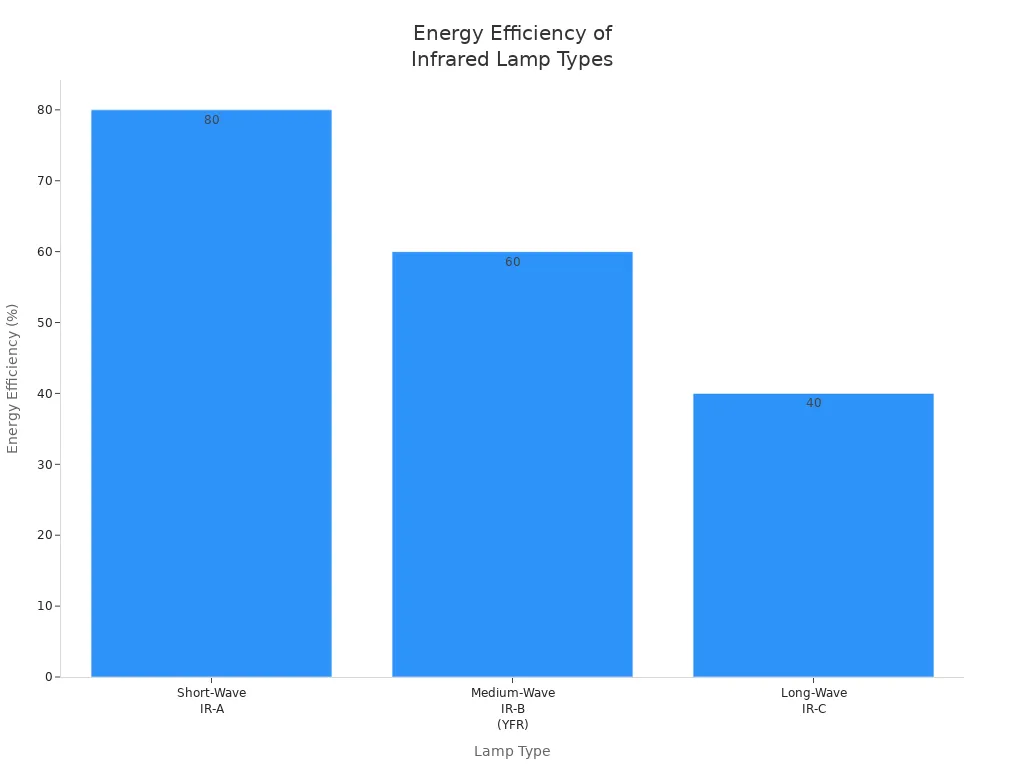
Short-wave infrared (SWIR) lamps are chosen when drying speed and high thermal efficiency are top priorities. Short-wave IR is commonly defined as radiation in the 0.9–1.7 µm range, with some definitions extending to about 2.5 µm. In this band, many inks and coatings absorb energy very efficiently, and the radiation can penetrate more deeply into certain layers.
A typical short-wave lamp used above a sheet-fed press delivery or coater is characterised by:
Concentrated emission in the short-wave infrared band
Very rapid start-up, with effective output often reached within 5–10 seconds
High thermal efficiency, especially when combined with vacuum-plated gold reflectors
Service life measured in several thousand hours under correct cooling and switching conditions
These lamps are most attractive in environments where presses routinely run at or near their mechanical speed limits and where heavy coatings, high coverage, or difficult substrates are common.
Key advantages include:
Very fast drying and curing – Short-wave systems make it possible to raise press speeds and handle demanding jobs that would otherwise require slowdowns.
High energy efficiency at full load – At high speeds and high power, more of the electrical input is converted into useful radiant energy at the sheet.
Compact dryer design – Because of the high power density, strong drying performance can be achieved in relatively short dryer sections.
On the other hand, short-wave systems:
Require careful setup to avoid overheating of sensitive substrates
Offer a narrower process window, demanding close attention to pile temperature and airflow
Usually involve higher initial investment than medium-wave solutions
For plants that consistently run heavy, high-value work, high-intensity short-wave lamps can be a highly effective upgrade, provided the integration is engineered and supervised carefully.
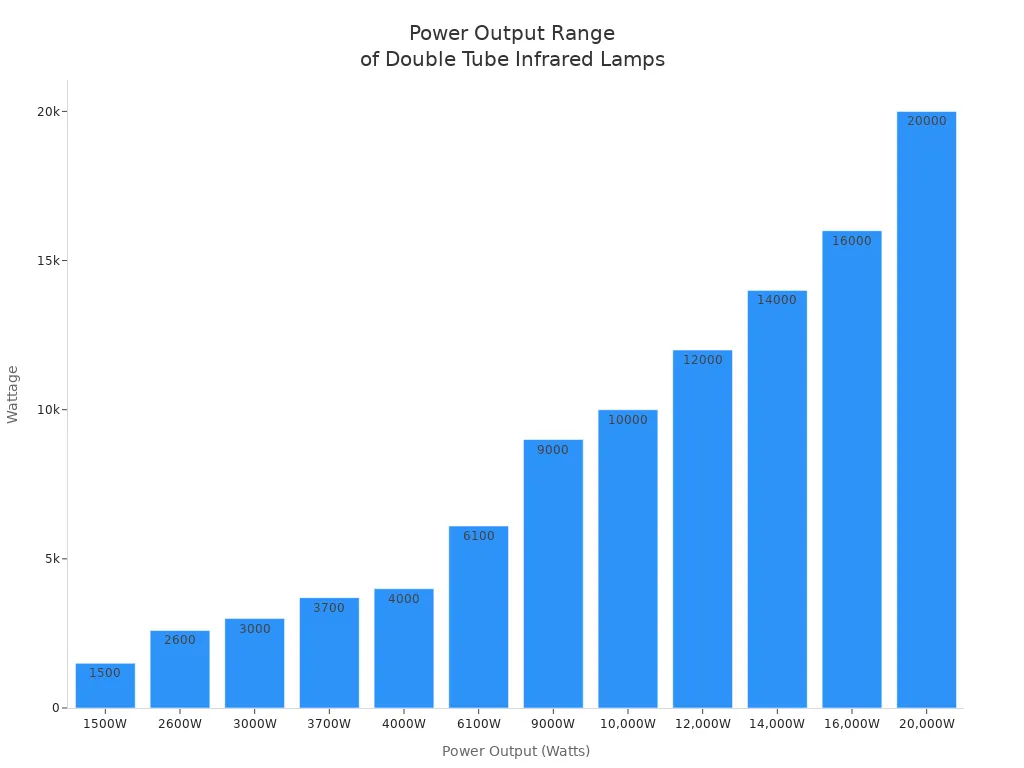
Twin-tube IR lamps use two parallel quartz tubes fused into a single profile, usually with a tungsten filament in each tube and halogen gas filling. This geometry increases mechanical strength and supports high power densities over large widths, which is valuable in wide-format presses and long dryer modules.
In practice, twin-tube lamps are used when:
The dryer must cover large sheet formats with uniform radiation
Lamps are exposed to vibration and mechanical stress
Multi-shift operation demands robust components with long service life
Typical specification ranges seen in printing applications include:
Power outputs from about 1.5 kW up to 20 kW or more per lamp
Voltage options aligned with common industrial supplies (for example, 230 V, 380 V, 400 V, or 480 V)
Lengths from a few hundred millimetres up to more than 4,000 mm
Medium-wave or fast medium-wave spectra, chosen for compatibility with paper, board, and many coatings
From an operational standpoint, twin-tube lamps offer:
Uniform heat distribution across the sheet width, which reduces drying streaks or bands
High mechanical robustness, limiting breakage during handling or vibration
Long service life when cooling air and switching cycles are correctly managed
For long-run commercial and packaging printers, twin-tube IR lamps are often the preferred option in main dryer sections where stability and uptime matter more than ultimate compactness.
Many presses still in daily use are equipped with IR dryers that were designed one or two generations ago. Original lamps may no longer be available, or newer lamp designs may offer better performance at similar power levels. In these cases, quartz IR replacement lamps are manufactured to match the mechanical and electrical characteristics of the existing dryer while benefiting from modern materials and reflector options.
Correct matching is critical. Even minor deviations in lamp length, wattage, or wiring can lead to:
Poor seating in holders and unreliable electrical contact
Uneven drying zones across the sheet
Overloading of transformers or power controllers
Reduced lamp life or unexpected failures
Before specifying a quartz replacement lamp, maintenance teams should document:
Overall length and heated length
Quartz profile and wave type (short-wave or fast medium-wave)
Wattage, voltage, and allowable current
Wiring style (series or parallel), lead length, and lead exit positions
Reflector type required by the dryer design
The exact position and function of each lamp within the press
Keeping a clear record of this information for every IR position makes future replacements faster, safer, and more consistent.
Quartz IR replacement lamps are especially valuable when:
Extending the usable life of older IR dryers
Upgrading from long-wave emitters to more efficient medium-wave or short-wave technology
Standardising lamp types across several similar presses within one plant
However, some very old dryer designs have unique dimensions or cooling concepts that justify a broader refurbishment or full replacement rather than repeated custom lamp orders.
No single lamp type is ideal for every press or every plant. The right choice depends on substrates, coatings, speed targets, and maintenance practices. A brief comparison helps highlight the differences:
Fast medium-wave lamps
Balanced heating for a wide range of paper and board
Fast response and good controllability for mixed work
Moderate power density and energy use
High-intensity short-wave lamps
Highest drying power and fastest results
Best suited to heavy coatings and maximum-speed production
Require careful tuning to avoid overheating and usually cost more initially
Twin-tube infrared lamps
Mechanically robust with even radiation over wide widths
Often used in main dryer sections of wide or high-power systems
Offer long service life when well cooled and correctly controlled
Quartz IR replacement lamps
Tailored to existing dryer and press dimensions
Enable performance upgrades without replacing the whole dryer
Depend heavily on accurate technical data and professional installation
Looking at cost over the full lamp life is more meaningful than purchase price alone. Plants that track lamp hours, energy consumption, and unplanned downtime usually find that the most efficient and stable solution is also the most economical over several years.
A structured selection process helps avoid compatibility problems and disappointing results. The following checklist can be adapted to any press:
Collect technical data
Gather press format, dryer locations, lamp-to-sheet distance, existing lamp ratings, wiring diagrams, and available cooling air.
Analyse production needs
List typical substrates and the most demanding jobs (highest coverage and thickest coatings). Decide whether your main limitation is drying speed, pile temperature, or marking/set-off.
Choose a lamp family
Select fast medium-wave lamps for broad flexibility on paper and board.
Consider short-wave lamps where maximum speed and heavy coatings dominate.
Use twin-tube designs where wide formats or long, high-power dryers are required.
Specify quartz replacement lamps carefully when maintaining or upgrading existing systems.
Confirm electrical and mechanical compatibility
Verify voltages, transformer capacity, control limits, lamp dimensions, sockets, and reflector fit before ordering.
Plan installation, testing, and monitoring
Use qualified personnel for installation. Start with controlled test runs at reduced speed, monitor pile temperature and sheet behaviour, and record lamp hours and energy use to build a fact-based maintenance plan.
Following this sequence turns lamp selection into an engineering decision rather than a trial-and-error exercise.
1. What is the main benefit of infrared drying on sheet-fed presses?
Infrared lamps accelerate drying so sheets reach handling strength sooner. This allows higher press speeds, cleaner piles, reduced powder usage, and more reliable scheduling of downstream finishing operations.
2. How do I know whether to choose medium-wave or short-wave lamps?
Medium-wave lamps are usually preferred for general commercial work and mixed substrates because they offer a forgiving temperature profile and good control. Short-wave lamps are better suited to very demanding jobs where maximum drying power is required, provided that substrate limits and pile temperatures are carefully respected.
3. Can maintenance staff replace IR lamps in-house?
Like-for-like lamp replacements are often handled by in-house maintenance teams following the press documentation and safety rules. Any change in lamp type, power level, wiring, or control should be reviewed by a qualified technician or electrician to protect both personnel and equipment.
4. How can I extend the life of IR lamps?
Avoid touching quartz tubes with bare hands, keep reflectors and cooling air paths clean, ensure the specified airflow is available, and minimise unnecessary on/off cycling. These simple measures reduce thermal shock and contamination, which are two of the main causes of premature lamp failure.
By understanding the strengths of fast medium-wave, short-wave, twin-tube, and carefully matched quartz infrared replacement lamps, you can design or upgrade an IR drying system that supports real production needs instead of limiting them. Thoughtful specification, professional installation, and ongoing monitoring translate directly into higher speeds, more stable print quality, and fewer drying-related surprises on press.
Last modified: 2025-11-21


