Author: Site Editor Publish Time: 2025-09-13 Origin: Site
Last updated: August 28, 2026
Salt-laden air, humidity, wind and outdoor electrical exposure make coastal heater selection different from a protected inland installation. The right infrared heater must be evaluated as a complete assembly: enclosure, fasteners, cable entries, controls, mounting and lamp are all part of the decision.
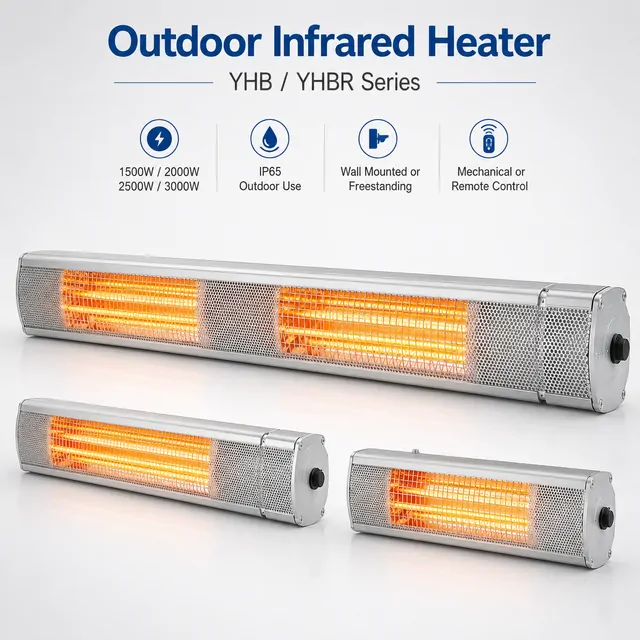
A covered terrace several kilometres from the shoreline does not face the same exposure as an open seafront installation. Record distance from salt water, prevailing wind, direct rain, spray, humidity, cleaning chemicals and whether the heater is stored or left outdoors year-round.
This information should be supplied to the heater manufacturer or installer before selecting a model.
An IP rating describes protection against specific solid-particle and water-ingress conditions for the rated product or enclosure. It does not automatically describe corrosion resistance, salt-spray durability or suitability for every mounting angle.
Confirm whether the rating applies to the complete heater, the lamp, a junction box or another component. Installation, cable glands and control accessories must preserve the intended protection.
| Component | Coastal checks |
|---|---|
| Housing and reflector | Material grade, coating system, drainage and cleaning access |
| Fasteners and brackets | Compatible corrosion-resistant material and avoidance of galvanic pairs |
| Cable entries | Rated glands, downward loops, seals and protected junction location |
| Controls | Outdoor rating, enclosure position and moisture protection |
| Lamp and terminals | Approved reflector, seals, connector temperature and replacement access |
“Stainless steel” alone is not a complete specification. Ask which parts use it and whether the complete assembly is intended for the stated environment.
Infrared heats people and surfaces directly, so it is less dependent on warming the whole air volume. However, wind still affects comfort and the temperature of exposed surfaces. Confirm mounting height, beam direction, occupied area and whether users remain seated or move through the zone.
Use the manufacturer's coverage data and clearance instructions. Avoid selecting solely by wattage because reflector design and mounting angle change the useful heated area.
Short-wave outdoor heaters can produce visible light. Low-glare and ultra-low-glare reflector lamps reduce visible output, but the complete heater design still affects comfort and performance. Confirm that a replacement lamp matches voltage, wattage, length, ends, reflector position and approved orientation.
Review YFR IP67 ultra-low-glare replacement lamps and the outdoor infrared heater range. The component rating should not be assumed to rate a different complete appliance.
Mounting must support the heater under expected wind and vibration while maintaining required clearances from combustible materials. Route cables away from hot surfaces and locations where water can collect. Outdoor electrical work should be designed and installed by qualified personnel according to local requirements.
Do not add an improvised cover that traps heat or blocks the approved airflow.
Remove salt deposits using the approved cleaning method.
Inspect housing seams, brackets, fasteners and cable glands.
Check reflector cleanliness and signs of terminal overheating.
Confirm that drains and ventilation paths remain open.
Record corrosion and replace affected parts before structural strength is reduced.
Inspection frequency should reflect exposure; an open seafront installation normally needs closer attention than a protected covered terrace.
No. IP ratings address ingress protection under defined tests, not unlimited salt corrosion resistance.
Only if the manufacturer approves that environment and installation. A canopy does not eliminate humidity, wind-driven rain or salt exposure.
No. Electrical rating, dimensions, reflector, ends and orientation must match the heater specification.
Provide location, exposure, mounting height, covered area, available voltage, required controls, photographs and the heater or lamp specification.
Send YFR the installation environment and heater requirements for an outdoor-heater or replacement-lamp review.


