


Author: Site Editor Publish Time: 2025-09-11 Origin: Site


Paint drying is rarely the “main process” on a production line—yet it often becomes the biggest bottleneck. When coatings stay wet too long, you risk dust nibs, rework, delayed recoat windows, and lower throughput. Infrared paint drying addresses these issues by delivering heat directly to the coating and the surface beneath it, helping you control drying and curing more precisely than hot air alone.
This guide explains how infrared paint drying works, where it fits best, and how to select practical settings so you can accelerate cycle time without overheating, blistering, or damaging the substrate.
Infrared heats the coating and surface directly, reducing “wait time” between coats.
Correct wavelength selection helps avoid overheating while improving cure consistency.
IR is especially effective for spot repairs, staged heating, and lines needing fast ramp-up.
The best results come from tuning power, distance, and line speed—not from “maximum heat.”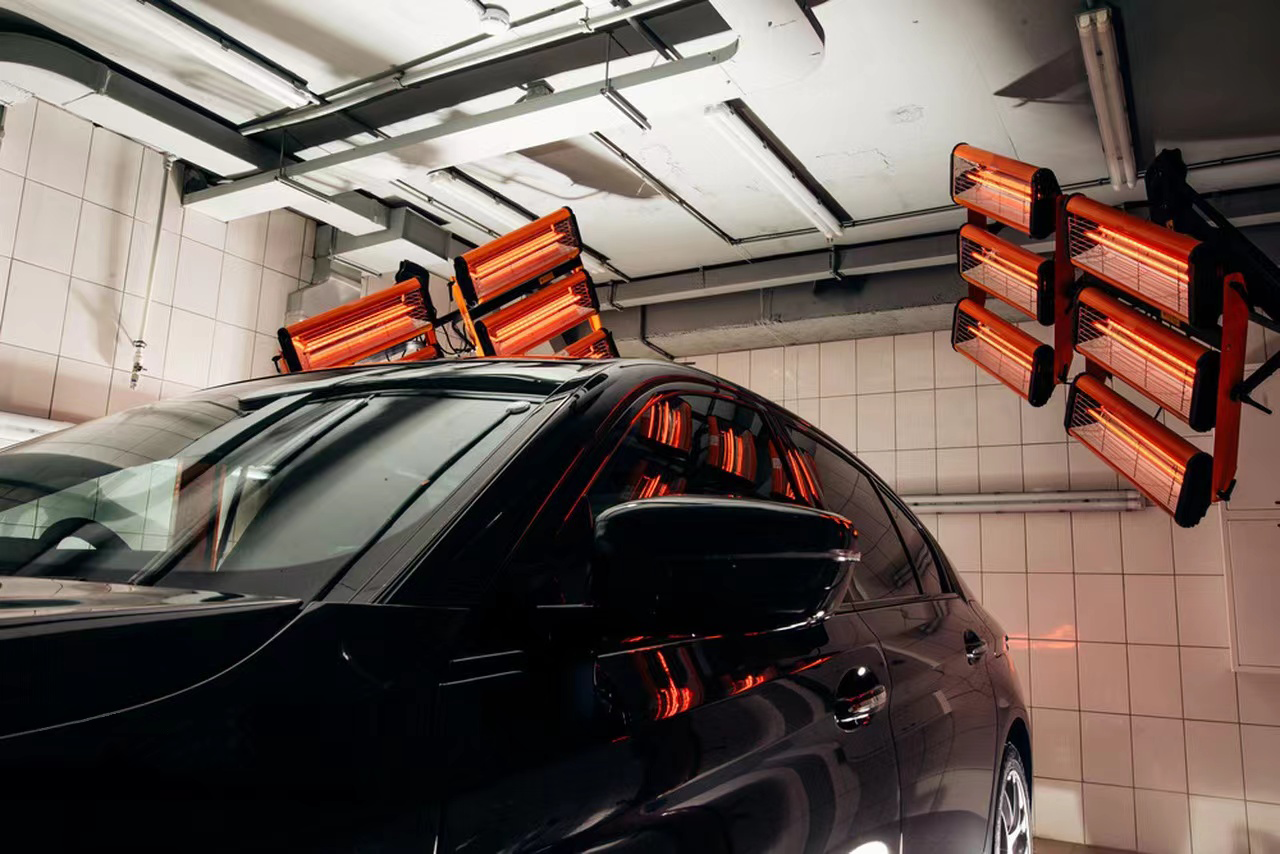
Before choosing equipment or settings, clarify the goal:
Drying typically means removing water or solvents so the film becomes tack-free and safe to handle.
Curing means completing the chemical/physical changes that deliver final hardness, adhesion, and chemical resistance.
Infrared can help with both—but the optimal profile differs. Many coating defects come from pushing cure too fast before the film releases volatiles safely.
Convection systems heat the air first, then rely on airflow and time to transfer heat into the coating. Infrared works differently:
Radiant energy reaches the coating surface immediately (minimal warm-up).
The coating and substrate absorb energy based on wavelength, color, and material.
Temperature rises quickly in the film zone, improving evaporation and/or reaction rate.
Controlled zoning lets you apply a staged profile (flash-off → ramp → cure/hold).
This “direct-to-workpiece” heating is why IR often improves productivity on lines that cannot afford long oven dwell times.
Infrared is not a universal replacement for ovens, but it’s highly effective in these scenarios:
Fast recoat windows and shorter bay occupancy
Reduced contamination risk because the film reaches handling strength sooner
Localized heating for panels without warming the entire vehicle
Faster ramp to target temperature for batch or conveyor operations
Useful as a booster stage before/after hot-air sections to stabilize line speed
Better control on high-mix production where recipes change frequently
Helps shorten drying between layers (primer/base/topcoat)
With conservative settings, can reduce risk of uneven drying on shaped parts
Often used to prevent workflow bottlenecks in sanding and recoat steps
Infrared can work well, but only when you tune wavelength and power density to avoid surface overheating while still achieving solvent release.
Wavelength selection matters because coatings and substrates absorb differently.
Best when you need:
Very fast ramp-up
Tight zone control
High throughput with consistent geometry
Use with care on:
Thin films with high solvent load (risk of “skinning over” too early)
Heat-sensitive plastics without staged profiles
Often preferred when:
You need gentler, more uniform heating
You’re drying thicker films or more complex shapes
You want a wider process window on mixed substrates
Practical rule:
If your line needs speed and precise zoning, you’ll likely lean short wave.
If your line needs stability and tolerance, medium wave is often easier to tune.
Instead of chasing a single “best temperature,” focus on these controllables:
Too high → solvent pop, bubbling, pinholes
Too low → slow drying, poor throughput
Closer isn’t always better; it can create hot spots
Use consistent positioning across the width to avoid edge undercure
Most lines succeed by balancing:
A short flash stage (gentle, to release volatiles)
A stronger ramp stage
A final hold stage for cure completion (if needed)
Use repeatable checkpoints:
Substrate surface temperature
Film appearance (gloss shift, tack-free point)
Adhesion and hardness tests after cooling
Likely cause: heating too aggressively before volatiles escape
Fix: add a lower-power flash zone; reduce peak power; increase airflow support
Likely cause: surface drying too fast relative to flow/leveling
Fix: reduce early-stage intensity; slightly extend flash-off; ensure consistent distance
Likely cause: overheating the substrate
Fix: choose a gentler wavelength profile; lower power density; improve zoning
Likely cause: insufficient hold time or wrong target temperature window
Fix: add a controlled finishing zone; confirm cure with standardized tests
You can estimate payback without “perfect data” by tracking three items:
Time saved per part (minutes or seconds)
Energy per cycle (kWh or fuel equivalent)
Rework reduction (defects per 100 parts)
Example logic:
If IR reduces dry-to-handle time and increases throughput, your ROI often comes more from capacity and delivery speed than from energy savings alone.
If you’re replacing long oven dwell times, energy reduction can become a major driver—but always validate against your baseline and utilization rate.
Yes. Many lines use IR to accelerate water evaporation, especially when airflow alone is not enough. The key is staged heating so the surface doesn’t seal too early.
It can be, but it requires careful wavelength selection and conservative power density with feedback control.
Often, a hybrid approach performs best: IR for rapid ramp-up and targeted heating, hot air for uniform airflow-assisted evaporation and final equalization.
Overdriving the first zone. Too much energy too early is a common cause of bubbling, pinholes, and inconsistent finish.
Run a controlled trial: keep coating chemistry and film thickness constant, then compare cycle time, defect rate, adhesion, and hardness after cooling.
Last modified: December 18, 2025


