Author: Site Editor Publish Time: 2025-09-14 Origin: Site
Last updated: September 1, 2026
Infrared powder coating lamps can provide fast, controllable heat to coated parts, but the lamp is only one element of a successful cure process. The final result depends on how the powder absorbs radiant energy, how heat conducts through the part, whether all coated surfaces can see the emitters, and whether the oven provides the airflow and temperature history required by the coating supplier.
The practical target is not a universal efficiency or cycle-time claim, but a repeatable part-temperature profile that produces the required appearance and film properties on the actual product mix.
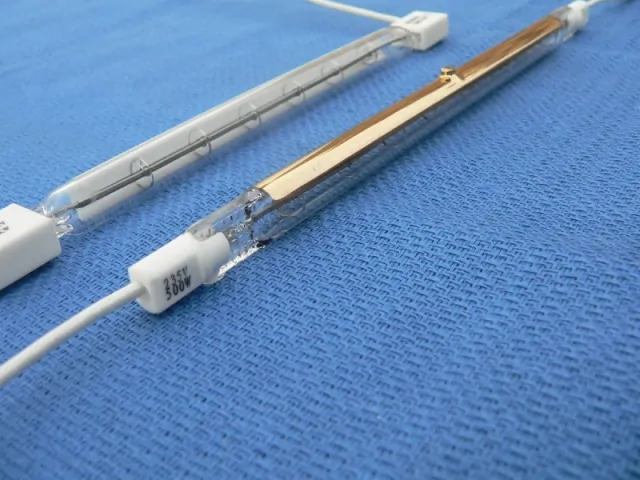
Infrared transfers energy by radiation from the emitter and reflector to surfaces within its field of view. The coating and substrate absorb part of that energy, reflect part of it, and may transmit a small part depending on the material and condition. Energy absorbed at the surface then moves through the coating and the workpiece by conduction. Infrared does not “penetrate metal” to heat hidden areas directly.
This distinction matters on complex components. A face directed toward the lamp may heat rapidly, while a recess, return flange or rear surface receives less direct radiation. The cooler area can still warm through conduction and surrounding hot air, but its temperature history will not automatically match the exposed face. Part thickness, thermal mass, alloy, colour, powder chemistry and line speed all influence the difference.
Powder curing is also more than reaching a single peak temperature. The powder must melt, flow and remain within the coating supplier's specified metal-temperature and time window. Excessive surface heating can change appearance before a heavy section or shadowed area has completed its required cure. For this reason, emitter selection should start with the coating technical data sheet and the measured temperature of the part, not a lamp-surface reading or a generic oven setpoint.
Electric infrared emitters can respond quickly to control signals, making them suitable for independently controlled zones. A line can reduce power during gaps, apply more heat to a high-load area, or use different recipes for selected product families. This flexibility is valuable when the control system, sensors and conveyor logic are designed as one coordinated process.
Because the energy can be directed toward the product, infrared is useful for flat or open geometries that present the coated area to the emitter. It may serve as a preheat stage, a gel or melt zone, a complete cure stage for suitable parts, or a responsive boost before or inside a convection oven. The best role depends on the product and coating rather than on the emitter name alone.
A modular lamp bank may fit where a longer hot-air section is impractical. It still needs correct working distance, guarding, electrical capacity, ventilation and safe behaviour during conveyor stops. The thermal profile and machine safety functions must also be proven.
The main infrared limitation is line of sight. Fixtures, adjacent parts, hooks and the product itself can create shadows. Closely spaced parts may also change exposure from one production run to another. Reflectors and emitter orientation can improve coverage, but they cannot make a deeply hidden surface behave like a directly exposed face.
Surface condition affects absorption. Different powder colours, finishes and film builds can respond differently to the same incident radiation. A recipe developed for one coating may not transfer directly to another. The bare substrate, an early powder-melt stage and the final flowed film can also absorb differently as the process progresses.
Released air and volatile material still have to leave the coating zone safely. Infrared supplies heat but does not replace ventilation, exhaust or the airflow required to manage the atmosphere around the part. Too much air movement can cool exposed surfaces or disturb loose powder; too little can allow an unsuitable local environment. The oven designer should establish airflow from the process, coating and applicable safety requirements.
Finally, fast response increases the need for protection. A stationary part can overheat if the conveyor stops while the lamps remain at production power. Line-motion interlocks, over-temperature protection, airflow proving where required, guarded hot surfaces and a defined restart sequence should be included in the machine design.
A hybrid process combines the responsive surface heating of infrared with circulating air that supports hidden faces and overall temperature equalisation. It can be helpful for parts with mixed section thickness, changing orientation or partially shadowed geometry. Infrared may raise the temperature of exposed areas or accelerate the early melt stage, while convection provides additional heat transfer to less visible surfaces and helps hold the part within its cure window.
The two heat sources must be tuned together. If the radiant zone creates too steep a surface-to-core temperature difference, convection may not correct a defect that has already developed. Product trials should compare zone power, conveyor speed, airflow and part loading as one recipe.
Do not choose an emitter by wave description or electrical power alone. Start with the part and required cure profile, then define the lamp, reflector, mounting and controls that can deliver it. The following inputs help a supplier evaluate the application:
| Selection input | Why it matters | What to document |
|---|---|---|
| Coating system | Defines the approved cure window and appearance requirements | Powder supplier, product code, technical data sheet and finish |
| Part and substrate | Controls absorption, conduction and thermal mass | Material, dimensions, section thickness, colour and starting temperature |
| Geometry and presentation | Determines direct exposure and shadowed areas | Drawings, photos, hook orientation, spacing and coated faces |
| Production requirement | Sets residence time and recipe range | Conveyor speed, loading pattern, product mix and line stops |
| Heater interface | Affects electrical and mechanical compatibility | Voltage, available power, heated width, working distance, cooling and control method |
| Acceptance criteria | Turns a heat trial into a production decision | Temperature profile, appearance, adhesion and other specified coating tests |
Different lamp constructions provide different response characteristics and spectral output. The appropriate choice depends on coating absorption, required control response, working distance, part geometry and the existing oven. A laboratory or pilot comparison using the actual powder and substrate is more reliable than selecting a fixed wave category from a general chart.
The reflector and lamp-bank geometry determine how energy is distributed. Check edge coverage, overlap and changes caused by part height. Very close placement can create local intensity differences; excessive distance can reduce useful irradiance. Map product temperature rather than assuming equal lamp spacing produces equal part temperature.
Specify independent zones where product loading or heat demand changes across the line. Confirm that switching devices, conductors and protection match the actual electrical load. Lamps, reflectors and terminals should be accessible for inspection without disturbing the alignment of the complete bank. Keep reflectors clean because contamination can change the delivered heat pattern even when electrical power remains unchanged.
Commission the system with representative parts, coatings and production spacing. Use suitable temperature profiling equipment to measure the workpiece through the heating sequence. Sensor attachment and emissivity settings must suit the surface and measurement method. Record zone power, conveyor speed, airflow, starting temperature and load pattern with each trial.
Evaluate the finished coating against the powder supplier's instructions and your quality plan. Depending on the application, this may include visual appearance, film thickness, adhesion, hardness, impact resistance or another specified test. Include worst-case products, cold starts, conveyor gaps and controlled stops. Energy use and throughput should be compared from measured baselines under equivalent production conditions; neither result should be guaranteed from lamp ratings alone.
No. Open, directly exposed parts are usually easier to heat evenly than deep or heavily shadowed geometries. Complex parts may need multiple lamp orientations, rotation, convection support or a different oven arrangement.
Infrared energy is absorbed at or near the exposed surface according to the material's optical behaviour. Heat then moves through the coating and metal by conduction. The actual temperature gradient must be measured on the part.
There is no single best wave category for every powder and substrate. Compare the coating response, lamp controllability, geometry, working distance and oven design through representative trials.
Sometimes, but not automatically. First confirm line-of-sight coverage, airflow, cure uniformity and safety on the complete product range. In many mixed-geometry applications, infrared is better used as a preheat, boost or hybrid stage.
The control system should reduce or remove radiant power promptly according to the validated stop sequence while maintaining any airflow or safety function that must continue. Restart conditions should also be defined and tested.
To review a new heater or retrofit, send YFR the powder technical data sheet, part material and drawings, coating colour, conveyor speed, loading pattern, available space, electrical supply and current temperature profile. Contact YFR for an application-specific infrared heating review and validate the final arrangement with representative production trials.


