Author: Process Heating Engineer Publish Time: 2026-04-02 Origin: Site
Last updated: August 30, 2026
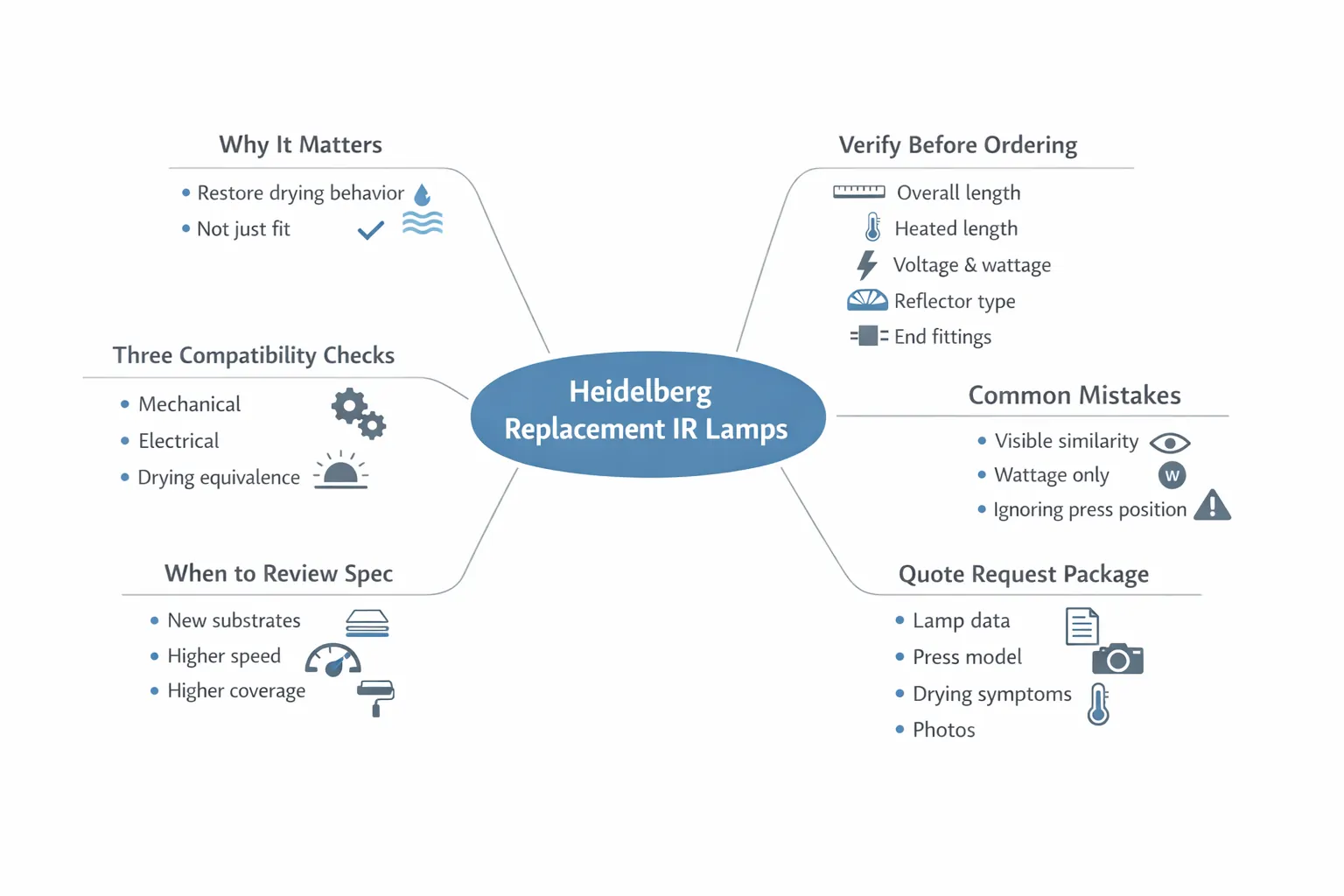
A Heidelberg press rarely stops because someone wants to think about lamps. It stops because a lamp fails, drying becomes unstable, or the plant is already running with too little margin and can no longer ignore it. That is why Heidelberg replacement IR lamps should not be treated as a routine spare-part reorder. The real requirement is not just to install a lamp that fits. It is to restore the drying behavior the press depended on before the failure.
That distinction matters because Heidelberg drying systems are integrated into the press, not bolted on as an afterthought. HEIDELBERG describes its DryStar systems as press-specific dryer systems, and on some Speedmaster configurations the dryer allows hot-air and infrared settings in one-percent increments while monitoring temperature, humidity, and air volume. In other words, the drying section is part of a controlled process window. A replacement lamp that is merely “close enough” on paper can still shift that window in production.
This is also why many replacement requests start after broader production symptoms appear. A plant may first notice set-off, slower finishing, reduced speed margin, or inconsistent drying across jobs, then discover that the next purchasing action is a lamp reorder. In practice, the spare-part request is often the last step in a longer drying problem, not the first. That is why teams often connect this work back to slow ink drying on printing presses before they confirm a replacement specification.
Heidelberg presses are used across demanding conventional, coating, UV, and specialty configurations, and the dryer’s role changes with the application. HEIDELBERG’s own DryStar pages emphasize different dryer variants, application-specific setup, stored dryer settings, and optimized drying even at high speed or high ink coverage. That means a lamp is not just a generic heater. It is a component inside an already tuned drying architecture.
The procurement shortcut is understandable: buyers look first at what they can measure quickly. Overall length, voltage, and wattage are usually available from the old part or the press team. Those three values matter, but they do not define the whole replacement. DOE guidance on industrial process heat makes the broader point clearly: heating performance depends on how energy is delivered to the material and how the system is controlled, not just on installed power.
With infrared specifically, DOE’s process-heating sourcebook describes a typical IR system as a combination of emitter, reflector, and controls, often with material handling and ventilation as well. It also notes that IR is commonly used where fast, surface-focused heating is needed and where accurate control matters because drying or curing may happen in seconds. That is exactly why small matching errors show up quickly on press.
The most common mistake is not technical ignorance. It is overconfidence in visible similarity. A lamp looks similar, the electrical rating looks similar, and the press team assumes the result will also be similar. That assumption is often wrong because replacement accuracy has three separate layers: physical fit, electrical compatibility, and drying equivalence under real jobs.
A second mistake is treating installation success as proof of process success. The lamp goes in, the machine powers up, and the problem appears solved until the press returns to production speed. That is where replacement errors tend to reveal themselves: not during installation, but under real substrate, coverage, and speed conditions. Heidelberg’s own dryer documentation highlights storable settings, integrated monitoring, and fine hot-air/IR adjustment, which only makes sense because dryer behavior is operationally sensitive.
A third mistake is assuming every drying issue is fundamentally the same. EPA guidance separates heatset from non-heatset lithographic drying: heatset inks are dried by evaporation of ink oil at elevated temperature, while non-heatset lithographic inks traditionally set through absorption and oxidation rather than heat-driven dryer evaporation. So before matching a replacement lamp, the plant should be clear about the drying task the lamp is actually performing on that Heidelberg configuration.
A correct replacement review should begin with the lamp itself, but it cannot end there. The aim is to confirm that the new lamp reproduces the same useful drying effect in the same zone of the press. DOE’s IR guidance is helpful here because it frames infrared performance around emitter type, reflector system, controls, and the way energy reaches the product surface.
Item to verify | Why it matters |
|---|---|
Overall length | Confirms basic fit within the housing or mounting position |
Heated length | Determines where the active drying energy is delivered |
Voltage | Confirms electrical compatibility with the existing circuit |
Wattage | Confirms nominal power input, but not full process equivalence by itself |
Reflector type | Changes how energy is directed toward the sheet or web |
Tube geometry | Affects spacing, mounting, and heat distribution |
End fittings and lead direction | Affects installation, serviceability, and safe routing |
Exact press position | Defines the functional role the lamp plays in the dryer section |
Current job mix | Determines whether the original spec still matches present production conditions |
The most important point in that list is the difference between overall length and heated length. Plants often record the first and miss the second. But a lamp with the right overall size and the wrong active heating zone can change where energy is being delivered on the sheet path. The lamp may fit perfectly and still produce a different drying result.
Reflector type also deserves more attention than it usually gets. DOE notes that IR systems depend on the interaction between emitted radiation and the material being heated, with reflector systems and controls shaping how that energy is used. In Heidelberg applications, where drying settings are integrated with the press and may need fine adjustment, a reflector mismatch can matter more than a buyer expects.
A compatible replacement IR lamp for a Heidelberg press must pass three checks.
The lamp must fit the housing, clearances, holders, and connection space without forcing modification or awkward routing. This is the easiest part to verify and the one most teams already check. The problem is that mechanical compatibility alone only proves the lamp can be installed. It does not prove it will dry the same way.
The lamp must match the voltage and power environment it will run in. This is the second check most buyers handle correctly. Still, electrical compatibility only proves the lamp can operate in the circuit. It does not prove that the press will recover its old drying window after installation.
This is the part that separates a true replacement from a “close-enough” spare. DOE’s IR guidance explains that infrared is often selected for surface-focused, rapid heating and that correct application depends on matching the heating method to the material and process. On a Heidelberg press, that means the real question is whether the replacement delivers the same useful energy, in the same place, under the same press conditions.
That is also why broader process pages such as printing press IR lamp replacement should sit near this Heidelberg page in your cluster. The brand name changes the commercial intent, but the thermal logic stays the same: fit is necessary, drying equivalence is decisive.
Like-for-like replacement is usually the right choice when the old setup was performing well before failure. If the press was running the current jobs reliably, at acceptable speed, with acceptable quality margin, then the replacement task is restoration rather than redesign. In that case, matching the original lamp as closely as possible is the safest path.
But that logic breaks when the production context has changed. Heidelberg’s own dryer materials highlight delicate substrates, thin films, integrated monitoring, and fine hot-air/IR control because the drying task is highly job-dependent. If the press now runs different substrates, higher speeds, or more demanding coverage, the original lamp may no longer be the right target.
Paper and board conditions matter here as well. TAPPI notes that moisture affects printability, shrinkage, dimensional stability, physical strength, and runnability. So if the plant’s current stock mix is more sensitive than before, restoring the previous lamp exactly may not restore the same process outcome. In those cases, the plant should review the replacement in the context of substrate behavior and, where relevant, related process topics such as infrared drying for offset printing rather than forcing a blind copy of the old part.
The first recurring mistake is ordering from photographs or rough dimensions only. Photos are useful for identifying a family resemblance, but they are weak technical documentation. Too many critical details are invisible: heated length, reflector design, connection style, and the exact way the lamp sits in the dryer assembly.
The second mistake is using wattage as the main shortcut. Wattage is essential, but it does not describe the whole thermal result. DOE’s sourcebook is explicit that IR performance depends on system design, controls, reflectors, and the interaction between emitted wavelengths and material absorption. Two lamps can look similar on a purchase sheet and still behave differently on press.
The third mistake is ignoring the functional role of the lamp in the Heidelberg dryer section. Some lamps support a broader drying task; some are more localized in effect; some operate inside systems where hot air, IR, monitoring, and stored settings work together. Heidelberg’s product pages make clear that these dryers are tuned as systems, not as isolated components.
Mismatch | Likely consequence |
|---|---|
Wrong heated length | Active drying zone shifts and print stability changes |
Wrong reflector type | Energy reaches the sheet differently than before |
Correct fit but different geometry | The lamp installs, but cross-sheet behavior changes |
Correct voltage and wattage only | Electrical operation is fine, process outcome is not |
Wrong end fittings or lead routing | Installation becomes difficult or serviceability suffers |
Original press conditions ignored | The replacement restores the part number, not the drying window |
The following is a typical engineering scenario rather than a universal claim.
A plant replaces a failed compatible IR lamp on a Heidelberg press. The purchasing team confirms overall length, voltage, and wattage. The lamp installs correctly and powers up without trouble. For a short period, the change looks successful. Then production returns to normal speed, and the team notices that drying margin is thinner than before. The line still runs, but the comfortable operating window is gone.
The problem turns out not to be electrical. The replacement differs in heated length and reflector behavior. That means the lamp is no longer delivering energy in quite the same way to the printed surface. DOE’s guidance would predict exactly this kind of outcome: infrared performance depends on the system’s emitter-reflector-control relationship and on how the material absorbs the energy.
In a Heidelberg environment, that mismatch is especially visible because drying is already integrated with press settings, substrate sensitivity, and monitored air conditions. The lesson is simple: the correct question is not “Did the lamp fit?” It is “Did the lamp restore the same drying job?”
A good quotation request should make it possible to judge both compatibility and drying risk.
Prepare the overall length, heated length, voltage, wattage, tube style, reflector type, and end-connection details.
Prepare the Heidelberg press family or exact model designation available to you, the lamp location in the dryer section, the substrate type, and the current production speed.
State whether the request is a routine failure replacement or whether the plant is also seeing drying instability, speed loss, set-off, register sensitivity, or substrate response issues.
Provide clear photos of the old lamp, both ends, the installed position, nearby brackets or shields, and the cable or lead routing.
That package turns a generic spare request into a technical replacement review. It also reduces the risk of buying a mechanically correct but functionally weak substitute.
Not necessarily. A compatible replacement lamp is best described as a specification-matched replacement designed to work in Heidelberg printing press applications. Unless you are explicitly selling OEM parts, the safer and more accurate language is “compatible replacement IR lamps for Heidelberg printing presses.”
You can start there, but you should not stop there. Heated length, reflector type, connection details, and the lamp’s position in the dryer section all influence whether the replacement will behave correctly on press.
Because fit only confirms mechanical compatibility. Drying performance also depends on how the lamp delivers energy to the printed surface and how that energy interacts with the substrate and the wider dryer system.
Keep the original specification when the old setup was stable and the goal is simply to restore proven performance. Review the specification when the substrate mix, speed, coverage, or drying demand has changed, or when the press was already running close to its drying limit.
Send the old lamp dimensions, heated length, voltage, wattage, reflector details, press information, lamp position, substrate type, running speed, and clear installation photos. That is usually enough to screen obvious mismatch risk before ordering.
Compatibility check
Confirm whether the old lamp should be copied exactly or reviewed against the press’s current operating conditions.
Specification check
Verify heated length, reflector type, voltage, wattage, end fittings, and installation geometry before reorder.
Drying-risk check
If the request started with quality complaints rather than simple lamp failure, review the replacement against the actual drying symptom, not just the old part dimensions.
Best first inquiry package
Old lamp photos, full measured data, Heidelberg press information, substrate type, current speed, and a short description of the drying issue.
TAPPI T 412.
Used for the point that moisture affects printability, shrinkage, dimensional stability, strength, and paper runnability.
Review YFR replacement infrared lamps and heating modules and controls. Confirm lamp compatibility and dryer settings through press trials.
Send YFR your material, dimensions, target, cycle time and current equipment details for an application-specific review.


