Author: Process Heating Engineer Publish Time: 2026-04-02 Origin: Site
Last updated: October 16, 2026
A printing plant replaces an IR lamp, installs it successfully, powers up the press, and assumes the job is done. Then the real problem starts. The new lamp fits, the press runs, but drying behavior shifts. Set-off risk returns. Speed margin shrinks. One side of the web dries differently from the other. The purchasing team thinks it bought an equivalent spare. The production team knows something changed. That gap is exactly why printing press IR lamp replacement goes wrong so often.
The reason is simple: replacement is not just a spare-parts task. It is a thermal matching task. In industrial process heating, the goal is not merely to energize a heater but to deliver heat reliably, in the correct zone, with controls and hardware that match the material and process window. DOE process-heating guidance makes that point clearly: performance depends on how energy is delivered to the material, not just on installed power alone.
That distinction matters even more in printing. In heatset offset processes, ink oils are driven off by heat in the dryer and the web is then cooled to solidify the ink film. In non-heatset lithographic work, inks generally set by absorption and oxidation rather than by evaporation in a dryer. So a replacement decision cannot be reduced to “same lamp, same watts, same result” without first understanding what drying job the lamp is actually performing on that press.
In many plants, the replacement request starts only after a broader drying complaint appears. That is why this topic often sits directly behind broader troubleshooting topics such as slow ink drying on printing presses. The plant is not buying a lamp in isolation. It is trying to recover a stable drying window.
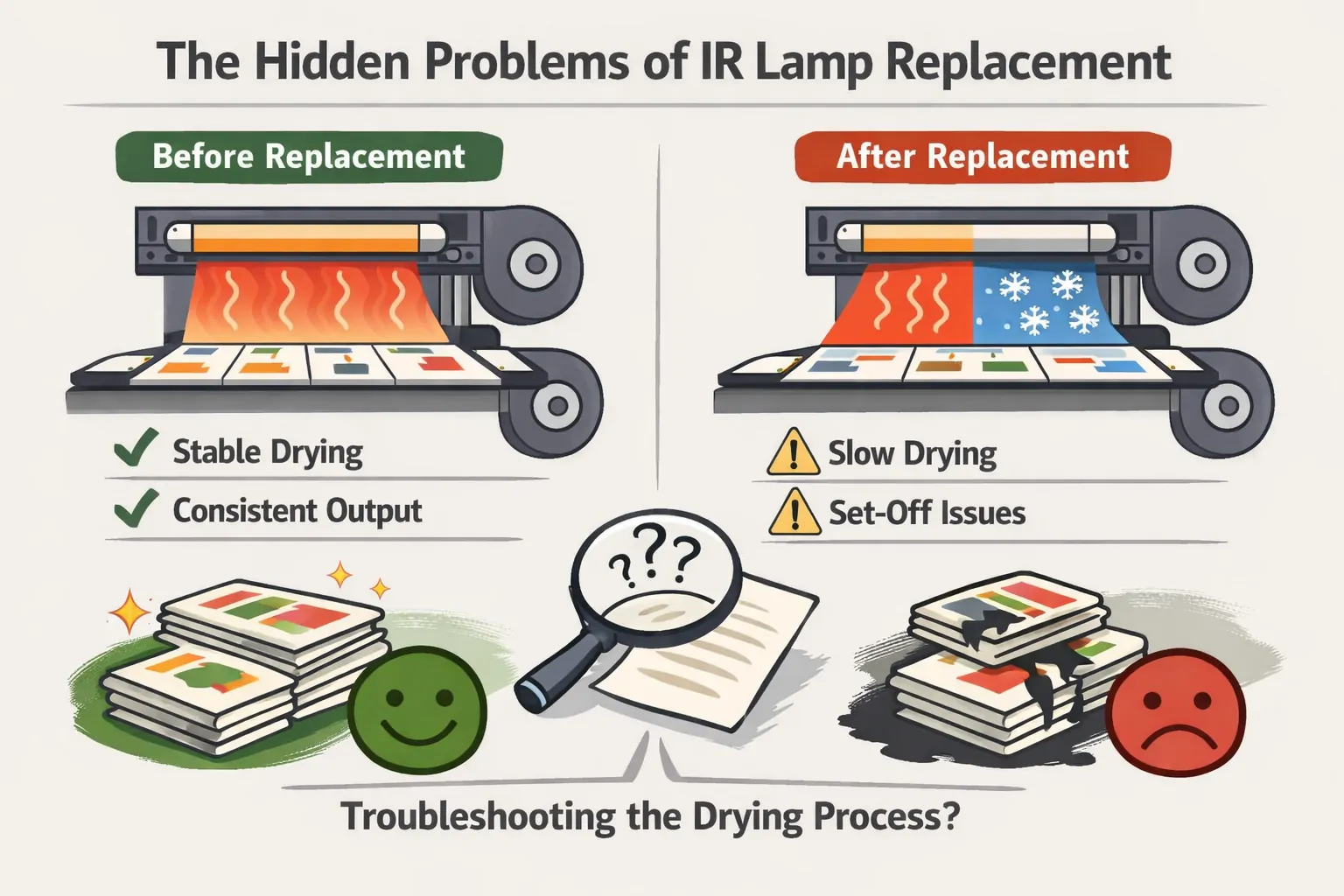
Most replacement mistakes come from a reasonable but incomplete shortcut: match what is easiest to see. Buyers often start with the old lamp’s overall length, voltage, and wattage because those are usually the fastest specifications to obtain. That is useful, but it is not enough.
A lamp can match the space available in the machine and still change how the press dries. That is because physical fit and process equivalence are not the same thing. DOE guidance on electric infrared systems notes that infrared is highly dependent on where and how energy reaches the workpiece, that it primarily heats the surface, and that it is often selected because of its fast, localized energy delivery. Those same strengths are exactly why matching errors show up so quickly on press.
On a printing press, a small change in heated length, reflector behavior, or emitter geometry can shift how energy is distributed across the printed surface. The lamp may still “work,” but not in the same way the original system worked.
Visible dimensions are easy to measure. Thermal behavior is not. A buyer can confirm end-to-end length in minutes. It takes much more process knowledge to confirm whether the new lamp is delivering the same effective energy to the same zone of the substrate.
That is also why some replacement errors only become obvious under production conditions. At low speed, the line may appear acceptable. At target speed, the margin disappears. The replacement has not necessarily failed electrically. It has failed functionally.
This is the central procurement mistake in printing press IR lamp replacement: treating a lamp as if it were defined completely by three visible numbers.
Overall length tells you whether the lamp may fit the assembly. Heated length tells you where the energy is actually being delivered. Those are not interchangeable. A lamp with the correct overall length but a different heated section can shift the active drying zone, leave part of the print under-heated, or concentrate energy where it is less useful.
In printing, that difference matters because the process window is spatial as well as thermal. The question is not only “does it turn on?” but also “does it deliver usable energy in the exact zone where the press needs it?”
Matching voltage and wattage is essential for electrical compatibility, but identical electrical ratings do not automatically create identical process results. DOE guidance describes electric infrared as a surface-focused heating method whose performance depends on the heating task, material response, and system configuration. Two lamps can share nominal electrical ratings and still behave differently in the press if the emitter construction or delivery geometry differs.
This is why a lamp can be “correct” on the quotation sheet and still be wrong on the machine.
Reflector configuration is not a cosmetic detail. It affects where the energy is directed, how concentrated it is, and how efficiently the printed surface receives it. In infrared process heating, absorption by the product is what matters; energy that is reflected away or spread differently changes the heating result. DOE’s industrial infrared guidance emphasizes that product response depends on absorption and on how the system delivers radiant energy to the material.
That is why reflector type, emitter orientation, and installation geometry belong in the replacement review, not at the bottom of the checklist.
A practical replacement review should cover five groups of information.
Record both. Do not assume one can stand in for the other. The first affects assembly fit. The second affects drying location and active energy coverage.
These are the starting point for electrical compatibility and power demand. They are necessary, but they are still only part of the match.
These affect how the lamp sits in the machine and how the energy is projected toward the substrate. A nominally similar lamp with a different construction can alter the drying profile.
End fittings, cable orientation, ceramic ends, mounting clearances, and lead exit direction are all practical details that can delay installation or force poor positioning if they are missed.
This is the part many buyers skip. Where is the lamp installed? What is it supposed to do there? Recover surface dryness? Assist a hot-air section? Stabilize a coating? Help a problem zone near a certain print unit? IR systems are frequently used in industrial settings either as standalone surface heaters or in hybrid arrangements with conventional ovens, and that distinction matters when judging what “equivalent” really means.
Parameter to verify | Why it matters |
|---|---|
Overall length | Determines whether the lamp can fit the housing or frame correctly |
Heated length | Determines where usable energy is actually delivered |
Voltage | Ensures electrical compatibility with the existing circuit |
Wattage | Sets nominal power input, but not full process equivalence by itself |
Tube geometry | Affects fit, spacing, and heat distribution |
Reflector type | Changes how energy is directed toward the print zone |
End connections | Affects installation, serviceability, and safe operation |
Lamp position in press | Defines the actual drying role the lamp performs |
The best way to avoid a bad replacement is to separate the evaluation into three layers.
Will the lamp fit the holder, brackets, spacing, shielding, and available clearance without forcing a compromise? This is the most obvious layer, and plants usually check it first.
Will the lamp operate correctly in the existing circuit, control scheme, and power range? This is the second layer, and it is also usually checked.
This is the layer that gets missed. Will the replacement produce the same useful effect on the print at the actual speed, coverage, substrate, and airflow condition that matter to the job? In process heating, energy must be delivered in the correct way to the material. In printing, the real question is whether the replacement restores the drying window, not just whether it completes the circuit.
That is why a plant can replace a failed lamp, see light and heat, and still lose performance.
Not every replacement should become a redesign. But not every old specification deserves to be copied blindly either.
If the press previously ran the target jobs reliably, with acceptable speed and quality margin, then like-for-like replacement is usually the safest route. In that case, the goal is restoration, not optimization.
This is especially true when the plant has good documentation and the original setup already matched the current substrate mix and production speed.
If the plant now runs faster, prints different substrates, or has moved into more demanding coverage conditions, the original lamp may no longer represent the right target. Paper moisture and dimensional stability directly affect printability and runnability, which means a change in substrate behavior can alter what the dryer must achieve without creating curl or instability. TAPPI’s moisture method specifically notes that moisture affects printability, shrinkage, dimensional stability, and runnability.
So when operating conditions have changed, a replacement review should ask whether the old lamp was actually optimal or simply adequate for an older process window.
This is the most expensive mistake. If the line was already running near its drying limit before the failure, copying the failed lamp exactly may only restore the same weak margin. In that situation, the better question is whether the plant needs a broader review of infrared drying vs hot air drying for printing, zoning, or total dryer strategy rather than a purely identical spare.
These errors show up repeatedly because they feel efficient during purchasing.
A photo can help identify a lamp family. It should never be treated as a sufficient technical specification. Too many critical details are invisible or ambiguous in photos alone.
Plants sometimes assume reflector differences are secondary because the lamp body appears similar. In reality, reflector behavior can change how much of the emitted energy reaches the target zone effectively.
Wattage matters, but it is not a synonym for drying performance. In infrared systems, process outcome depends on how the emitted energy interacts with the product surface and the surrounding process design. DOE’s industrial infrared guidance explicitly points to application fit, surface heating, and hybrid use cases as central design considerations.
They are not. Press position, lamp construction, substrate sensitivity, and the role of the IR section all change what constitutes a correct replacement. That is why serious buyers usually move from rough part matching to a more controlled review of printing press replacement IR lamps before ordering.
What is mismatched | What usually goes wrong |
|---|---|
Heated length | Active drying zone shifts or becomes uneven |
Reflector type | Energy reaches the print differently than before |
Voltage | Lamp may not operate correctly or safely |
Wattage only used as the main criterion | Drying result does not match expectations |
End fittings or lead exits | Installation becomes difficult or forces compromise |
Original role of the lamp ignored | New part fits physically but does not solve the process need |
The following is an illustrative specification-checking example using hypothetical conditions.
A maintenance team replaces a failed lamp in a printing dryer section. It verifies overall length, voltage, and wattage. The replacement arrives, installs without major difficulty, and powers up normally.
The heated length is slightly different from the original. The reflector configuration is not truly equivalent. The plant also fails to confirm whether that lamp’s location was intended for broad support heating or a more concentrated correction zone.
At moderate speed, the press appears acceptable. At target speed, the drying margin is weaker than before. The lamp did not fail electrically. It failed to reproduce the same useful energy delivery to the printed surface. Because infrared performance is strongly tied to where radiant energy reaches the material and how the surface absorbs it, a small mismatch became a production problem rather than an obvious installation problem.
This is why procurement teams should stop asking only, “Does this lamp match the part?” and start asking, “Does this lamp match the drying job?”
A good quotation request reduces back-and-forth and improves the chance of getting the right replacement the first time.
Prepare:
overall length
heated length
voltage
wattage
lamp shape or tube style
reflector type
end connection details
Prepare:
press model
exact lamp location
substrate type
current operating speed
whether the lamp works alone or alongside other drying sections
Prepare:
whether the lamp is being replaced after failure only
whether drying quality changed before the failure
whether the current process already shows limited speed margin
what defect appears when drying is insufficient
Prepare clear photos of:
the old lamp
both lamp ends
the installed position
nearby brackets or shielding
connection leads
the drying section as a whole
Pair each photo set and dimensioned drawing with a reference ID, the press model, dryer position and any readable original lamp code. Keep the full lamp, both ends and installed position under the same ID so that each measurement can be traced to the correct item. Anonymised copies can retain the technical markings and dimensions needed for identification. Mark estimated or unknown dimensions and include the paired record with the quotation enquiry. Photos support identification; final replacement matching still requires the relevant specifications and installation checks.
No. Those are important starting points, but they are not enough by themselves. Heated length, reflector configuration, connection details, and drying role in the press also affect whether the replacement will behave correctly.
Overall length is the lamp’s total end-to-end dimension. Heated length is the active section that delivers usable radiant energy. In replacement work, the first mainly affects fit, while the second strongly affects drying behavior.
No. Infrared performance also depends on emitter construction, energy direction, installation geometry, and how the surface absorbs the radiation. DOE industrial guidance makes clear that infrared process performance depends on the specific application and the way heat is delivered to the product.
Keep the original specification when the prior drying window was stable and the plant simply needs to restore the same function. Re-evaluate the specification when speed, substrate, job mix, or drying requirements have changed, or when the old setup was already marginal.
Send measured lamp data, clear photos, press model information, lamp position, substrate type, operating speed, and a brief description of the drying problem you are trying to solve.
Replacement review
Check whether the old lamp should be copied exactly or re-evaluated against current operating conditions.
Specification check
Verify heated length, reflector type, voltage, wattage, and end-connection details before ordering.
Drying-risk check
If the lamp request started with a quality complaint, review the replacement against the actual drying symptom, not only the failed part.
A useful first inquiry package usually includes the old lamp dimensions, photos, press model, substrate, line speed, and the defect seen when drying performance is unstable.
U.S. Department of Energy — Process Heat Basics.
Used for the core process-heating principle that performance depends on how heat is delivered to the material, not only on installed power.
DOE Sourcebook for Industry — Improving Process Heating System Performance.
Used for the industrial role of electric infrared, including surface-focused heating, drying and curing applications, and hybrid use with conventional ovens.
U.S. EPA — Technical Support Document for Printing Facilities.
Used for the distinction between heatset and non-heatset lithographic drying mechanisms.
TAPPI T 412 — Moisture in Pulp, Paper and Paperboard.
Used for the point that moisture affects printability, shrinkage, dimensional stability, strength, and runnability.
Review YFR replacement infrared lamps and heating modules and controls. Confirm lamp compatibility and dryer settings through press trials.
Send YFR your material, dimensions, target, cycle time and current equipment details for an application-specific review.


