


Author: Site Editor Publish Time: 2025-11-10 Origin: Site


A high power infrared tube is one of the most energy-dense, responsive ways to deliver heat to industrial products—in drying, curing, forming, bonding, sintering, preheating, and many other operations. This guide distills the engineering criteria you need to choose the right tube style (short-wave quartz halogen, fast-medium-wave quartz, or carbon medium-wave), size it correctly, integrate it with controls and safety, and tune it for throughput and quality. The selection logic below reflects established industrial best practices and consensus engineering references.
In industrial heating, infrared refers to electromagnetic radiation just beyond red light. IR sources are categorized by the wavelength they primarily emit (which depends on filament material and operating temperature). In tube form factors used on production lines, three families dominate:
Short-wave (SW) quartz halogen tubes (tungsten filament in a quartz envelope) — extremely high surface power density and millisecond-to-second response.
Fast-medium-wave (FMW) quartz tubes — engineered for medium-wave emission with short-wave-like ramp times (about 1–2 s).
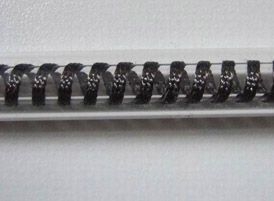
Carbon medium-wave (CMW) tubes — carbon filament emitters in quartz that produce strong 2–4 µm radiation with gentle, uniform heat for coatings, plastics, textiles, and water-based chemistries.
Traditional ceramic panels and metal-sheathed emitters are also “infrared heaters,” but as assemblies they prioritize ruggedness or broad-area heating over maximum power density from a tube. It’s useful to keep the whole category landscape in mind while you narrow to tubes.
Heat transfer with IR is spectral: materials absorb some wavelengths strongly and others weakly. Many water-rich chemistries, adhesives, inks, and numerous polymers show strong absorption in the medium-wave band (roughly 2–4 µm), so they heat efficiently under CMW or FMW tubes. Metals reflect more in this region and may benefit from higher-temperature short-wave sources for rapid surface or penetrative heating. The practical takeaway: match the tube’s dominant wavelength to your product’s absorption peaks.
Water’s absorption features in the IR are particularly strong, which is one reason water-based coatings often dry faster under medium-wave emitters than under pure convection at the same energy input.
Two attributes distinguish a high power infrared tube:
Surface power density (SPD) — how much radiant power the emitter can deliver per unit area of its surface.
Response time — how quickly it reaches steady emission after a power change.
Typical upper-end capabilities used for concepting:
Short-wave (SW) twin-tube quartz: up to roughly 150 kW/m² maximum rated power density; ramp to full power in ~0.1–1 s depending on geometry and controls.
Fast-medium-wave (FMW) quartz: up to roughly 120 kW/m², with ~1–2 s response, bridging the gap between gentle medium-wave and ultra-fast short-wave.
Conventional medium-wave (MW) quartz: lower SPD and longer ramp (on the order of minutes) but often ideal for large ovens and steady processes.
These values aren’t “design guarantees”—they’re capability bands that inform feasibility during concepting. Always confirm with the supplier’s verified rating and test in your fixture, since reflector geometry, spacing, and cooling impact delivered flux at the product.
Short-wave quartz halogen tubes
Emission: ~0.78–1.4 µm (near-IR/short-wave).
Best for: very high line speeds, metals and glass, deep penetration, rapid thermal cycles.
Pros: highest SPD, fastest response; pairs well with gold reflectors for directional intensity.
Watch-outs: risk of over-baking heat-sensitive substrates without closed-loop control.
Fast-medium-wave quartz tubes
Emission: ~1.4–2.4 µm (medium-wave edge) with short-wave-like ramp.
Best for: coatings, inks, thermoplastics, textiles where absorption is strongest in MW but the process still demands quick cycling.
Pros: excellent controllability, often higher electrical efficiency “to product” in these materials than SW.
Watch-outs: slightly lower peak SPD vs SW; ensure zone density covers your width.
Carbon medium-wave tubes
Emission: ~2–4 µm.
Best for: water-based chemistries, polymer films/sheets, laminates; gentle surface heating without glare.
Pros: efficient spectral match to many industrial substrates; uniform, “soft” heat.
Watch-outs: response faster than ceramic but slower than SW; confirm lamp life and control strategy.
Context: ceramic & metal-sheathed IR assemblies
Useful for large-area or rugged environments; longer warm-up; typically not used when the objective is maximum SPD from a tube.
Most high power IR tubes are paired with integral reflectors (gold or white ceramic) or housed in modules with shaped reflectors. Gold coatings offer very high reflectivity in IR bands, which concentrates energy on the product and minimizes rear losses; white ceramic broadens the emission and can be beneficial for uniformity over larger standoff distances. Choose based on whether your bottleneck is peak intensity or uniform coverage.

Two solid-state control strategies dominate IR tube power delivery:
Phase-angle SCR control: varies the conduction angle of each AC half-cycle to deliver quasi-continuous power—ideal for fast response SW/FMW tubes and tight PID loops. It can increase harmonics and electrical noise, so filtering and proper transformer/line sizing are important.
Zero-cross (burst-fire) control: switches whole AC cycles on/off at zero voltage crossings; excellent for reducing harmonics and works well on many resistive heaters. Some advanced controllers hybridize: phase-angle for ramp/accel, then zero-cross for steady-state.
For multi-zone arrays, modern multi-loop SCRs manage separate tube banks, enabling thermal profiling across web widths or along an oven, while maintaining grid compatibility.
Use the following criteria to select and configure a high power infrared tube system:
Substrate & chemistry
Is the product metal, glass, polymer, wood, textile?
Water-based vs solvent-based? Spectral absorption favors MW for many polymers and water-rich coatings; SW for dense or reflective materials requiring penetration or extremely fast cycles.
Process target
Throughput (line speed), target temperature profile, acceptable ΔT across width, and takt time.
Decide if you need “instant heat on demand” (favor SW/FMW) or steady continuous heat (conventional MW).
Power density & zone design
Start with capability bands (e.g., SW up to ~150 kW/m²; FMW up to ~120 kW/m²) and back-solve how many tubes and zones you require to deliver the flux at your standoff distance and emitter angle. Use reflectors to “steer” intensity where needed.
Mechanical envelope
Single-tube vs twin-tube: twin tubes raise rigidity for long spans and provide higher radiation density in compact housings—useful on wide web lines.
Controls & power quality
Pick SCR modes (phase-angle, zero-cross, hybrid) based on response and EMC limits; verify the panel’s thermal management and short-circuit protection.
Safety & compliance
For North America, evaluate against UL 499 (Electric Heating Appliances) and local electrical codes; add mechanical guarding, interlocks, and over-temperature protection.
Maintenance & lifecycle
Confirm lamp life under your cycling profile; plan for quick swap fixtures, sight ports for inspection, and spare inventory sizing.
Environment
Dust, fibers, splashing liquids, or aggressive vapors dictate enclosure and shield choices; debris on tubes reduces emissive output and raises breakage risk.
Goal: Estimate required tube power for an in-line drying or heating step. This back-of-the-envelope method frames feasibility before detailed trials.
Inputs (example values):
Web material: 200 µm PET film, width 1.5 m, density 1.38 g/cm³.
Line speed: 20 m/min.
Temperature rise: 25 °C → 110 °C (ΔT = 85 °C).
Specific heat cpc_pcp: ~1.0 kJ/kg·K (PET, mid-range).
Surface moisture/coat: negligible (if present, add latent + sensible load).
Chosen emitter: Fast-medium-wave tubes (spectral match to polymer).
Step 1: Mass flow
Thickness × width × speed = volume flow
0.0002 m×1.5 m×20/60 m/s=0.0001 m3/s0.0002 \text{ m} \times 1.5 \text{ m} \times 20/60 \text{ m/s} = 0.0001 \text{ m}^3/\text{s}0.0002 m×1.5 m×20/60 m/s=0.0001 m3/s
Mass flow = volume flow × density = 0.0001×1380≈0.138 kg/s0.0001 \times 1380 ≈ 0.138 \text{ kg/s}0.0001×1380≈0.138 kg/s.
Step 2: Sensible heat
Q˙=m˙⋅cp⋅ΔT≈0.138×1.0×85≈11.7 kW\dot Q = \dot m \cdot c_p \cdot ΔT ≈ 0.138 \times 1.0 \times 85 ≈ 11.7 \text{ kW}Q˙=m˙⋅cp⋅ΔT≈0.138×1.0×85≈11.7 kW.
Step 3: Efficiency & margins
Not all radiant power reaches the product (view factor, reflection, re-radiation, air movement). For FMW PET with matched reflectors, effective “wall-plug to product” radiative efficiency can be high compared to convection, but design conservatively: assume 50–60% net. Therefore, electrical power ≈ 11.7/0.55 ≈ 21 kW delivered by tubes in that zone. (You’ll refine this with trials and thermal imaging.)
Step 4: Zone & tube count
If your chosen FMW tubes are rated 2 kW each at the workable length, you need ~10–12 tubes in staggered banks, ensuring overlap for uniformity. Use gold-coated optics for higher irradiance if standoff is limited; white ceramic when you prioritize evenness over peak intensity.
Step 5: Controls
Use multi-loop SCRs in phase-angle for fast ramps and zero-cross for steady state (hybrid strategy), tied to IR pyrometers or embedded thermocouples where feasible.
Tip: If your process has volatile thickness or moisture content, split the bank into at least three controllable zones across the width and two along the machine direction. This allows you to flatten the thermal profile without running the whole array at excess power.
Mounting geometry: Keep a consistent standoff distance and angle to maintain uniform irradiance. Use adjustable brackets for commissioning.
Reflector cleaning: Dust and overspray can cut effective irradiance dramatically. Schedule dry wipe-downs and periodic deep cleans with approved solvents and lint-free wipes.
Shielding: Add quartz glass or metal mesh guards to protect tubes without blocking IR (avoid shiny meshes that re-reflect into the tube).
Thermal feedback: Combine non-contact pyrometers (for moving webs) with embedded thermocouples on fixtures for redundancy.
Air management: Cross-flow can cool tubes; plan baffles so exhaust removes volatiles without stripping heat from the product.
Commissioning: Map uniformity with an IR camera or calibrated heat-flux sensors and adjust zone setpoints, reflector angles, and tube spacing until the target ΔT across width is met.
Versus convection: IR can deliver heat directly to the product without first heating large air masses, dramatically improving ramp rates and sometimes energy use—especially when spectral matching is favorable. Convection still excels at core heating of bulky parts and when shadowing is a concern.
Versus panels/ceramics: Tube arrays achieve higher SPDs, tighter control, and compact footprints. Panels bring ruggedness and coverage but can have slower dynamics.
Electrical safety: Design and evaluate to UL 499 (or equivalent regional standards). Include lockable disconnects, proper circuit protection, and conductor sizing per local codes.
Thermal safety: Interlock access doors, add airflow or over-temperature cutouts for housings, and design guards that meet machine safety norms.
EMC/power quality: If the site has harmonic limits, consider zero-cross at steady load or line reactors/filters for phase-angle SCRs.
Reliability: Use vibration-resistant mounts, strain-relieved leads, and clean power. Document lamp hours and swap proactively.
Drying water-based coatings & inks (films, paper, foil): CMW or FMW tubes, moderate standoff, gold reflectors. Tune zone power using web-edge moisture or temperature feedback to minimize curl.
Thermoforming & preheating polymers (PET, PP, PC, PMMA): FMW tubes for spectral match; add preheat and boost zones to accommodate variable line speeds.
Metal/glass preheat or stress-relief: SW tubes for rapid surface temperature rise and deep penetration, with phase-angle control to tame overshoot.
Textiles & laminates: CMW or FMW for uniform, gentle heating without scorching; wide arrays with ceramic reflectors can improve uniformity across weaves.
Selecting by wattage, not irradiance: A 2 kW tube can underperform if mounted too far or in a poor fixture. Always design around irradiance at the product plane.
Ignoring spectral match: If the material doesn’t absorb at the emitter’s wavelength, most of your purchased watts never couple into the product. Use medium-wave when coatings/polymers dominate; short-wave for dense, reflective, or high-speed thermal shocks.
Under-zoning: A single bank across a wide web cannot compensate for edge-to-center differences or upstream variability; break it into multiple zones.
Power quality surprises: Phase-angle without filters can trip upstream protection or violate site harmonic limits. Hybridize or filter per your plant’s standards.
Reflector neglect: Contaminated reflectors can silently cut effective power; add cleaning to the PM schedule.
When you contact us with a high power infrared tube enquiry, include:
Substrate(s), thickness, basis weight, and moisture/solvent content
Incoming and target temperature profiles (including allowable ΔT)
Required line speed or cycle time
Available envelope, standoff limits, and access constraints
Utilities (line voltage, phase, available cooling air/water)
Site requirements for EMC/harmonics and safety
Any upstream/downstream constraints (e.g., adhesive open time, nip pressure, web tension)
Armed with this, we’ll propose the tube category, zone layout, reflector geometry, and control strategy—and validate with calculations and an application trial plan.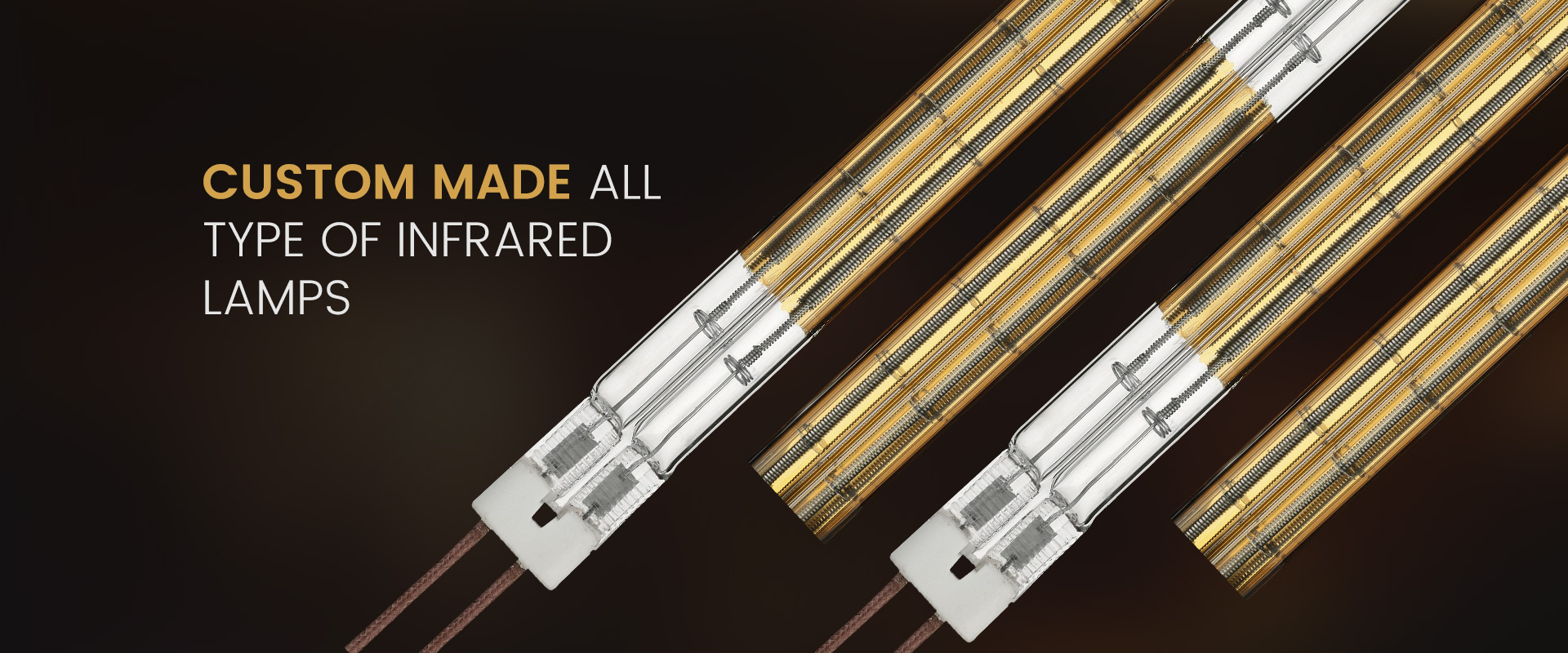
Q1: What makes an infrared tube “high power”?
Combination of high surface power density (tens to over a hundred kW/m² possible depending on tube type) and fast response. SW tubes lead on both; FMW approaches their agility with MW spectral benefits.
Q2: How do I decide between short-wave and medium-wave?
Start with spectral absorption of your material and the process dynamics you need. MW often wins for water-based chemistries and many polymers; SW wins for extreme ramp, penetration, or reflective surfaces.
Q3: Do I need gold reflectors?
If your bottleneck is peak irradiance at a constrained standoff, gold’s high IR reflectivity helps. If you need wider, more uniform coverage, white ceramic reflectors can be the better fit.
Q4: What about safety and approvals?
Design toward UL 499 (or local equivalents), add interlocks and over-temp cutouts, and follow plant electrical codes and guarding standards.
Last modified: 2025-11-10 JST — Huai’an Yinfrared Heating Technology Editorial Team


