Author: Site Editor Publish Time: 2025-10-28 Origin: Site
Last updated: August 29, 2026
Industrial infrared heat lamps differ in emission behaviour, response, construction, reflector and electrical interface. Selecting a type should start with the product and process, then translate that duty into a complete lamp specification.
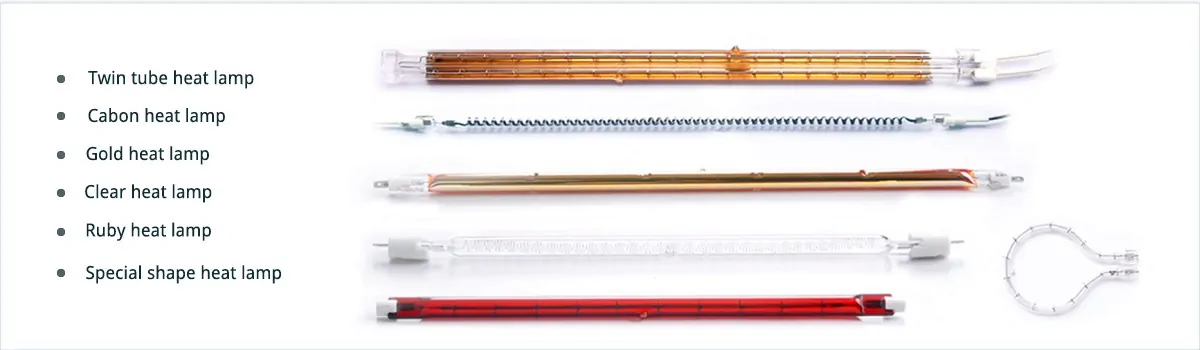
Short-wave halogen, carbon, fast medium-wave and medium-wave constructions offer different response and spectral behaviour. No family is universally best; material, depth, speed and control requirements decide the fit.
Record voltage, wattage, circuits, total length, heated length, cold ends, tube shape, terminals and leads. Separate active geometry from overall fit dimensions.
Reflector, twin-tube or single-tube form, coating, sealing and mounting should match the machine environment and optical direction.
| Input | Why it matters | Record |
|---|---|---|
| Short wave | Fast response and high source temperature | Rapid controlled processes |
| Carbon or FMW | Intermediate response and spectrum | Drying and plastic heating trials |
| Medium wave | Longer response in robust constructions | Moisture and steady process duty |
Review cold-start conditions, switching method, zone size, sensor position and line-speed logic. Fast lamps still require a controller and protection suited to the actual load.
Confirm fit, current, heat profile, product temperature and final quality. Use a controlled first article when replacing an existing lamp or introducing a custom design.
Coordinate the emitter with YFR industrial infrared heating lamps and heating modules and controls. Confirm the final configuration with product trials and documented acceptance limits.
No. Element and operating temperature are more directly related to emission.
Not unless voltage, geometry, optics and interfaces also match.
They affect mounting, seals and the position of the active zone.
It can direct more radiation toward the product when orientation and environment are suitable.
Send YFR your material, dimensions, target temperature, cycle time and current equipment details for an application-specific review.


