Author: Site Editor Publish Time: 2025-10-30 Origin: Site
Last updated: August 29, 2026
Infrared heater power is often stated in watts, while the process responds to energy reaching a particular area over time. Installed watts, power density and absorbed heat are related but not identical. Working distance, reflector geometry, product motion and heat loss determine how useful the rated power becomes.
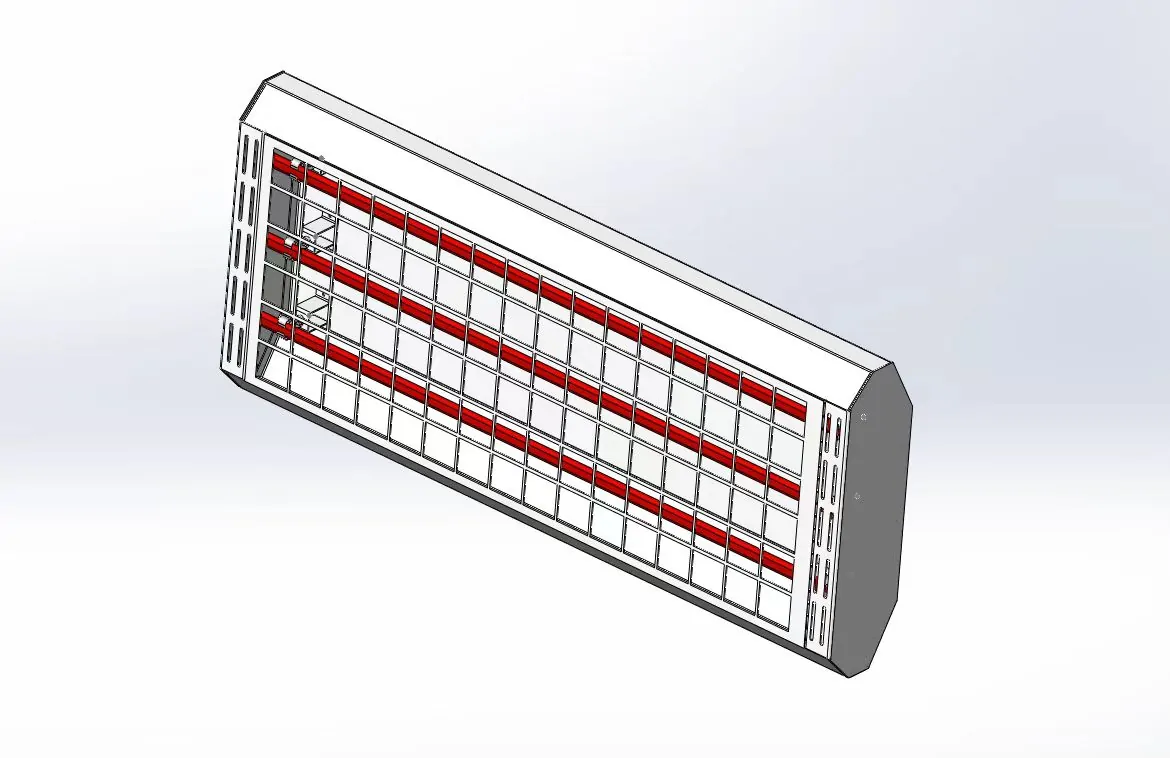
A simple installed power-density estimate is total lamp wattage divided by the nominal heated area. It is useful for comparing layouts, but it is not the radiation received by the product. Some energy is reflected outside the target, absorbed by the fixture, lost through open space or blocked by supports.
Use the estimate as a starting point and verify the real process with temperature and quality measurements.
Increasing distance generally spreads radiation over a larger area and can improve overlap between adjacent lamps, but it normally reduces peak intensity. A shorter distance can increase local intensity while making lamp spacing, part height and alignment more critical. Reflectors and emitter length mean a real heater does not behave as a perfect point source.
Do not apply the inverse-square law blindly to an extended lamp or reflector assembly.
| Variable | Process effect | Useful measurement |
|---|---|---|
| Lamp spacing and reflector | Changes overlap and edge loss | Cross-area temperature map |
| Working distance | Changes peak intensity and uniformity | Temperature at several distances |
| Material colour and chemistry | Changes absorption and reflection | Trial with production material |
| Line speed or dwell | Changes energy delivered per part | Time in each heating zone |
| Airflow and surroundings | Changes convective losses | Ambient and product temperatures |
For a conveyor or web, calculate exposure time from heated length and line speed. Then compare the product mass, specific heat, temperature rise and expected losses. This energy balance does not predict spectral absorption or temperature uniformity, but it can identify an obviously undersized concept before a trial.
For batch heating, include warm-up, holding and unloading conditions rather than using peak load alone.
Test at fixed material, lamp type and airflow. Change distance, power and line speed one at a time. Record centre and edge temperatures, final product quality and any fixture temperature limit. A successful recipe must tolerate normal variation in part position and incoming temperature.
Compare available industrial infrared lamps and infrared heating modules.
No. It usually describes installed or nominal power density. Absorbed power depends on the entire optical and thermal arrangement.
There is no universal distance. It must balance intensity, uniformity, part height, cooling, guards and temperature limits.
No. Drying chemistry, heat transfer, exhaust, product limits and downstream cooling may remain the controlling factors.
Map the temperature profile first, then adjust lamp overlap, reflector geometry, edge zoning or insulation without overheating the centre.
Send YFR the heated area, distance, speed and temperature target for a preliminary emitter review.


