Author: Site Editor Publish Time: 2025-08-06 Origin: Site
Last updated: August 28, 2026
Retrofitting infrared lamps into an existing industrial oven can add fast, targeted heating without replacing the entire machine. A successful retrofit depends on the process target, available space, electrical capacity, airflow, control strategy and safety—not on lamp wattage alone.
First identify the limiting step. Typical objectives include faster warm-up, higher line speed, improved edge temperature, a compact preheat stage, quicker recovery after loading or better control of a specific coating zone. A retrofit should have one or more measurable acceptance criteria.
Starting and target product temperature
Maximum allowable surface temperature
Current and required cycle time or line speed
Acceptable temperature variation across the part
Required product result such as dryness, adhesion, forming or cure
| Survey item | Data to record |
|---|---|
| Heating space | Usable length, width, height, access and working distance |
| Product movement | Conveyor speed, indexing pattern, orientation and loading variation |
| Electrical supply | Voltage, phase, available current, cabinet space and protective devices |
| Air system | Exhaust rate, recirculation, cooling air and solvent or moisture load |
| Construction | Insulation, reflective surfaces, observation windows and heat-sensitive components |
| Controls | Existing PLC, temperature sensors, line interlocks and permissible control signals |
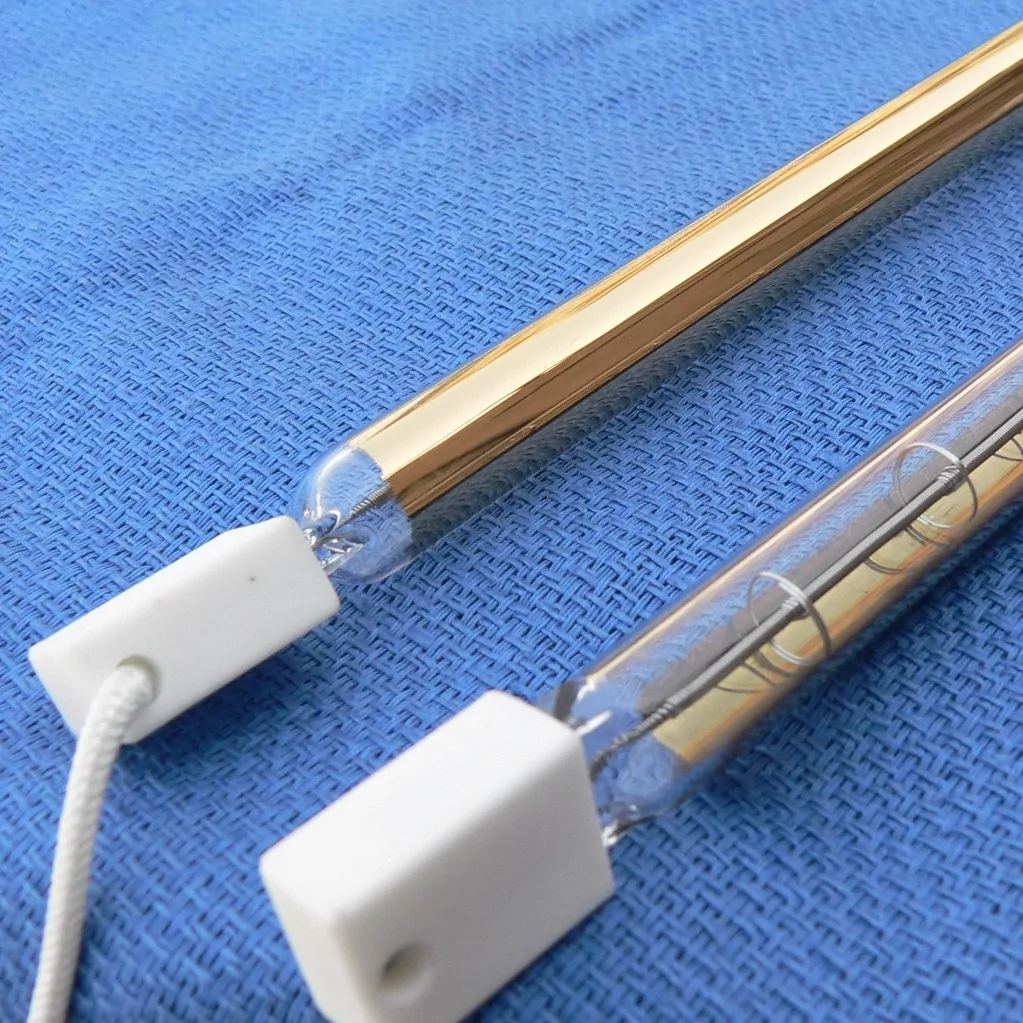
Short-wave lamps provide very fast response and high intensity. Fast medium-wave, conventional medium-wave and carbon emitters can offer better coupling for many coatings, plastics and drying processes. The correct choice depends on absorption, product thickness and the time available.
When retrofitting a small zone, response speed may matter as much as total power because the lamps must follow conveyor stops and recipe changes without overheating stationary product.
Map the required heated width and length, then account for cold ends, edge losses and spacing between emitters. Reflectors should direct useful radiation toward the workpiece while allowing safe lamp temperature and maintenance access. For wide products, divide the array into zones so edge or cross-web corrections can be made without changing the whole oven.
YFR infrared heating modules can combine lamps, reflectors and mechanical support when a complete array is more practical than individual emitters.
Verify supply voltage, total current, branch protection, conductor temperature rating, switching devices and cabinet cooling. The control method must suit the lamp type and process. Options may include staged switching, phase-angle control, burst firing or closed-loop regulation.
Interlock heater output with conveyor motion, airflow and over-temperature protection. A suitable infrared lamp power controller can improve recipe control, but it does not replace correctly sized protection and safety circuits.
Infrared heats the product directly, but drying still requires a path for moisture or solvent to leave. Check whether the existing exhaust can handle the revised evaporation rate. Lamp seals, reflectors, cables and nearby components may also need cooling or thermal shielding.
For flammable vapours or regulated processes, the complete oven must be reviewed by qualified safety professionals against the applicable electrical, ventilation and fire requirements.
Record the existing temperature profile and product result.
Commission one zone at conservative power.
Measure surface and internal temperature where relevant.
Check uniformity, exhaust behaviour and stationary-line protection.
Increase power or line speed in documented steps.
Save the approved recipe and maintenance settings.
Do not claim an energy saving before comparing equivalent production output and product quality. The useful result is a verified process improvement under the same operating boundary.
Sometimes, but many processes benefit from a hybrid design. Convection can manage air temperature and moisture removal while infrared supplies rapid targeted energy.
Power must be calculated from the product load, absorption, exposure time, losses and required temperature rise. Oven dimensions alone are not sufficient.
Often yes, through suitable power-control hardware and interlocks. Confirm signal compatibility, switching method and response requirements.
Provide oven drawings, product details, line speed, temperature target, available space, electrical supply, airflow information and photographs of the existing heating zone.
Send YFR your oven layout and process data for an emitter, module and control review.


