Author: Site Editor Publish Time: 2025-10-30 Origin: Site
Last updated: August 29, 2026
A twin-tube infrared lamp uses two connected quartz channels to increase mechanical stiffness and provide a stable mounting geometry. It may contain one or more heating circuits, and it can be supplied with different elements, reflectors and terminations. The twin-tube shape alone does not define wavelength or output.
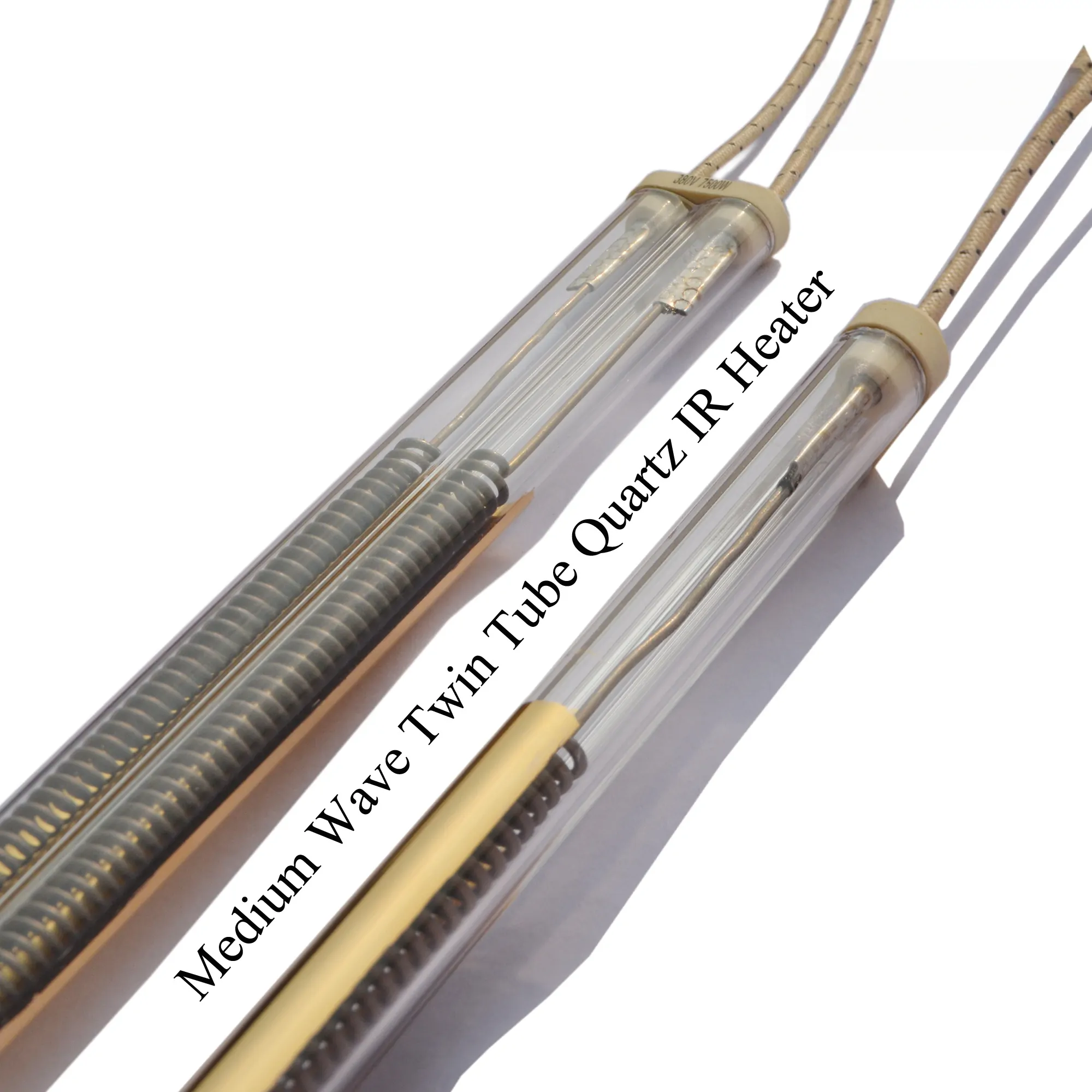
The bridge between the two quartz channels improves rigidity and provides reference surfaces for clips or supports. Circuit arrangement, cold ends and seals must still be protected from mechanical stress and excessive temperature.
Twin-tube lamps can use short-wave, fast medium-wave, medium-wave or carbon elements. Select the emission behaviour from the product and process; select the tube structure from the required power, rigidity and installation.
| Group | Required details | Verification |
|---|---|---|
| Electrical | Voltage, total wattage and circuits | Label and resistance |
| Dimensions | Cross-section, total and heated length | Drawing and caliper |
| Ends | Caps, leads, connectors and cold zones | End photographs |
| Reflector | Material, coverage and clocking | Installed orientation |
Supports should hold the lamp without point loading or twisting. Confirm clearances, lead temperature and the cooling arrangement. Do not allow clips to cover the active heated zone unless the design specifically permits it.
Review YFR infrared lamp constructions and heating modules.
Verify resistance before installation, check current after energising and compare the product-temperature profile with the approved reference. Inspect for arcing, seal overheating, vibration and reflector misalignment.
No. Power depends on the electrical and thermal design.
No. Cross-section, tolerances and cold-end design must match.
Yes. Incorrect orientation can send energy away from the target.
Yes. It provides a useful receiving and troubleshooting check.
Send YFR the original part number, dimensions and installation photographs for a replacement review.


