Author: Process Heating Engineer Publish Time: 2025-09-02 Origin: Site
Last updated: September 2, 2026
For industrial equipment only, review YFR infrared heating lamps and the industrial-versus-household infrared lamp guide. These products are not offered as animal-habitat heaters.
A standard industrial infrared lamp should not be installed directly in a reptile enclosure.
Industrial lamps may operate at high wattage, require specialized ceramic holders, use exposed terminals or lead wires, and depend on a metal reflector housing or machine safety enclosure. They are normally integrated by equipment manufacturers into drying ovens, printing machines, coating lines, PET heating systems and other industrial equipment.
A reptile heat lamp, ceramic emitter or heat projector should be sold and labeled for animal-habitat use. It should be compatible with an appropriate fixture, thermostat and protective guard, and should be used according to the manufacturer’s instructions and the requirements of the particular species.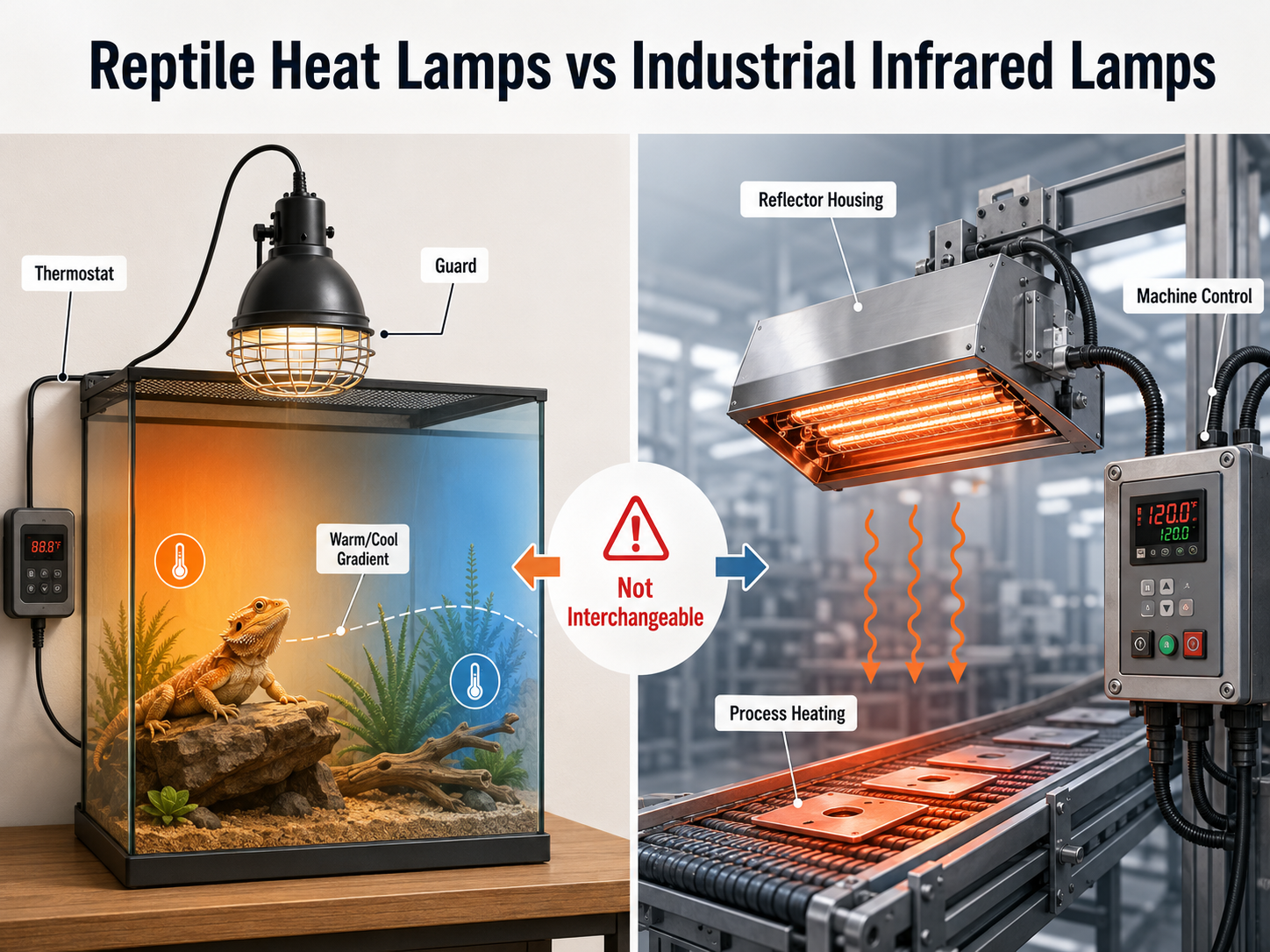
Reptiles are ectothermic animals. They rely on environmental heat to regulate body temperature rather than maintaining one constant internal temperature independently of their surroundings.
This does not mean that the entire enclosure should be heated to one uniform temperature. A suitable habitat normally provides a warmer basking area and a cooler area so the animal can move between different thermal conditions.
The Merck Veterinary Manual’s reptile husbandry guidance explains that appropriate heat sources should be thermostat controlled, screened from the animals and positioned toward one end of the enclosure to provide a thermal gradient.
The correct gradient is species-specific. A desert lizard, tropical snake and crepuscular gecko may require different basking temperatures, nighttime conditions, humidity and lighting.
For that reason, a heater should not be selected from enclosure size or wattage alone.
A reptile heating product is designed around animal husbandry and enclosure safety.
An industrial infrared lamp is designed around a manufacturing process. Its purpose may be to heat plastic, dry ink, cure paint, soften an adhesive, preheat a PET preform or raise the temperature of a moving industrial product.
| Factor | Reptile Heating Product | Industrial Infrared Lamp |
|---|---|---|
| Intended use | Animal habitats and terrariums | Industrial machinery and process heating |
| Product format | Complete bulb, emitter or habitat heater | Lamp or emitter component |
| Typical control | Species-appropriate thermostat and lighting timer | SCR, thyristor, PLC, PID or machine controller |
| Installation | Rated fixture with guard and safe enclosure position | Machine holder, reflector housing or heating module |
| Electrical structure | Usually designed for compatible consumer fixtures | May use custom voltage, terminals and industrial wiring |
| Temperature objective | Controlled habitat gradient | Product heating, drying, curing or forming |
| User guidance | Species and enclosure instructions | Machine drawings and process specifications |
| Safety validation | Animal-habitat use | Industrial equipment integration |
The presence of infrared radiation does not make the two product categories equivalent.
A common approach is to select a reptile lamp by comparing enclosure size with bulb wattage. This is not reliable by itself.
The resulting temperature also depends on the distance from the lamp to the basking surface, enclosure ventilation, room temperature, reflector design, fixture position, substrate, enclosure material and thermostat setting.
A 100-watt lamp mounted close to a dark rock can create a very different surface temperature from the same lamp mounted farther away above a ventilated enclosure.
The lamp’s beam shape also matters. A narrow radiant beam may create a very hot spot while leaving most of the enclosure cool. A broad emitter may increase ambient temperature but provide an inadequate basking zone.
The correct setup must be checked through actual temperature measurements at locations accessible to the animal.
There is no single “safe reptile temperature” that applies to every species.
The warm side, cool side, basking surface and nighttime minimum may all differ according to the animal’s natural habitat and behavior.
Species-specific care information should therefore be obtained from a reptile veterinarian, recognized animal-welfare organization or experienced specialist.
For example, the RSPCA’s corn snake care guidance recommends placing the heat source at one end to form a thermogradient, guarding the lamp, controlling it with a thermostat and checking both the basking and cool areas with separate temperature measurements.
A fixed wattage recommendation copied from another enclosure may not reproduce the required conditions.
A thermostat regulates the heat source. A thermometer measures the resulting temperature.
These functions should not be confused.
The thermostat probe should be positioned according to the heater type, enclosure layout and manufacturer’s instructions. An incorrectly positioned probe may register a safe temperature while another accessible surface becomes too hot.
Independent temperature measurement is still required because a thermostat or probe can be inaccurate, displaced or affected by the surrounding structure.
A practical setup may include a digital thermometer near the basking area, another at the cool end and a handheld infrared thermometer for checking accessible surface temperatures.
An infrared thermometer measures surface temperature rather than air temperature. It should therefore supplement rather than automatically replace fixed air-temperature sensors.
A heat source must not be positioned where the animal can touch the hot bulb, ceramic emitter or exposed electrical parts.
A suitable wire guard or other approved protective structure reduces the risk of direct thermal burns and injury if a bulb breaks.
The fixture must also be rated for the lamp type and electrical load. A high-temperature ceramic socket may be required for some reptile heating products, while ordinary plastic fittings may deform or overheat.
Industrial lamps often use custom ceramic caps, metal clips, lead wires or open terminals that are designed to sit inside a machine housing. These parts should not be treated as consumer lamp fittings.
A protective cage cannot make an otherwise unsuitable industrial component appropriate for animal use. The complete product and installation must be designed for the habitat.
YFR’s industrial infrared heating lamps are developed for process equipment.
Depending on the model, they may have high power density, long heated lengths, directional reflector coatings, custom electrical terminals or voltages selected for machinery rather than household fixtures.
Some industrial lamps are designed for rapid response and concentrated surface heating. A short wave infrared lamp used in PET processing or paint curing can create intense localized radiation that would be difficult to manage safely inside a small terrarium.
Other industrial emitters operate more gradually. However, a medium wave infrared lamp is still not automatically a reptile product merely because its heating response is gentler.
The central issue is not only wavelength. It is the complete design, including fixture, guard, wiring, control, mounting distance, surface temperature and intended certification.
Some older reptile products use red, blue or purple visible light and are marketed for nighttime heating.
Visible colored light should not automatically be described as invisible to reptiles or guaranteed not to affect their day-and-night behavior.
Reptile vision and lighting needs vary by species. A visible red lamp may still alter the enclosure’s nighttime light conditions.
When nighttime background heat is necessary, the product should be selected according to species-specific veterinary or husbandry guidance. Non-light-emitting options designed for reptiles may be considered where appropriate, but they must still be controlled by a thermostat and protected from animal contact.
Daytime basking heat, visible light and UVB provision are also separate functions. One heating lamp does not necessarily provide all of them.
Infrared radiation provides heat. UVB radiation serves a different biological function.
Many reptiles require suitable UVB exposure for vitamin D3 production and calcium metabolism, but the required UV level depends on the species and habitat design.
An industrial infrared lamp does not provide a validated reptile UVB output.
Similarly, a reptile UVB lamp may not supply enough heat to create the required basking zone.
A complete habitat may therefore require separate but coordinated heat, visible-light and UVB systems.
Each product should be installed at the manufacturer’s specified distance and checked at the level the animal can reach.
Terms such as gold lamp, ruby lamp, red lamp and carbon lamp describe appearance, material or construction, but they do not determine whether a product is safe for a reptile enclosure.
A gold reflector on an industrial lamp is intended to direct radiation toward one side of a machine. It is not automatically an energy-saving or safety feature for a terrarium.
A red quartz tube may change visible light or radiation characteristics, but it does not replace a thermostat, guard or species-specific setup.
A carbon element may provide a different radiant response from tungsten, but the complete heater still needs to be designed and tested for the intended environment.
Heating safety comes from complete product design and correct installation, not from the tube color.
The first question should be the reptile species, not the wattage of the lamp.
The enclosure dimensions, ventilation, ambient room temperature, required thermal gradient, basking surface, nighttime minimum, UVB requirement and humidity must then be considered together.
The selected heater should be clearly intended for reptile or animal-habitat use. Its fixture, guard and thermostat should be compatible with the product.
After installation, the enclosure should be monitored at several locations before the animal is exposed to the new setup.
The animal’s ability to move away from the heat is essential. A small enclosure or poorly positioned lamp may prevent effective thermoregulation even when the thermostat reading appears acceptable.
| Information | Why It Matters |
| Reptile species and life stage | Determines temperature, light, UVB and humidity requirements |
| Enclosure dimensions | Affects heat distribution and gradient |
| Enclosure material and ventilation | Affects heat retention |
| Room temperature | Changes the required heating capacity |
| Basking and cool-zone targets | Defines the thermal gradient |
| Day and night requirements | Determines timing and heater type |
| Fixture and socket rating | Prevents electrical and thermal mismatch |
| Guard design | Helps prevent burns and contact |
| Thermostat type | Must suit the selected heat source |
| Sensor locations | Determines control and measurement accuracy |
| Manufacturer instructions | Defines distance, orientation and safe use |
These details should be confirmed using information specific to the animal rather than a universal online wattage chart.
YFR does not position its standard industrial lamp range as reptile-enclosure equipment.
The company supplies industrial infrared heating lamps, custom emitters and infrared heater modules for equipment manufacturers and industrial process systems.
Typical applications include printing and ink drying, coating curing, PET blow molding, plastic forming, industrial ovens, wood processing, textile drying and glass heating.
Industrial modules can combine lamps, reflectors, metal housings, brackets, wiring and controls. This is fundamentally different from a pet heater intended to be installed above or inside a terrarium.
Customers seeking a heating component for industrial equipment should provide the voltage, wattage, dimensions, heated length, reflector direction, working distance and machine drawing.
Reptile owners should instead select products specifically designed and labeled for animal-habitat use.
Professional advice is appropriate when the species has specialized temperature, humidity, UVB or nighttime requirements.
A reptile veterinarian should be consulted when an animal shows signs of possible thermal stress, burns, persistent inactivity, appetite changes or other health concerns.
Equipment manufacturers and pet-product instructions can explain installation, but they do not replace species-specific veterinary care.
The safest approach is to combine reliable husbandry guidance, suitable reptile products, thermostat control and independent temperature measurements.
Standard industrial infrared lamps should not be placed directly in reptile enclosures. They are equipment components and may require specialized fixtures, wiring, housings and controls that are not designed for animal habitats.
No. Both may emit infrared radiation, but their intended use, power, fixture, wiring, safety design and installation requirements are different.
Wattage cannot be selected from enclosure size alone. Species requirements, mounting distance, room temperature, ventilation, fixture design and thermostat control must all be considered.
No. Heating and lighting requirements vary by species. Some habitats use basking lamps, ceramic emitters, heat projectors, panels or other products designed for reptiles.
A visible red lamp should not automatically be treated as darkness. Nighttime heating should follow species-specific guidance and use a suitable thermostat-controlled product designed for reptiles.
Not necessarily. Infrared heat and UVB radiation are different. A product must specifically provide an appropriate UVB output if it is being used for that purpose.
No. A thermostat is essential, but independent thermometers should also be used to confirm temperatures in the basking area and cool zone.
A guard helps prevent direct contact burns and injury from a hot or broken bulb. It must be suitable for the heater and installed so the animal cannot reach the heat source.
YFR’s standard infrared lamps are industrial components for machinery, drying, curing, forming and process heating. They are not marketed as reptile-enclosure products.
Industrial infrared lamps should not be substituted for purpose-designed reptile heating products.
A safe reptile setup requires a species-specific temperature gradient, a suitable thermostat, independent temperature measurement, a rated fixture, a protective guard and appropriate day-and-night lighting.
The term “infrared” only describes part of the energy emitted by the heater. It does not establish that the complete product is appropriate for an animal habitat.
Reptile owners should follow veterinary or recognized husbandry guidance and use heaters specifically designed and labeled for their intended enclosure.
Industrial customers looking for lamps, modules or replacement emitters should select products according to the equipment, material, process temperature and control requirements.
YFR supplies components for industrial drying, curing, forming and process-heating equipment. We do not select heaters for animal habitats or provide veterinary husbandry advice. For an industrial machine application, send the voltage, wattage, dimensions, mounting and process requirements for a compatibility review.


