Author: Site Editor Publish Time: 2025-10-31 Origin: Site
Last updated: August 29, 2026
Fast-response quartz infrared lamps can follow production changes quickly, but the system must handle cold-start electrical behaviour, thermal expansion, cooling and high local irradiance. Integration should begin with a load and interface review, not only a lamp wattage choice.
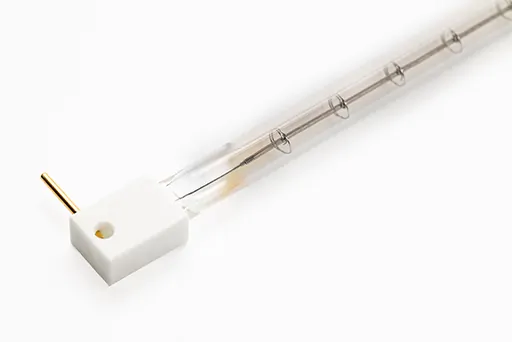
Document supply voltage, lamp circuits, rated current, cold-start behaviour, switching frequency and controller compatibility. Check cables, terminals, protection and upstream capacity for the full heater bank.
Provide correct supports, cold-end clearance, reflector orientation, service access and allowance for thermal movement. Avoid transferring frame misalignment into the quartz tube.
Select control hardware for the lamp load and required response, then define zones that match product width and motion.
| Input | Why it matters | Record |
|---|---|---|
| Electrical | Prevents overloaded switching and wiring | Load and start review |
| Mechanical | Protects quartz and optical alignment | Mounting and clearance |
| Control | Matches energy to production state | Zones and fault tests |
Protect seals, terminals and reflectors from excessive temperature. Keep cooling paths clear and prevent oil, dust or process deposits from accumulating on quartz and optical surfaces.
Verify current, switching, zone response, sensor behaviour and product temperature. Test gaps, acceleration, line stops, cooling loss and emergency conditions before production release.
Coordinate the emitter with YFR industrial infrared heating lamps and heating modules and controls. Confirm the final configuration with product trials and documented acceptance limits.
A cold filament can draw differently from its hot operating condition.
The controller must be rated for the actual lamp load and switching duty.
No. The machine must still command a safe state promptly.
Check quartz, terminals, holders, reflectors, cooling and contamination.
Send YFR your material, dimensions, target temperature, cycle time and current equipment details for an application-specific review.


