Author: Process Heating Engineer Publish Time: 2025-07-21 Origin: Site
Last updated: August 30, 2026
Inkjet printing often looks fast until drying becomes the bottleneck. The print engine may keep up, but the line slows down because the ink film still needs time to set, release moisture or solvents, and resist smearing before the substrate moves to the next step. In many cases, the real production limit is not printhead speed. It is drying stability.
This is where infrared drying becomes valuable. A well-matched infrared system can accelerate ink drying, improve surface stability, and reduce waiting time between print and handling. For inkjet lines running on paper, film, labels, packaging materials, or coated substrates, infrared drying is often one of the most practical ways to raise throughput without expanding machine footprint.
The key is not simply adding more heat. The key is delivering the right amount of radiant energy to the ink and substrate at the right distance, power level, and dwell time. Done correctly, infrared drying can reduce smearing, blocking, and ghosting while keeping heat-sensitive materials under control.
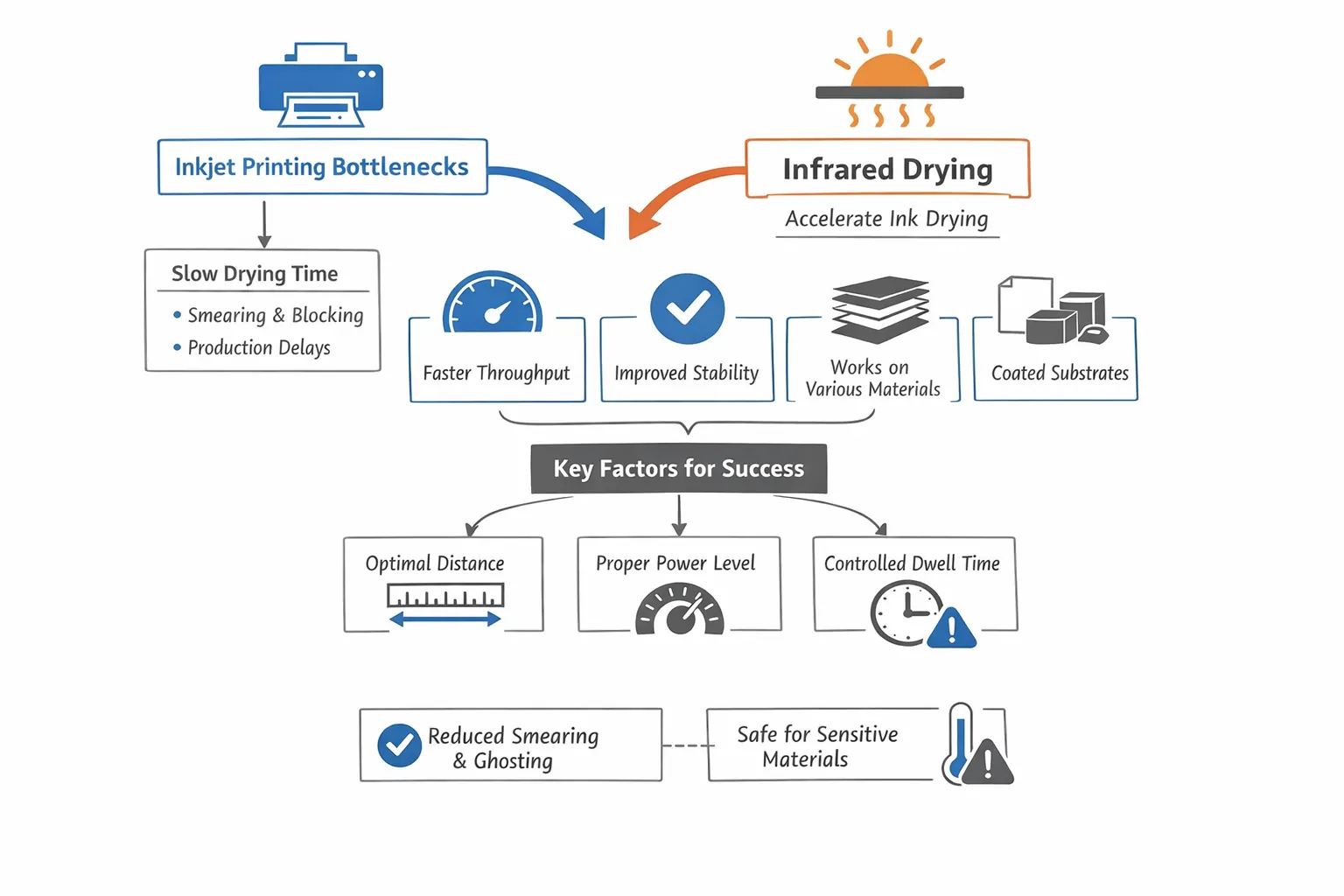
Inkjet printing creates a thin but highly sensitive wet layer. That layer must stabilize quickly enough to avoid image defects during transport, stacking, rewinding, or downstream finishing. When drying is too slow, the line begins to show problems such as:
smearing during transport
offsetting or set-off after printing
poor color consistency caused by unstable ink fixation
blocking when printed surfaces contact each other
reduced line speed to protect print quality
substrate distortion when operators overcompensate with excessive heat
In many production environments, operators try to solve these issues by increasing ambient heat or extending dwell time. That may help temporarily, but it usually creates a new compromise between speed and quality. A more effective solution is to make the drying stage more targeted.
Infrared drying transfers radiant energy directly to the printed layer and surrounding substrate surface instead of relying only on hot air to warm the whole environment. In practical terms, that means faster drying response and more efficient energy use in the drying zone.
For inkjet printing, infrared drying is especially useful when the process needs:
shorter drying windows
higher line speed
better control over wet ink behavior
reduced surface smearing
more stable print handling after deposition
Infrared is not always used alone. In many printing lines, it works best as part of a combined drying strategy with hot air, airflow management, or exhaust control. The infrared section provides rapid surface energy, while the rest of the system helps carry moisture or solvent away.
The advantage of infrared in printing is not just speed. It is controllability.
A properly designed infrared drying stage can help the printer tune the process around actual production conditions, including ink load, substrate sensitivity, image density, and line speed. Compared with a broad hot-air-only approach, infrared gives the line a more direct tool for addressing the printed zone.
This matters most when:
the substrate is sensitive to excessive bulk heating
the image has high coverage areas that dry more slowly
the line must maintain speed without increasing smear risk
the press cannot be extended with a long drying tunnel
drying needs to be upgraded on an existing machine footprint
In these cases, infrared is often selected because it adds drying intensity without forcing a full redesign of the machine layout.
Hot air is still useful in printing, but by itself it is often less responsive than a targeted infrared stage. Hot air systems need time and airflow volume to move heat into the process. Infrared responds faster and can concentrate energy where drying is actually needed.
That does not mean infrared always replaces hot air. In many printing applications, the best setup is a coordinated system:
infrared for fast surface energy input
hot air for moisture or solvent removal
airflow control for drying uniformity
power adjustment for different print loads
If the process uses only hot air, the line may need longer drying distance or lower speed. If it uses only excessive IR power without enough process balance, the substrate may overheat or the ink may dry unevenly. The strongest result usually comes from matching the infrared stage to the real ink and substrate behavior.
Smearing appears when the printed film is still unstable during transport. Infrared drying can help the line firm up the print earlier, reducing the chance of contact damage.
When printed surfaces contact each other before the ink is sufficiently dry, blocking or set-off can occur. A properly tuned infrared stage can shorten the time before the print is safe for stacking or rewinding.
Heavy ink coverage usually dries more slowly than light graphics. Infrared drying helps the line maintain better consistency across different job types without relying only on lower machine speed.
If operators try to solve slow drying by simply adding more heat everywhere, films and lightweight materials may curl, shrink, or distort. Infrared systems must therefore be selected and positioned with substrate sensitivity in mind.
Paper, labels, coated stock, films, and specialty packaging substrates do not respond the same way. An infrared system with adjustable power and appropriate lamp type helps the printer handle this variation more effectively.
Not every IR lamp is suitable for every printing machine. The selection should be based on the process, not on a generic lamp description.
The most important factors are:
A coated paper stock behaves differently from PET film, PP film, label stock, or flexible packaging material. Heat-sensitive substrates usually need tighter control and more careful lamp-to-web distance.
Water-based, solvent-based, UV-assisted, and hybrid printing systems do not dry the same way. The IR stage should support the chemistry in use, not fight against it.
A slow line can tolerate a gentler drying window. A fast line often needs stronger radiant response or a better-optimized combination of IR and airflow.
Solid areas, dark graphics, and dense image regions may require more drying support than light text or low-coverage designs.
Retrofitting an existing inkjet machine often means working within tight mechanical limits. In that situation, lamp size, reflector shape, mounting orientation, and access for maintenance all matter.
A useful printing IR system should not be limited to a simple on/off state. Adjustable power helps the machine respond to job changes, substrate changes, and speed changes more effectively.
For many inkjet printing applications, the most practical approach is not “maximum lamp power.” It is balanced drying design.
A strong configuration usually includes:
lamp type matched to the substrate and ink behavior
reflector geometry that focuses energy on the effective print zone
enough airflow or exhaust support to remove released moisture or solvent
adjustable output for different jobs
stable installation distance to maintain repeatable process conditions
This is why printing-machine IR projects should be treated as process upgrades rather than simple component replacements.
Good IR drying performance depends heavily on how the lamp is installed.
Key installation points include:
keep the heating zone aligned with the actual printed area
avoid placing the lamp so close that local overheating occurs
maintain stable distance across the web or substrate path
allow for maintenance access and reflector cleaning
verify that airflow does not disturb the print while still supporting drying
use controls that let operators adjust output by job condition
In practice, a poorly positioned high-quality lamp can still perform badly. Installation quality is part of drying performance.
A few process rules usually make more difference than adding raw power.
Match the IR intensity to the substrate, not just the ink.
Increase drying support gradually and observe print stability.
Watch for both under-drying and heat damage.
Check dense image areas separately from light coverage zones.
Clean reflectors and lamp surfaces regularly to maintain output consistency.
Review line speed, exhaust, and web handling together instead of treating the lamp as an isolated fix.
These adjustments are often what separate a stable printing upgrade from a frustrating one.
A label converter runs an inkjet line on coated stock. The print engine can run faster, but operators keep reducing speed because dark graphics smear during transport to the next section. Hot air alone helps, but the drying window remains too long.
An infrared drying stage is added above the printed path with controlled output and reflector focus aimed at the effective print zone. After tuning distance, airflow, and lamp power, the line can hold a higher production speed with fewer smearing complaints and more consistent print handling.
The main gain is not just “more heat.” The gain comes from putting drying energy where it matters and reducing wasted time between print deposition and safe downstream movement.
Not automatically. The suitability depends on the ink system, substrate, machine layout, and available drying space. Many machines can benefit from IR, but the setup must be matched to the process.
Sometimes, but not always. In many printing applications, infrared works best together with hot air or controlled airflow rather than as a complete replacement.
Common signs include smearing, blocking, slow dry-down on dark coverage, reduced line speed, and repeated quality variation caused by unstable drying.
It can if the system is oversized, placed incorrectly, or run without proper control. The purpose of a good IR design is to improve drying without overheating the substrate.
The most important factors are substrate type, ink system, line speed, print coverage, installation space, and output controllability.
[Printing Application Upgrade]
If your inkjet printing line is limited by slow drying, smearing, or reduced output speed, the next step is not simply adding more heat. It is choosing an infrared drying setup that matches your substrate, ink system, and machine conditions.
YFR can help evaluate lamp type, drying layout, reflector configuration, and control logic for inkjet printing applications where faster drying and better print stability are required.
Review YFR replacement infrared lamps and heating modules and controls. Confirm lamp compatibility and dryer settings through press trials.
Send YFR your material, dimensions, target, cycle time and current equipment details for an application-specific review.


