Author: Process Heating Engineer Publish Time: 2026-04-07 Origin: Site
Last updated: September 1, 2026
Set-off in the delivery pile. Sheets that look acceptable at the press exit but mark on the back side a few minutes later. Jobs that only run safely when the speed margin is reduced. Coated stocks that behave well one day and become unstable on the next run. In real production, infrared drying for offset printing is usually discussed when one of these symptoms starts limiting throughput or quality.
For equipment planning, compare YFR industrial infrared lamps and Heidelberg replacement lamps.
That matters because offset printing drying problems are rarely just “slow drying.” In sheetfed offset, the immediate question is often whether the ink film has set enough to survive transfer, piling, coating, and downstream handling, not whether it appears superficially dry. Ink set-off is specifically associated with wet ink transferring to the reverse side of the next sheet in the delivery pile, and published work on sheetfed offset drying shows that restricted air access in the pile can slow completion of drying dramatically compared with full air exposure.
That is why offset drying trouble should be treated as a process-window problem. The root cause may be energy delivery, but it may also be ink-paper interaction, coating behavior, substrate sensitivity, emulsification level, delivery conditions, or aging hardware. ISO 12647-2 frames offset printing as a controlled production process with defined parameters, and the paper/ink literature reaches the same practical conclusion: drying behavior depends on the interaction of ink formulation, coating structure, substrate porosity, and production conditions.
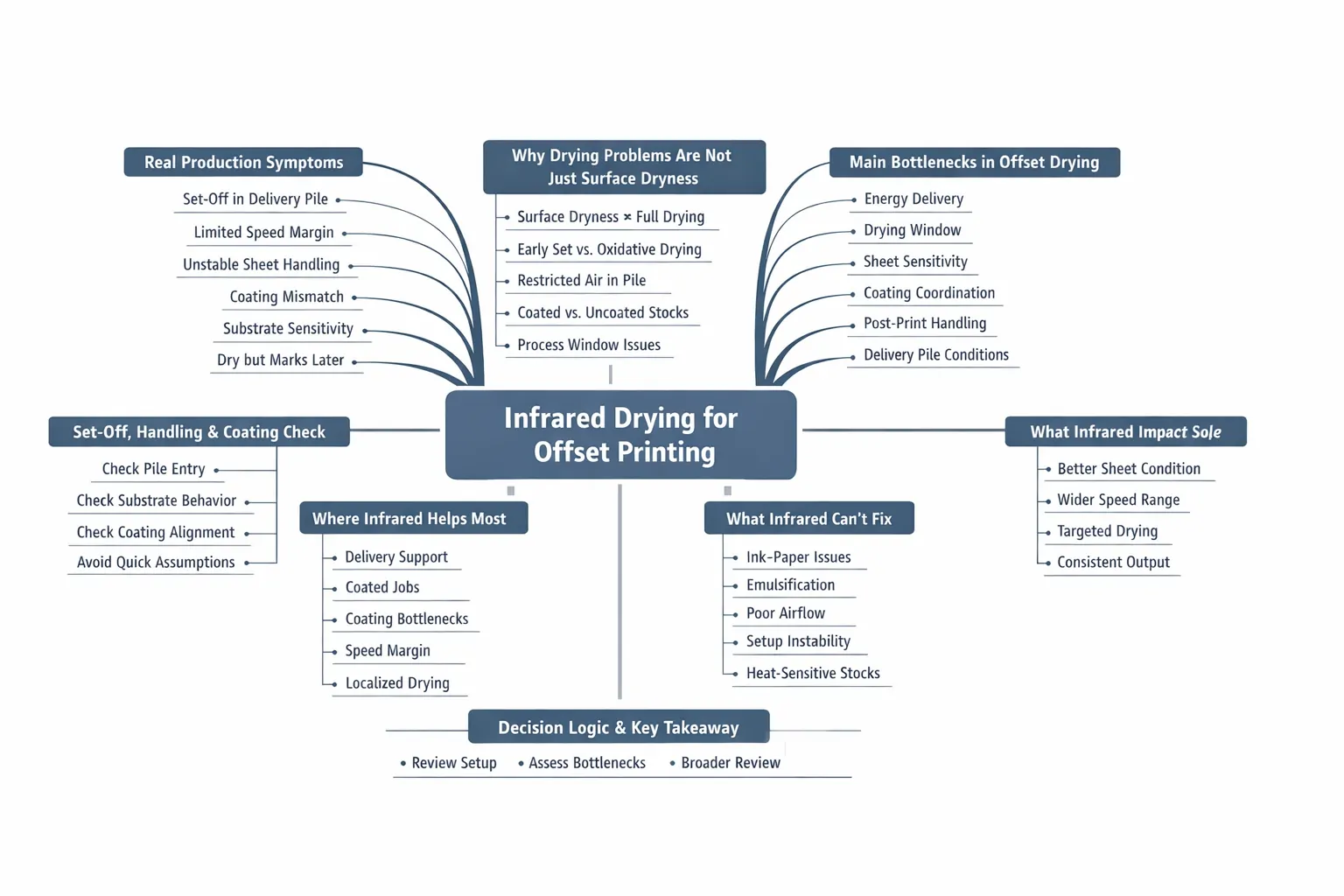
In conventional sheetfed offset, the film does not “finish drying” in one simple step. Early-stage setting involves movement of lower-molecular components away from the ink film, while later drying depends on oxidative polymerization of the binder system. That is one reason a sheet can look stable at the delivery end yet still remain vulnerable to blocking, marking, or pile-related set-off.
Coated substrates make this more complex, not less. Reviews of offset ink interaction with coated paper show that coating porosity, pore size, latex properties, and ink rheology all influence setting behavior. Other studies also note that coated papers can be more susceptible to defects such as set-off and mottling when the paper-ink interaction is not well balanced.
A more useful production question is this: what is the symptom actually telling you?
Offset symptom | Likely drying meaning |
|---|---|
Backside marking in the delivery pile | The film may have skinned enough to leave the last unit clean, but not set enough for pile pressure and reduced air access |
Stable run on uncoated stock, unstable run on coated stock | Ink-paper interaction and coating structure may be part of the limit, not just dryer output |
Speed must be reduced on heavy solids or dense dark work | The job may be energy-limited, especially at the delivery end |
Aqueous coating behaves inconsistently across jobs | Drying and coating coordination may be mismatched |
Sheets curl, wave, or show heat sensitivity | The issue may be excessive or poorly distributed energy, not insufficient drying |
That distinction is important for cluster planning as well. A plant dealing with broad slow ink drying on printing presses problems may need a wider diagnosis than the narrower offset-process question addressed here. The offset page is about judging where IR helps inside the press window, not about treating every drying complaint as the same problem.
Infrared helps most when the press needs more controlled energy at the right point, not merely more heat in general.
One of the most defensible uses of IR on offset presses is to improve the condition of the sheet before it enters the delivery pile. If the problem is marginal setting at the handoff from print to pile, localized IR can widen the window enough to reduce smearing and set-off risk without requiring a full press-speed retreat on every job.
This is especially relevant on high-coverage work, dense solids, coated board, and jobs where the last printed surface reaches the pile with very little tolerance. In those cases, IR is acting as a targeted control tool at a process choke point.
IR can also be useful where the constraint is tied to water-based coatings, varnishes, or similar surface layers that need faster first-stage moisture removal. Technical reviews of printing-ink drying note that IR is commonly applied in printing for dehydration-oriented tasks, particularly with water-containing layers. That is not the same thing as saying IR solves every offset ink-drying problem, but it does explain why coating-related bottlenecks often respond better than purely oxidative limits.
When a press runs most jobs well but loses stability on a narrow set of demanding combinations, IR is often worth reviewing. The classic pattern is a line that is fundamentally sound, yet repeatedly forced to slow down on:
heavy-coverage sheets
coated substrates
dark process builds
jobs with tight post-print handling windows
coating combinations with narrow tolerance
That is where a practical comparison with infrared drying vs hot air drying for printing becomes useful. Hot air and IR are not interchangeable in how they deliver energy, and the right choice depends on whether the bottleneck is moisture removal, surface energy delivery, substrate heat tolerance, or overall dryer architecture.
Infrared can improve process control. It cannot replace process balance.
A practical way to judge IR is to separate the effects it can often influence from the conditions that usually require wider correction.
What infrared can often improve | What usually requires wider process review |
|---|---|
Marginal setting before delivery piling | Ink-paper incompatibility across many stocks |
Narrow speed margin on difficult jobs | Excessive emulsification or unstable water balance |
Moisture-related coating bottlenecks | Delivery airflow, powdering, or post-print handling issues |
Uneven performance caused by weak or aged emitters | Broader press setup drift or maintenance neglect |
Localized drying support in retrofit zones | Substrate heat sensitivity that worsens under added energy |
In other words, IR is usually effective when the press is close to stable and needs targeted help. It is much less effective when the real issue sits elsewhere in the chain. The coating-and-paper literature consistently shows that substrate structure, porosity, and ink setting behavior strongly affect print performance. That is why simply raising energy does not always produce a better result.
Set-off is one of the clearest reasons offset plants start looking at IR, but it is also one of the easiest symptoms to misread.
If the only observation is “the pile marks,” the wrong conclusion is often “the dryer is weak.” Sometimes that is true. Sometimes the actual problem is that the job reaches the pile with too much residual vulnerability for the pile height, powder level, sheet temperature, coating condition, or time-to-finish sequence being used.
Three practical checks matter here.
If the first few hundred sheets look good and the pile becomes unstable later, look beyond raw dryer output. Delivery conditions, heat buildup, and pile behavior may be shifting during the run. Research on sheetfed offset drying also shows why pile conditions matter: drying completion under limited air exposure is much slower than with full air access.
Coated papers do not all accept and release ink components in the same way. Reviews and experimental work tie print quality differences to coating structure, surface topography, porosity, and ink-setting behavior. If one coated grade repeatedly causes trouble while another runs cleanly, it is risky to label the problem “not enough dryer” without checking the stock interaction first.
Aqueous coating, varnish load, and press sequencing change the drying burden. If the line was tuned for conventional ink behavior and later pushed into more demanding coating combinations, IR may help, but only when the emitter placement, intensity, exposure window, and downstream handling are aligned with that coating behavior. Otherwise, the press may simply shift from set-off risk to substrate stress.
Not every offset plant needs a bigger drying project. Sometimes the right action is to keep the current configuration and tighten control around it.
Keep the current setup when:
issues are limited to a narrow family of jobs rather than the full production mix
the press remains stable once the job is tuned correctly
substrate temperature stays acceptable
delivery pile behavior is predictable
the real gap appears to be maintenance, calibration, or replacement of aging components rather than dryer concept
That last point matters more than many retrofit plans assume. On presses already equipped for IR support, degraded performance may come from lamp aging, reflector contamination, output mismatch, or zone inconsistency. In those cases, a review of Heidelberg replacement IR lamps or equivalent matched replacement hardware may be more effective than redesigning the whole drying section.
A broader drying review is more justified when:
the same defect appears across multiple substrates and job types
speed limits are becoming structural, not occasional
coating combinations have changed but the drying setup has not
operators rely increasingly on workarounds such as extra powder or speed reductions
the line shows simultaneous symptoms in drying, handling, and heat sensitivity
That is the point where the question should shift from “Do we need more IR?” to “Where is the actual process bottleneck?”
A sheetfed offset plant runs coated carton work with medium-to-heavy solids and an aqueous coating. Most jobs are stable, but one product family repeatedly forces the team to slow the press because backside marking appears in the delivery pile even though the sheet surface looks acceptable at exit.
The first reaction is to ask for a stronger dryer.
A better review starts with four checks:
whether the problem is limited to one board grade or appears across several
whether the issue worsens as pile height and delivery temperature rise
whether coating load and press sequence changed compared with earlier jobs
whether the IR section is actually delivering uniform output across the working width
In this scenario, the plant finds that the issue is concentrated on one coated board family and becomes worse later in the run. Lamp output is no longer uniform, reflector surfaces are contaminated, and the pile becomes less forgiving as heat accumulates. The fix is not sold internally as “more drying.” It is treated as restoring controlled delivery-end support and rebalancing the job window.
That is the right mindset. A good IR decision in offset printing is usually not about chasing maximum heat. It is about deciding whether the line needs localized energy support, better hardware matching, tighter coating coordination, or a wider process correction.
Not by itself. IR can reduce set-off risk when the root cause is marginal sheet condition at delivery entry or a narrow drying window on difficult jobs. But set-off can also come from coating mismatch, pile behavior, substrate interaction, or wider press-balance issues.
No. Dryer output matters, but offset printing drying speed is also shaped by ink formulation, coating structure, substrate porosity, air access, and the way sheets are handled after printing.
Usually when the press is close to stable and needs targeted help at a bottleneck, such as delivery-end setting support, difficult coated jobs, or coating-related first-stage drying limits. It is less convincing as a cure-all for broadly unstable production.
Yes. If energy is poorly matched, the plant may trade one problem for another, including substrate stress, unstable sheet handling, or unnecessary heat load. That is why IR should be tuned as a process-control tool rather than treated as a simple “more is better” upgrade.
Start with symptom pattern. If the issue is localized, recent, zone-specific, or tied to weak output consistency, inspect lamps, reflectors, and matching first. If the defect is broad, repeatable across job families, and connected to coating or handling changes, review the wider drying process. That decision logic is consistent with how offset drying problems are described in process-control and printability literature.
Review the bottleneck before you buy more heat
If your offset line is running into set-off risk, unstable speed margin, or coating-related drying variation, the first job is not to assume the answer is “a stronger dryer.” It is to identify whether the limit is coming from localized energy delivery, aging IR hardware, substrate sensitivity, or a broader imbalance between ink, coating, and handling.
A practical drying review should answer four questions:
Is the press short of controlled energy at the right location?
Are the current lamps and reflectors still delivering matched output?
Is the problem job-specific, stock-specific, or systemic across the line?
Would replacement parts, setup correction, or a wider drying redesign be the better investment?
If you are evaluating a retrofit, checking replacement lamp matching, or trying to understand whether IR is the right response to a real offset bottleneck, this is the stage where engineering detail matters more than generic product claims.
ISO 12647-2 — Process-control framework for sheetfed and web-fed offset printing. (ISO)
PrintWiki: Ink Setoff — Practical definition of set-off in the delivery pile and why it matters in sheetfed offset. (PrintWiki)
BioResources review: Interaction between offset ink and coated paper — Review of coating structure, porosity, and ink-setting behavior in sheetfed offset. (BioResources)
Physical and chemical drying in sheet-fed offset printing on coated paper — Useful reference on early-stage setting, oxidative drying, and the effect of restricted air access in the pile. (ResearchGate)
Studies on coated-paper printability and ink distribution — Supporting background on how coating structure and surface topography affect offset print performance. (ScienceDirect)
Send YFR your press model, substrate, coating, speed and dryer details for a replacement or process review.


