Author: Process Heating Engineer Publish Time: 2025-09-30 Origin: Site
Last updated: August 28, 2026
Infrared wavelength selection should begin with the material and process target, not with a general preference for “near” or “far” infrared. Absorption, product thickness, required heating rate, working distance and allowable surface temperature determine which emitter response is most useful.
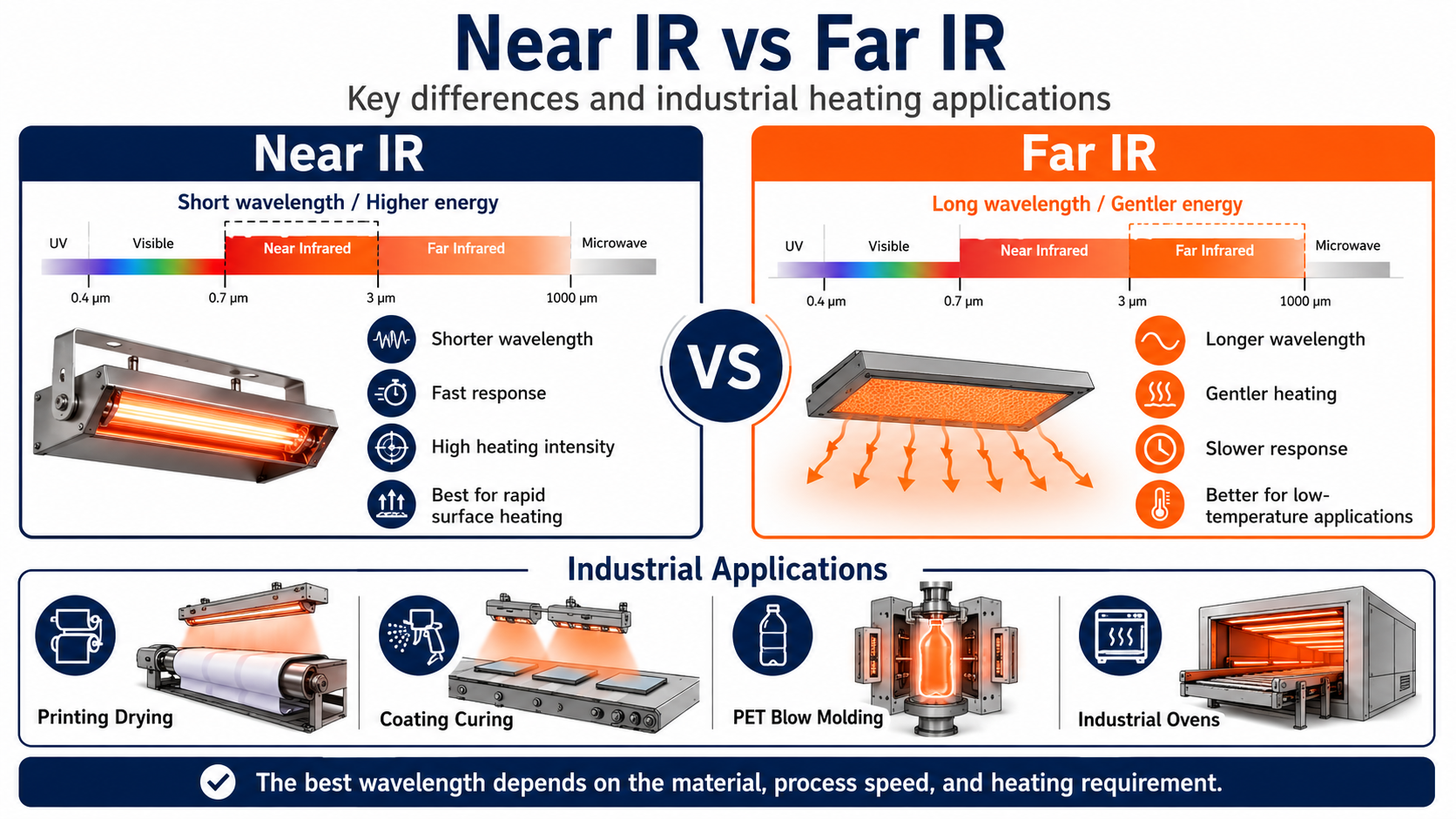
Near infrared overlaps the region commonly produced by fast-response short-wave emitters. Industrial medium-wave and carbon emitters operate at longer peak wavelengths. “Far infrared” is often used broadly in marketing, so a supplier should state the actual emitter type, operating temperature or spectral information instead of relying on a label alone.
| Emitter class | Typical process characteristic | Common selection reason |
|---|---|---|
| Short wave / near IR | High intensity and very fast response | Short heating windows, compact zones and responsive control |
| Fast medium wave | Fast response with a longer peak wavelength | Coatings, printing and processes needing balanced response and absorption |
| Medium wave | Moderate response and strong coupling with many coatings, water and polymers | Drying, laminating, thermoforming and continuous process heating |
| Carbon emitter | Fast medium-wave response with a broad useful output | Heat-sensitive materials and processes requiring rapid control |
The boundaries between these groups vary by source and product design. Final selection should be based on test results or documented emitter data.
A material heats efficiently when it absorbs a useful portion of the incident radiation. Colour alone is not enough to predict performance: pigments, moisture, coating thickness, fillers, surface finish and substrate composition can all change absorption.
Clear or translucent polymers may transmit some short-wave energy into the section.
Water-based coatings often respond well to medium-wave energy, provided moisture can escape.
Dark, thin coatings may absorb several wave ranges and therefore be limited by surface temperature rather than available power.
Reflective metal usually requires attention to coating absorption, incidence angle and reflector geometry.
A fast line with a short heating zone often benefits from a responsive short-wave emitter. A thicker product or a drying process may need a longer dwell time and staged power. High intensity does not guarantee faster useful heating if the surface overheats before heat conducts into the product.
Record the starting temperature, target temperature, exposure time and maximum allowable surface temperature. These values define the practical heating window.
Wavelength cannot compensate for poor geometry. Working distance, emitter spacing, reflector condition, edge losses and product movement all affect uniformity. A well-matched emitter installed too far from the workpiece or arranged with large gaps may still produce unacceptable temperature variation.
For moving webs or wide parts, divide the heater into independently controlled zones where the process requires cross-web correction or different heating stages.
Fast-response emitters are useful when production stops frequently, recipes change or closed-loop control must react quickly. Conventional medium-wave emitters can be effective for stable continuous processes. Carbon infrared emitters provide another fast-response option where their spectral output and construction suit the application.
Control selection should also account for sensor location, product emissivity, line speed and whether lamps are switched, phase-controlled or regulated by another power method.
| Keep constant | Measure |
|---|---|
| Product, starting condition and working distance | Surface and internal temperature where applicable |
| Heated area and exposure time | Temperature uniformity and edge behaviour |
| Target process result | Dryness, adhesion, forming quality, cure or dimensional stability |
| Comparable delivered power | Control response and recovery after a line stop |
The preferred emitter is the one that reaches the required process result with a controllable temperature profile—not simply the one that produces the highest surface reading.
Near-IR emitters can respond and deliver high intensity quickly, but useful heating speed depends on absorption, thickness, distance and the allowable surface temperature.
No. Surface temperature depends on absorbed power and exposure time. A longer wavelength does not by itself guarantee gentle heating.
Sometimes one emitter class provides an acceptable compromise, but different products may require recipe changes, zone control or a different emitter.
Send material details, colour and thickness, target result, starting and maximum temperatures, heating time, working distance, heated dimensions and available electrical supply.
Send YFR your material and process data to compare suitable emitter classes and define a controlled test before final equipment selection.


