


Author: Process Heating Engineer Publish Time: 2025-09-30 Origin: Site


Near infrared and far infrared are often discussed in everyday heating, wellness, outdoor comfort, and home-use applications. However, infrared technology is not limited to consumer heating. In industrial production, different infrared wavelengths are selected according to material absorption, heating speed, process temperature, line speed, and equipment design.
YFR focuses on industrial infrared heating lamps, infrared emitters, and replacement heating solutions for manufacturing systems. We do not manufacture medical therapy devices, pet heating lamps, or consumer wellness products.
This guide explains the difference between near IR and far IR from an industrial heating perspective.
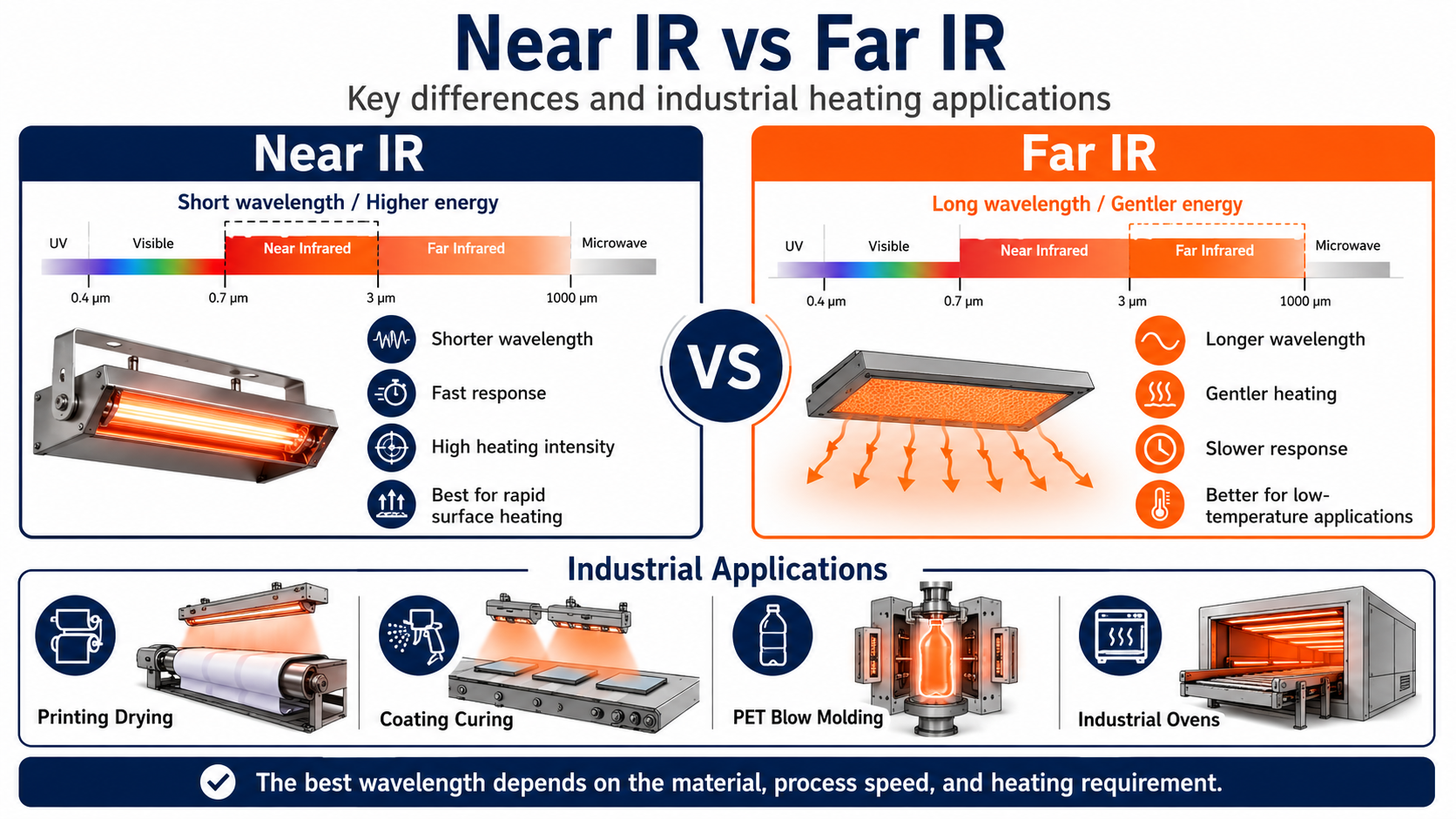
Infrared radiation is part of the electromagnetic spectrum. It is located beyond visible red light and is usually divided into different wavelength ranges, including near infrared, medium infrared, and far infrared.
Near infrared, often called Near IR or NIR, has shorter wavelengths compared with far infrared. It usually delivers faster heating response and higher energy intensity.
Far infrared, often called Far IR or FIR, has longer wavelengths. It is commonly associated with gentler surface heating and is often discussed in consumer heating or comfort-based applications.
In industrial heating, the most important question is not simply “near IR or far IR.” The real question is:
Which wavelength matches the material and production process?
Near infrared and far infrared behave differently because their wavelengths are different.
Near IR usually provides:
Shorter wavelength
Faster response
Stronger heating intensity
Better suitability for rapid surface heating
Common use in high-speed industrial processes
Far IR usually provides:
Longer wavelength
Gentler heating effect
Slower heating response
More surface-oriented thermal transfer
Common discussion in comfort heating and low-temperature applications
For industrial users, both wavelength behavior and process conditions must be considered. Material type, moisture content, coating thickness, surface color, heating distance, and production speed can all affect infrared heating performance.
Many articles discuss near IR vs far IR as if one is always better. This is not accurate for industrial heating.
The better choice depends on the application.
Near IR may be better when fast response and high-intensity heating are required. Far IR may be suitable for gentler heating or lower-temperature applications. Medium wave infrared is often used where balanced absorption and stable heating are needed.
For this reason, many industrial systems use different emitter types, including short wave infrared lamps, medium wave infrared lamps, and carbon infrared emitters depending on the material and process requirement.
Infrared heating is widely used in industrial production because it can transfer heat directly to materials without relying only on hot air.
Typical industrial applications include:
Printing ink drying
Coating and varnish curing
PET preform heating
Plastic forming and thermoforming
Industrial oven heating
Film and packaging drying
Surface treatment and process heating
For example, printing drying infrared lamps are used to support faster ink drying and coating curing on printing lines. In PET bottle production, PET blow molding heating lamps help heat preforms before forming. For drying and thermal processing equipment, industrial oven replacement lamps can be selected according to oven structure, power demand, and heating zone design.
Near infrared is often used where fast heat response is required. It can be useful in applications that need rapid temperature rise, short heating cycles, or high-intensity energy transfer.
Typical industrial use cases include:
Fast drying
Paint curing
Printing ink drying
High-speed production lines
Surface heating processes
Equipment requiring quick on/off response
Near IR is often associated with short wave infrared lamps. These lamps can respond quickly and are suitable for applications where process speed and energy density are important.
However, near IR is not automatically suitable for every process. Some materials may require different wavelength behavior to achieve uniform heating or avoid surface overheating.
Far infrared is often associated with longer wavelengths and gentler heating. It may be used in lower-temperature heating or applications where aggressive high-intensity heating is not required.
Far IR can be useful when the process needs:
Lower heating intensity
More gradual heat transfer
Gentle surface warming
Lower-temperature thermal processing
However, for many industrial production lines, far IR alone may not provide the response speed or power density required. This is why industrial heating systems often use short wave, medium wave, fast medium wave, or carbon infrared lamps depending on actual process requirements.
In many manufacturing systems, the practical choice is not only near IR or far IR. Medium wave infrared and carbon infrared are often important options.
Medium wave infrared can provide stable heating for coatings, plastics, films, and other materials. Carbon infrared can also be used where medium-wave radiation and controlled heating are required.
YFR supplies carbon infrared lamps for industrial heating systems where stable infrared output and process compatibility are required.
The right choice depends on the material, heating time, target temperature, and installation environment.
Wavelength is important, but it is not the only factor. Reflector design also affects heating efficiency and direction.
For example, gold reflector IR lamps are often used when directional heating is needed. The reflector helps direct more infrared energy toward the target material instead of losing heat in other directions.
This can be useful in:
Printing drying systems
Coating curing lines
Plastic heating processes
Industrial ovens
Equipment with limited installation space
When selecting an industrial infrared lamp, wavelength, reflector coating, tube structure, and installation distance should be evaluated together.
Near IR and far IR are often mentioned in everyday heating, outdoor comfort, pet heating, and wellness-related discussions. These applications usually focus on comfort, warmth, and low-power use.
Industrial infrared lamps are different.
Industrial systems are designed for:
Continuous operation
Higher power output
Machine integration
Controlled heating zones
Process stability
Material-specific absorption
Replacement compatibility
YFR does not manufacture home therapy lamps, pet heating lamps, or consumer wellness devices. Our products are designed for industrial drying, curing, forming, heating, and manufacturing systems.
When choosing an infrared heating lamp for industrial use, do not select only by the name “near IR” or “far IR.” Instead, evaluate the actual process.
Important selection factors include:
Material type
Coating or ink thickness
Moisture content
Target temperature
Heating time
Working distance
Production line speed
Available installation space
Required lamp power
Reflector structure
Existing machine compatibility
If the application involves drying or curing, IR drying modules may also be considered as part of a complete heating system instead of using only separate lamps.
YFR provides infrared heating lamps and modules for industrial applications, including:
Short wave infrared lamps
Medium wave infrared lamps
Carbon infrared lamps
Gold reflector IR lamps
Replacement IR lamps
IR drying modules
Custom infrared heating solutions
Our infrared lamps are used in printing, coating, PET blow molding, plastic processing, industrial ovens, paint curing, and other manufacturing systems.
For replacement projects, buyers can send the old lamp photo, voltage, wattage, total length, heated length, tube diameter, end cap type, and machine model. This helps confirm the correct replacement structure.
Near IR is not always better than far IR, and far IR is not always better than near IR. In industrial heating, the best wavelength depends on the material, process speed, heating distance, and production requirement.
For high-speed heating, short wave or near infrared may be suitable. For balanced process heating, medium wave or carbon infrared may be more practical. For directional heating, reflector structure also matters.
If your application involves industrial drying, curing, printing, PET blow molding, plastic forming, or oven heating, YFR can help evaluate the heating requirement and recommend a suitable infrared lamp or heating module.


