


Author: Process Heating Engineer Publish Time: 2025-08-08 Origin: Site


Last updated: September 1, 2026
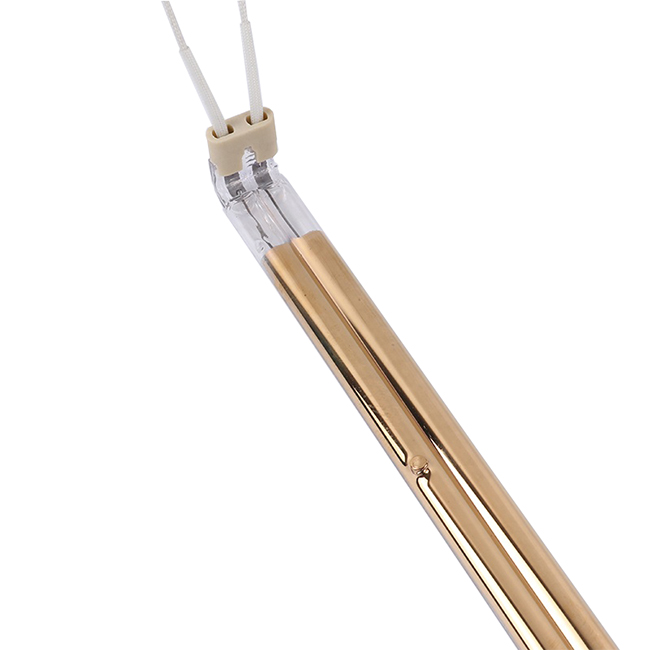
Quartz heating is widely used in industrial equipment because quartz infrared elements can provide compact, controllable radiant heat without requiring direct contact with the product. However, the term “quartz heating” covers several different lamp structures, emission characteristics and reflector designs.
A quartz tube alone does not determine how an infrared heater performs. The internal heating element, operating temperature, tube construction, reflector, working distance and material being heated must all be considered.
YFR supplies industrial infrared heating lamps, quartz IR emitters, directional reflector lamps, custom replacement tubes and complete heating modules for drying, curing, printing, coating, PET processing, forming and industrial ovens.
Industrial quartz heating normally refers to infrared emitters built with a quartz-glass tube or envelope.
Inside the tube, an electrical heating element converts electrical input into heat and infrared radiation. Depending on the design, the internal element may use tungsten, halogen-related construction, carbon material or another resistance-heating structure.
The quartz tube performs several functions. It separates the heating element from the surrounding environment, provides a stable physical structure and allows a useful portion of the emitted radiation to travel toward the product.
Quartz is therefore an important component, but it is not the complete heating technology.
Two quartz heaters can have the same external tube dimensions while producing different radiant characteristics because their internal elements, operating temperatures and electrical designs are different.
This is why “quartz heater” should not be treated as one single lamp type.
Quartz heating is usually a form of infrared heating.
The phrase describes how an infrared emitter is constructed, rather than a completely separate heat-transfer principle.
Infrared heating describes the transfer of radiant energy from the source to the product. Quartz describes the tube or envelope used in many infrared emitters.
A more accurate relationship is:
Industrial quartz heaters are one important category of infrared heating elements.
This distinction matters because buyers sometimes compare “infrared” and “quartz” as if they were competing technologies. In practice, a short-wave quartz lamp, a fast-medium-wave quartz emitter and a carbon quartz lamp are all infrared sources, but they do not behave identically.
Electrical current passes through the internal resistance element and raises its temperature.
The hot element emits radiation. Part of that radiation travels through the quartz tube and toward the product.
The product can absorb, reflect or transmit the incoming radiation. Only the absorbed portion directly contributes to raising the product temperature.
The U.S. Department of Energy explains in its Process Heating Sourcebook that industrial infrared systems should be considered as combinations of emitters, reflectors and application-specific controls. It also emphasizes matching the radiation source to the absorption behaviour of the material.
This means the same lamp can produce different results on:
dark and light surfaces;
plastic and polished metal;
wet and dry coatings;
thin film and thick sheet;
porous textiles and dense glass;
moving and stationary products.
Lamp wattage alone cannot predict the final heating rate.
Quartz glass can operate around high-temperature heating elements and transmit useful infrared radiation in selected wavelength ranges.
However, quartz should not be described as perfectly transparent to all infrared energy.
NIST research on infrared transmittance of fused silica shows that transmission changes across the infrared spectrum and that fused silica has wavelength-dependent absorption features.
For industrial users, the practical conclusion is straightforward:
Quartz grade, emitter design and operating wavelength must be considered together.
A lamp should not be selected only because its outer tube is made from quartz.
Some quartz infrared emitters, especially short-wave designs, can respond rapidly when power is applied or reduced.
This is useful on production lines where heating output must follow conveyor speed, product presence or recipe changes.
Fast response may also reduce unnecessary heating during startup and short production interruptions. Actual energy performance must still be measured at system level.
Quartz lamps can provide substantial radiant output from a relatively compact tube.
They can be installed in ovens, drying cassettes, forming machines and conveyor systems where available heating space is limited.
Several lamps can be arranged into independent zones to control the entrance, centre, exit or edges of a heating area.
Industrial quartz elements can be produced with different:
voltages;
wattages;
total lengths;
heated lengths;
tube diameters;
end caps;
lead wires;
terminals;
reflector coatings.
This makes them suitable for both new equipment and custom replacement projects.
A clear lamp radiates in several directions around the tube.
A gold, white or ceramic reflector coating can redirect more radiation toward the working side. An external reflector housing can also shape the heating field and support the lamp.
YFR’s gold reflector IR lamps are intended for applications that require more directional one-sided heating.
The reflector does not create additional electrical power. It changes the direction in which more of the emitted radiation travels.
Quartz infrared elements can heat a moving product without touching it.
This is useful where direct-contact heaters could mark, contaminate or mechanically interfere with the material.
Typical applications include coating, paint curing, printing, PET preform heating, plastic forming, textile drying and industrial oven processes.
Quartz heating is not automatically the best solution for every process.
A product must absorb the incident radiation before useful heating occurs.
Highly reflective surfaces may respond differently from dark or coated materials. A transparent material may allow part of the radiation to pass through.
The emitter type should therefore be evaluated with the actual product rather than selected from a generic industry name.
A powerful lamp installed too close to the product may produce a narrow, intense heating field.
Poor lamp spacing can create alternating hot and cold bands. Excessive overlap can overheat the centre while leaving the edges cooler.
Working distance, lamp spacing and reflector geometry must be designed together.
Infrared supplies heat, but it does not automatically remove evaporated water, solvent or process fumes.
Drying systems may still require airflow and exhaust to carry vapour away from the product.
Adding more lamp power will not solve a drying limitation caused by saturated air or inadequate exhaust.
Quartz is suitable for many high-temperature applications, but the tube can still be damaged by impact, incorrect holders, excessive mechanical stress or contamination.
The complete machine should include suitable supports, guards and maintenance access.
A bare quartz lamp also does not automatically give the complete heater an IP protection rating. IP classification depends on the assembled enclosure, wiring, seals and complete equipment design.
Two lamps marked with the same voltage and wattage may have different:
heated lengths;
reflector directions;
tube structures;
terminals;
mounting positions;
radiation patterns.
An incorrect replacement may fit electrically but produce the wrong heating field.
Quartz elements should be classified across several separate dimensions.
| Selection Dimension | Main Options | What It Changes |
|---|---|---|
| Emission behaviour | Short wave, fast medium wave, medium wave, carbon | Response speed and interaction with the process material |
| Tube construction | Single tube, twin tube, round tube, special shape | Mechanical strength, mounting and available heated length |
| Reflector structure | Clear, gold coated, white or ceramic coated, external reflector | Direction of radiant output |
| Supply format | Loose lamp, cassette, complete module | Installation, support, wiring and control scope |
These categories are not mutually exclusive.
For example, one lamp may be:
short wave + twin tube + gold reflector + custom ceramic end caps
This classification is more useful than treating “gold lamp,” “twin-tube heater” and “short-wave heater” as three competing product types.
Short-wave infrared lamps provide rapid response and high available radiant intensity.
They are useful starting points for:
fast conveyor processes;
compact preheating zones;
PET preform heating;
paint curing;
printing and coating equipment;
processes requiring fast output adjustment.
Their high intensity requires careful control.
A short-wave lamp mounted too close to a temperature-sensitive product can create local overheating before the rest of the product reaches the required temperature.
Short wave should not automatically be described as heating every material more deeply. Effective heating depth depends on the material’s absorption, thickness, structure and surface condition.
Fast-medium-wave IR emitters can provide a different balance between radiant intensity, response and process control.
They are often evaluated for coatings, textiles, printing, continuous webs and materials that require a broader heating window.
Medium-wave or carbon elements may be suitable where a less intense visible output or more gradual thermal response is preferred.
These lamps can retain more heat after electrical power is reduced than some short-wave designs. Stop conditions and residual heat must therefore be considered in the machine-control strategy.
The correct choice should follow material testing rather than wavelength labels alone.
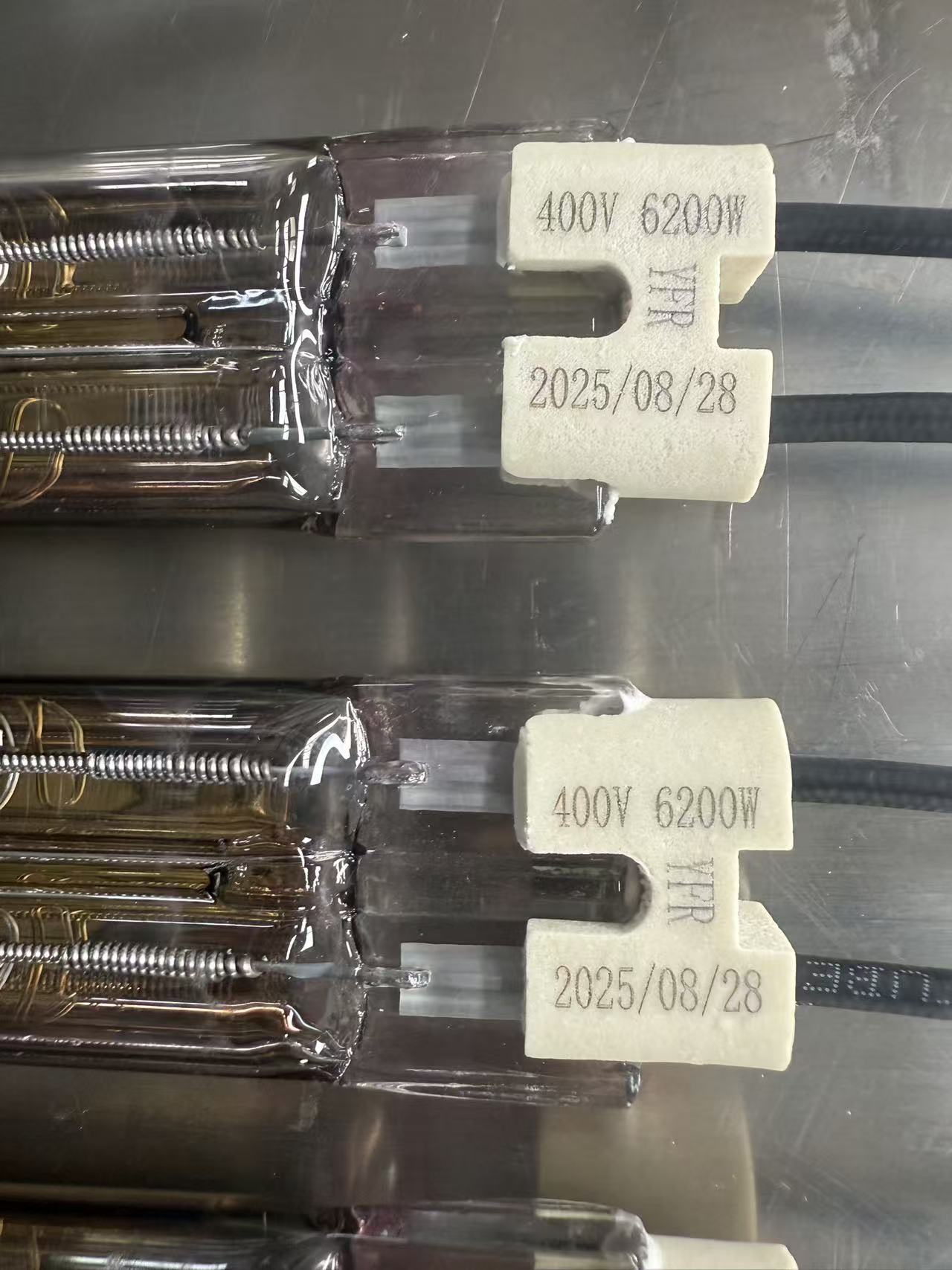
Single-tube lamps are flexible for narrow heaters, special shapes and many replacement applications.
Twin-tube lamps use two connected quartz channels. This structure can provide increased mechanical rigidity, particularly for longer emitters or wide heating modules.
Twin-tube construction does not determine wavelength.
A twin-tube lamp can still be short wave, fast medium wave or another emitter design.
For replacements, the buyer must confirm:
tube width and height;
distance between channels;
centre-bridge position;
heated length;
end-cap structure;
reflector orientation.
A clear lamp is appropriate when the machine already uses a suitable external reflector or when broader radiation is required.
A gold reflector coating is useful for compact, one-sided heating where less radiation should travel toward the rear of the lamp.
A white or ceramic coating may be used in equipment originally designed around that reflector type, including some PET and oven applications.
An external metal reflector can be removed, cleaned or adjusted separately from the lamp, but it requires more installation space.
The original reflector type should normally be retained in a replacement project unless the complete heating system is being redesigned and tested.
A loose quartz lamp is sufficient when the existing holder, reflector, wiring and controller remain suitable.
A lamp cassette can combine the emitter with a reflector and mounting structure, making replacement and maintenance more consistent.
A complete infrared heating module is more appropriate when the project requires:
multiple lamps;
new mounting dimensions;
independent heating zones;
integrated reflectors;
revised wiring;
improved maintenance access;
installation into new industrial equipment.
The equipment manufacturer remains responsible for complete guarding, ventilation, over-temperature protection and machine certification.
Start with the process rather than the lamp catalogue.
Define:
what material is being heated;
the initial and target temperature;
whether the material is moving or stationary;
line speed or cycle time;
available heating length;
working distance;
maximum allowable surface temperature;
whether moisture or solvent must be removed;
available voltage and electrical capacity;
whether the project is new equipment or a replacement.
Material trials are recommended when absorption, product colour or coating chemistry varies significantly.
For wide products, thermal mapping should be completed across the full heating area rather than at one centre point.
| Required Information | Why It Is Needed |
| Voltage and wattage | Determines electrical compatibility |
| Total length | Determines mechanical fit |
| Heated length | Defines the active radiant area |
| Tube dimensions | Determines holder and reflector compatibility |
| Single-tube or twin-tube structure | Defines mechanical construction |
| Emission type, if known | Supports short-wave, FMW or other selection |
| Reflector type and direction | Determines the working side |
| End caps and terminals | Determines mounting and connection |
| Lead-wire length and direction | Supports equipment wiring |
| Target material | Helps assess radiant absorption |
| Initial and target temperature | Defines the heating objective |
| Line speed or cycle time | Defines available exposure time |
| Working distance | Affects intensity and coverage |
| Existing lamp photos or drawing | Supports replacement verification |
| Equipment model and application | Helps identify installation constraints |
For a replacement lamp, photographs should show:
the complete tube;
both end caps;
terminal and wire direction;
reflector boundary;
label or lamp code;
original installed orientation.
YFR’s custom replacement IR tubes can be evaluated from a sample, drawing, lamp code or clear dimensional photographs.
One common mistake is selecting a lamp only by total length.
The total length may match while the heated section is too short or positioned incorrectly.
Another mistake is matching voltage and wattage while ignoring reflector direction. A reversed reflector can direct heat toward the housing instead of the product.
Buyers may also request the highest available wattage without checking working distance, product temperature limits or exposure time.
In drying applications, insufficient exhaust is sometimes misdiagnosed as insufficient lamp power.
These problems can usually be reduced by defining the complete process and installation before confirming the heater.
YFR supplies industrial infrared heating lamps for new machinery and replacement projects.
Available options include:
short-wave quartz infrared lamps;
fast-medium-wave emitters;
medium-wave and carbon lamps;
single-tube and twin-tube structures;
gold and ceramic reflector coatings;
custom end caps, terminals and lead wires;
replacement infrared tubes;
reflector cassettes;
complete infrared heating modules;
compatible power-control components.
Custom specifications should be confirmed from the actual equipment and process requirements.
The final heating result depends on the lamp, reflector, working distance, product absorption, ventilation and control system operating together.
Yes. Industrial quartz heating normally refers to infrared emitters constructed with a quartz tube or envelope.
No. The internal heating element and operating temperature are major factors. Quartz is part of the lamp structure and transmission path.
No. Short wave provides rapid response, but fast-medium-wave, medium-wave or carbon elements may suit other materials and processes.
The difference is mainly physical construction and mechanical behaviour. Either structure can be designed with different emission characteristics.
No. The reflector changes the direction of radiant output. It does not create additional electrical power.
It can supply heat without airflow, but drying processes may still require airflow and exhaust to remove moisture or vapour.
Provide voltage, wattage, total length, heated length, tube dimensions, reflector direction, end caps, terminals, lead wires, equipment model and clear photographs.
Quartz heating elements are flexible industrial infrared components, but “quartz heater” is not a complete technical specification.
The correct element must be selected according to emission behaviour, tube structure, reflector design, working distance, process material and control requirements.
Short-wave lamps are useful where rapid response and high radiant intensity are required. Fast-medium-wave, medium-wave and carbon emitters offer different response and spectral characteristics that may suit other materials and production conditions.
For replacement projects, voltage and wattage are only the starting point. Heated length, reflector direction, end caps and installation geometry must also match.
For a new system, provide YFR with the material, target temperature, line speed, installation space, electrical conditions and required heating area so that a suitable lamp, cassette or module can be evaluated.
Share the material, process target, working distance, line speed, available installation space, voltage, power range and any existing lamp drawing or photo. YFR can review whether a lamp, replacement emitter, cassette or controlled module is the appropriate starting point.


