Author: Process Heating Engineer Publish Time: 2025-09-10 Origin: Site
The main industrial emission types are short wave, fast medium wave, medium wave and carbon infrared.
Short wave lamps are generally selected for fast response and concentrated radiant heating. Fast medium wave emitters provide a balance between response speed and controlled heating. Medium wave lamps are often used for moisture-rich coatings, textiles and processes that benefit from gentler heat. Carbon emitters provide stable medium-wave-dominant radiation and are frequently considered for coatings, wood, textiles and temperature-sensitive products.
These emission types are separate from lamp construction. A single-tube or twin-tube lamp describes the shape of the quartz body, not its wavelength. A gold reflector lamp describes the radiation direction, not the filament type.
The correct lamp therefore depends on the material, process objective, dimensions, line speed, working distance, reflector design and control method.

Most industrial quartz infrared lamps use electrical resistance heating.
Electric current passes through a tungsten filament, carbon element or resistance wire. As the element heats, it emits electromagnetic radiation, including infrared energy.
The quartz envelope protects the heating element, maintains the required atmosphere around the filament and allows useful radiant energy to pass toward the product.
When this radiation reaches the target, part of it is absorbed, part is reflected and, for some materials, part may pass through. Only the absorbed portion directly contributes to heating the material.
The U.S. Department of Energy’s Process Heating Sourcebook explains that electric infrared systems are widely used for heating, drying, curing and surface-treatment processes, but the workpiece must have suitable infrared absorption for the system to be effective.
This is why lamp selection cannot be based only on maximum wattage. A high-power lamp may still perform poorly if its radiation is not well matched to the product or coating.
Industrial infrared lamps are commonly classified by emission behavior and by physical construction.
Emission classification describes how the lamp behaves thermally. This includes short wave, fast medium wave, medium wave and carbon infrared.
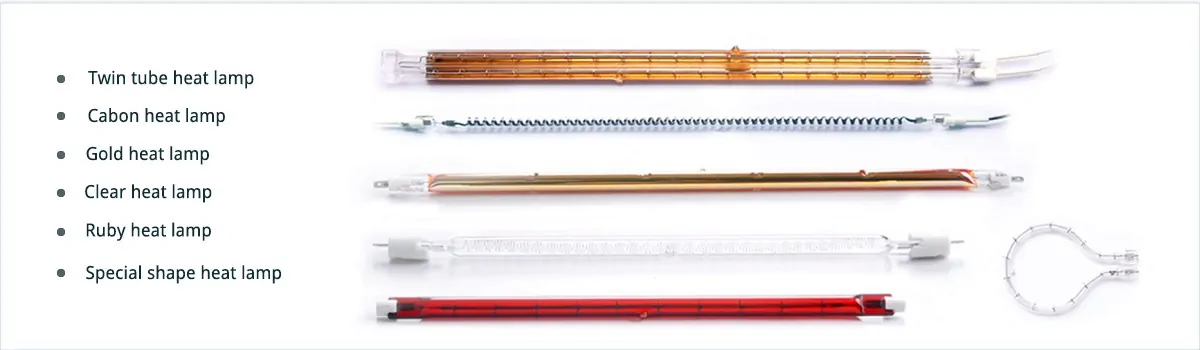
Construction classification describes how the lamp is physically manufactured. This includes single tube, twin tube, round tube, special-shaped tube and reflector-coated tube.
These systems overlap. For example, a twin-tube emitter may use a short wave tungsten filament, a fast medium wave filament or a medium wave resistance element. The same twin-tube lamp may also have a gold reflector coating on one side.
Understanding this distinction prevents a common purchasing error: comparing a structural term such as “twin tube” directly with an emission term such as “medium wave.”
| Lamp Type | Response Characteristic | Better Fit | Main Consideration |
|---|---|---|---|
| Short wave infrared lamps | Very fast response and relatively high radiant intensity | Rapid preheating, PET processing, paint flash-off, compact heating zones and high-speed production | Requires careful distance, power and surface-temperature control |
| Fast medium wave IR emitters | Faster response than conventional medium wave with a more controlled heating profile than short wave | Printing, textiles, coatings, plastics, moving webs and continuous lines | Must be matched to line speed, product absorption and coating thickness |
| Medium wave infrared lamps | Moderate response with gentler radiant heating | Moisture-rich coatings, paper, textiles, adhesives and controlled drying | Longer warm-up and cooldown than short wave |
| Carbon infrared lamps | Fast-to-moderate response with stable medium-wave-dominant output | Wood, textiles, coatings, delicate surfaces and wider controlled heating areas | May not suit very short, high-intensity heating cycles |
This table provides a general starting point, not a universal rule. The same lamp can behave differently when the reflector, mounting distance, product color or process speed changes.
Short wave infrared lamps normally use a high-temperature tungsten filament inside a quartz tube.
They reach useful output rapidly and can respond quickly to power changes. This makes them suitable for equipment that must start, stop or adjust output without a long thermal delay.
Typical applications include PET preform heating, paint flash-off, plastic forming, localized heating, packaging, high-speed conveyor zones and compact industrial dryers.
Short wave radiation can deliver high surface intensity. This is useful when rapid heating is required, but it also increases the risk of hot spots, surface overheating or product distortion if the lamp is too close or poorly controlled.
A short wave lamp should therefore be selected together with its reflector, installation distance, heated length and power-control system.

Fast medium wave emitters are designed to provide a quicker response than conventional medium wave lamps while maintaining a more moderate radiant profile than many short wave lamps.
They are frequently used in printing, textile processing, coating drying, adhesive heating, plastic processing and moving-web systems.
For continuously moving products, fast medium wave emitters can provide useful control when line speed changes. Their response allows the system to reduce output during slowdown or increase output when production speed rises.
They are also available in long twin-tube structures, which can improve mechanical stability in wide machines and heating modules.
The correct FMW lamp still depends on product absorption, coating chemistry, wet-film thickness, working distance and available exhaust capacity.

Medium wave lamps generally operate at a lower emitter temperature than short wave quartz halogen lamps and respond more gradually.
They are often selected for water-based coatings, textiles, paper, adhesives, wood products and processes that need stable rather than extremely rapid heat input.
Medium wave radiation can be useful where the product or coating absorbs strongly in the corresponding spectral region. However, this must be confirmed with the actual material.
A medium wave lamp is not automatically more efficient or more penetrating than a short wave lamp. Its value depends on how well the radiation is absorbed and how the process removes moisture or solvent.
Because medium wave lamps retain heat longer after power is reduced, conveyor-stop protection and temperature monitoring remain important.

Carbon infrared lamps use a carbon-based heating element instead of a conventional tungsten filament.
Their radiation is generally concentrated in a medium-wave region and can provide smooth, stable heating across coatings, textiles, wood products and temperature-sensitive surfaces.
Carbon emitters are useful when the process requires a wider control window rather than maximum radiant intensity.
They may also be selected for applications where a short wave lamp produces excessive local surface temperature or visible brightness.
Carbon lamps still require suitable reflectors, working distance and airflow. In drying applications, the lamp supplies heat, while airflow and exhaust remove evaporated water or solvent.

Single-tube lamps use one quartz tube around the heating element.
They are flexible in dimensions and are widely used for replacement lamps, narrow heating zones, compact equipment and customized end structures.
Twin-tube lamps use two connected quartz channels with a central bridge. This geometry can provide greater mechanical rigidity, especially for longer emitters.
Twin-tube structures are commonly used in wide heating modules, printing equipment, glass-processing systems and industrial production lines where long lamps must remain stable.
Neither structure automatically determines the wavelength. Both single-tube and twin-tube lamps can be designed as short wave, fast medium wave or medium wave emitters.
The choice depends on available space, unsupported length, mechanical mounting, electrical load, reflector design and equipment structure.
Round quartz tubes are common where the lamp must fit a standard holder, oven cassette or compact reflector.
Special-shaped lamps may include L-shaped, U-shaped, curved or other customized structures. These designs are useful where a straight lamp cannot follow the required heating area.
Special shapes should be developed carefully because bends and joints affect filament positioning, mechanical stress and mounting.
For replacement projects, a drawing or physical sample is usually more useful than only the machine model.
A reflector coating is applied to part of the quartz tube to redirect radiation toward one side.
A gold reflector infrared lamp can reduce radiation toward the rear of the lamp and direct more energy toward the product.
White or ceramic reflector coatings serve a similar directional function but may be selected for different lamp temperatures, environments and process requirements.
The reflector layer is not merely decorative. Its position determines the direction of useful radiation.
During replacement, the reflector orientation must match the original lamp. A lamp with the correct voltage and length but the wrong reflector direction may heat the machine housing instead of the product.
A reflector-coated lamp is also different from a separate external reflector. Some systems use only an external aluminum reflector, while others combine an internal coating with a reflector housing.
A common oversimplification is that shorter wavelengths always penetrate more deeply or that longer wavelengths always heat more efficiently.
Industrial heating does not follow one universal rule.
The result depends on how the specific product absorbs, reflects and transmits radiation. Color, surface texture, moisture, thickness, coating composition and temperature can all change the response.
Heraeus explains in its technical article on infrared systems and material absorption that only absorbed radiation contributes to heating and that the absorption spectrum differs from one material to another.
This means the best emitter is the one that matches the process, not necessarily the lamp with the highest wattage or shortest wavelength.
A black coating may respond differently from a reflective metal. Water-based ink may respond differently from dry plastic. Clear glass may transmit some radiation while a polymer interlayer absorbs it.
Whenever possible, selection should be confirmed using the actual product or a representative sample.
Paint and coating systems require the lamp to be matched to both the wet film and the substrate.
Short wave lamps can be useful for fast flash-off and rapid surface heating. Fast medium wave emitters may provide a wider control range for coating lines and moving products. Medium wave or carbon emitters may suit moisture-rich or heat-sensitive coatings.
Airflow and exhaust remain necessary when water or solvent must leave the drying zone.
The selected emitter must not raise the substrate above its acceptable temperature. This is especially important for plastic, composite and coated wood products.
Printing applications often require fast response because press speed and ink coverage change during production.
Fast medium wave and medium wave lamps are frequently considered for water-based ink drying and coating processes. Short wave lamps may be used for flash-off or compact booster zones.
The correct system should coordinate lamp power, line speed, air movement and exhaust.
For replacement projects, the heated length and reflector direction are often just as important as voltage and total lamp length.
PET preform heating commonly uses rapid-response infrared lamps arranged in several independently controlled zones.
The system may adjust power according to preform thickness, color, wall distribution and required stretching profile.
Short wave lamps are commonly used because they respond quickly and fit compact oven structures.
Other plastic-forming and welding applications may use short wave or fast medium wave lamps depending on the polymer, thickness and process speed.
Material testing is important because clear, colored, filled and reinforced plastics do not absorb infrared radiation in the same way.
Wood, paper and textile processes often require coordinated heating and moisture removal.
Medium wave and carbon emitters may provide controlled heating for coatings, adhesives and moisture-containing surfaces.
Fast medium wave emitters may be useful in continuous textile or paper lines where faster response is needed.
For thick wood or high-moisture products, infrared heating is usually only one part of the drying system. Airflow, humidity control and sufficient residence time remain necessary.
Infrared heating can support glass cutting assistance, polymer-interlayer heating, coating drying, bending, forming and localized preheating.
The lamp does not automatically strengthen glass or create safety glass. Final properties depend on the complete lamination, tempering, cooling or forming process.
Fast medium wave twin-tube emitters with directional reflectors may be used for controlled line heating and laminated-glass interlayer separation.
Lamp position, working distance and zone control should be verified with the actual glass structure.
A separate lamp is normally appropriate when the machine already includes compatible holders, reflectors, wiring and controls.
This is common in ovens, printing equipment, PET machines, paint dryers and existing industrial heating cassettes.
When the project requires several lamps, a wide heating zone, integrated reflectors, wiring groups and mechanical support, a complete infrared heater module may be more suitable.
A module can simplify lamp spacing, reflector alignment, installation and maintenance.
The module still needs to be integrated with the machine’s airflow, safety system, temperature sensors and power supply.
For adjustable multi-zone systems, infrared heating controls can regulate lamp groups according to temperature, line speed or process recipes.
Replacement lamps should not be matched by overall length alone.
The original lamp may have a different heated length, filament position, reflector direction, end cap, ceramic connector or lead-wire orientation.
An incorrect lamp may physically fit but create a different heating pattern or electrical load.
YFR’s custom replacement IR tubes can be evaluated using the original specifications, equipment model, drawings and clear photographs.
Both ends of the lamp should be photographed because many replacement errors occur at the terminal and holder interface.
| Required Information | Why It Matters |
| Product material, color and surface | Affects infrared absorption and reflection |
| Process objective | Defines whether rapid heating, drying, curing or forming is required |
| Voltage and wattage | Determines electrical compatibility |
| Total length and heated length | Determines mechanical fit and active heating width |
| Tube diameter and construction | Determines holder and reflector compatibility |
| Single-tube or twin-tube structure | Affects installation and mechanical stability |
| Working distance | Affects radiant intensity and coverage |
| Line speed or cycle time | Determines exposure time |
| Reflector type and direction | Determines where the radiation is directed |
| End caps, lead wires and terminals | Determines electrical and mechanical connection |
| Maximum product temperature | Helps prevent damage or overheating |
| Existing lamp photos or drawing | Supports accurate replacement matching |
For new equipment, the heating-zone dimensions and process conditions should be provided.
For replacement projects, the original lamp label, machine model and photos of both ends are especially important.
YFR supplies industrial infrared lamps and heating components for equipment manufacturers, maintenance teams and system integrators.
The main product directions include short wave infrared lamps, fast medium wave emitters, medium wave infrared lamps, carbon infrared lamps and gold reflector IR lamps.
YFR also supplies custom replacement IR tubes, infrared heater modules and infrared heating systems and controls.
Custom options may include voltage, wattage, total length, heated length, tube diameter, filament structure, reflector coating, end caps, lead wires and terminals.
Final lamp selection should be based on the complete machine and process requirement rather than only the lamp name.
The main emission types are short wave, fast medium wave, medium wave and carbon infrared. Lamps can also be classified structurally as single tube, twin tube, round tube, special shape or reflector coated.
No. Twin tube describes the quartz structure. A twin-tube lamp may be short wave, fast medium wave or medium wave depending on its heating element and operating design.
Short wave quartz lamps generally provide the fastest response. However, the fastest lamp is not automatically the best choice for every material or process.
No. Medium wave can be useful for moisture-rich coatings and controlled drying, but performance depends on material absorption, airflow, line speed, coating thickness and working distance.
A gold reflector lamp has a directional reflective coating on part of the quartz tube. It directs more radiation toward one side, while an uncoated lamp radiates more broadly.
They can be suitable for controlled medium-wave heating of wood, textiles and coatings. The actual material and process should be tested before final selection.
No. Voltage, wattage, dimensions, construction, response speed, reflector direction, material absorption and control method must all be considered.
Provide voltage, wattage, total length, heated length, tube diameter, reflector type, end caps, lead wires, terminals, equipment model and clear photos of the original lamp.
A module is more suitable when the process requires multiple lamps, wide heating coverage, integrated reflectors, mounting frames, zone wiring or easier maintenance.
Industrial infrared lamp selection should begin by separating emission type from physical construction.
Short wave, fast medium wave, medium wave and carbon infrared describe heating behavior. Single tube, twin tube and reflector coating describe how the lamp is built and how radiation is directed.
The best lamp is not simply the most powerful or fastest option. It is the emitter that matches the material absorption, process speed, product temperature limit, working distance and equipment design.
For a reliable recommendation, provide complete process and lamp information before confirming the replacement tube or heating module.