


Author: Site Editor Publish Time: 2025-10-30 Origin: Site


As industrial heating systems increasingly seek efficiency, precision, and minimal footprint, the selection of the correct infrared emitter becomes a key engineering decision.
This article focuses on the specification, advantages, and selection criteria of the carbon infrared lamp (also called carbon medium-wave infrared emitter) for industrial heating processes.
It is written for engineers, system integrators, and procurement specialists who evaluate infrared lamp technologies, with the goal of demonstrating technical expertise (E-E-A-T: Experience, Expertise, Authoritativeness, Trustworthiness).
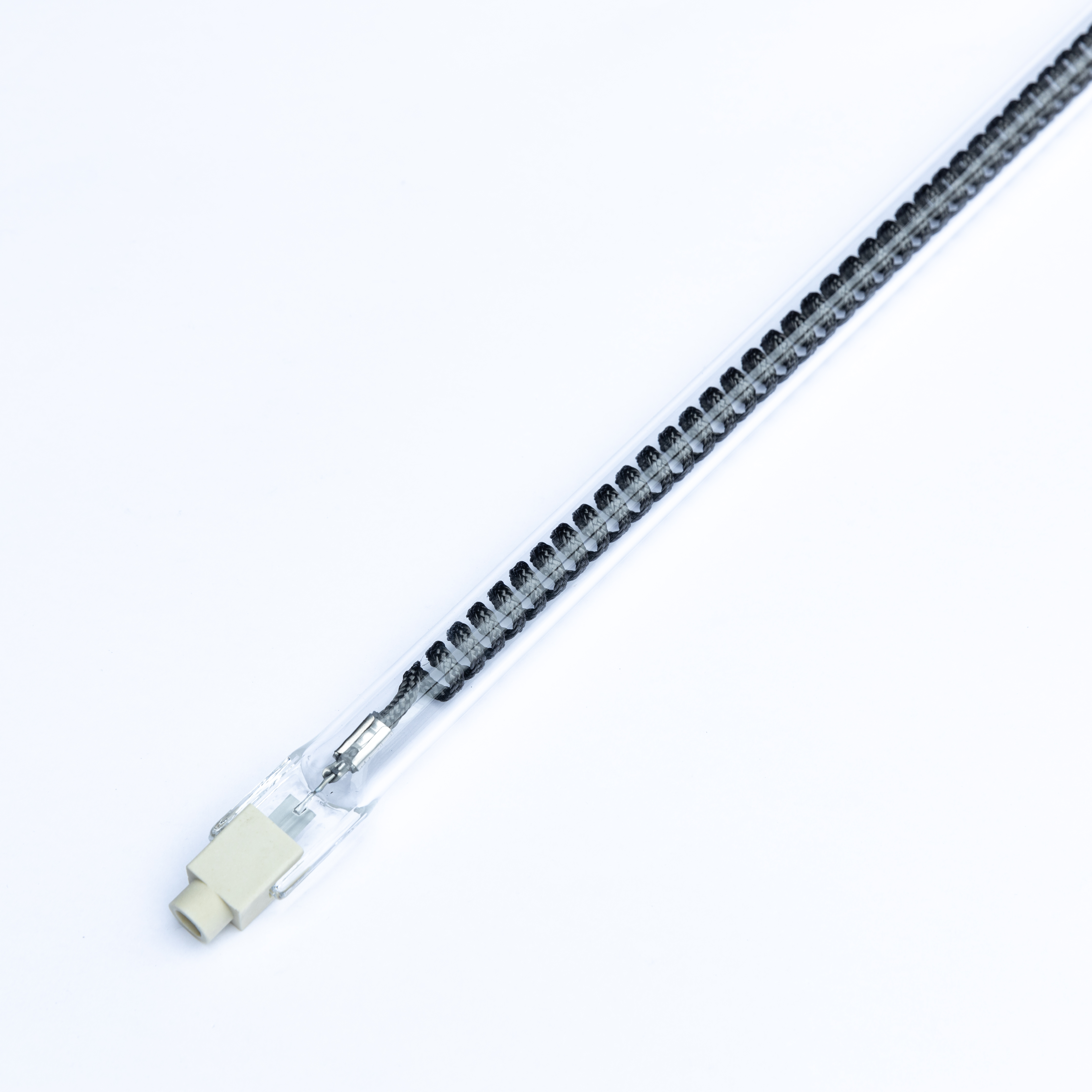
A carbon infrared lamp is an infrared radiator that uses a carbon fiber or carbon filament as its heating element. The filament is enclosed within a quartz tube—usually under vacuum or filled with inert gas—to ensure stability and prevent oxidation.
The defining feature is its medium-wave radiation, typically in the 2.0–4.0 µm range. This wavelength corresponds closely to the absorption spectrum of water, organic coatings, and many plastics—making carbon lamps highly efficient for drying, heating, and curing applications.
Compared with tungsten or halogen lamps (short-wave IR), carbon filament lamps operate at lower filament temperatures, emit less visible light, and deliver more controlled radiant heat.
1. Optimal Wavelength for Industrial Materials
Medium-wave infrared (2.0–4.0 µm) matches the absorption characteristics of many industrial materials such as water, coatings, adhesives, and plastics. This means faster, more uniform heating with less wasted energy.
The radiation is absorbed by the material surface almost instantly, converting energy directly into heat without the need for air as a transfer medium.
2. Fast Response and Efficient Energy Conversion
Carbon infrared lamps achieve over 95% electrical-to-heat conversion efficiency.
Their low thermal mass allows extremely fast response—reaching operating temperature within seconds—and precise control when switched on or off.
This rapid thermal cycling minimizes standby energy consumption and is ideal for automated or batch-type processes requiring immediate heat.
3. Gentle, Uniform Heating
Because the emission wavelength is longer than short-wave types, carbon infrared lamps produce a softer, less intense light and lower surface temperature.
This prevents scorching, color change, or substrate damage—critical for heat-sensitive materials such as paper, textiles, or coated films.
4. Long Service Life and Stability
The carbon filament’s inherent durability and quartz encapsulation result in extended service life—typically 5,000 to 8,000 hours—significantly longer than standard tungsten emitters.
This longer lifespan reduces downtime, maintenance, and total cost of ownership.
5. Compact Design and Energy Savings
Infrared radiation transfers heat directly to objects rather than to the surrounding air.
This allows carbon infrared lamps to shorten heating time, reduce space requirements, and save energy by focusing radiation precisely on target areas through reflector design.
| Type of IR Lamp | Wavelength Range (µm) | Typical Heating Element | Key Applications |
|---|---|---|---|
| Short-Wave IR | 0.7–1.4 | Tungsten / Halogen | Deep penetration, high-temperature heating, metal and glass processing |
| Medium-Wave IR | 1.4–4.0 | Tungsten or Carbon Filament | Drying, coating, plastics forming, food heating |
| Long-Wave / Far-IR | 4.0–15.0 | Ceramic or Alloy Wire | Gentle heating, comfort heating, low-temperature drying |
The carbon medium-wave lamp sits within the medium-wave category but distinguishes itself by its carbon filament and quick response—combining the gentle heating of medium wave with the reactivity of short wave.

To ensure the best performance, consider the following technical selection parameters when specifying a carbon infrared lamp.
1. Wavelength and Filament Composition
Confirm the emission peak (2.0–4.0 µm) matches the absorption characteristics of your target material.
Ensure the filament is pure carbon fiber rather than tungsten to maximize efficiency for organic or moisture-based substrates.
2. Radiant Intensity and Surface Temperature
Evaluate radiant power density (W/cm or kW/m²). Carbon lamps produce moderate radiant intensity suitable for surface and thin-layer heating.
Their lower operating temperature prevents thermal damage to sensitive surfaces.
3. Response Speed
For rapid cycle or intermittent operations, fast response is crucial.
Carbon infrared lamps reach full intensity within seconds and cool down quickly, allowing precise temperature control and efficient on/off cycling.
4. Uniformity and Geometry
Uniform heating requires proper lamp geometry and reflector design.
Twin-tube designs can provide symmetrical radiation and better mechanical stability than single-tube designs.
5. Lamp Construction
Check quartz tube quality, vacuum integrity, filament support, and electrical connections.
Proper sealing ensures stability under frequent on/off cycles and extends service life.
6. Lifetime and Maintenance
Plan for long-term reliability—lamp degradation over time will reduce radiant efficiency.
Select lamps rated for ≥5,000 hours and with consistent output retention.
7. Energy Efficiency
Assess energy consumption relative to throughput.
Infrared lamps can transfer large energy amounts quickly, achieving higher production speed and lower overall power use than convection heating.
8. Safety and Compatibility
Ensure lamps include proper reflectors, heat shielding, and cooling.
Match radiant output with substrate limits to prevent overheating or chemical degradation.
9. Process Matching
Consider process parameters—target temperature, dwell time, web speed, and substrate type—to define the correct lamp power and configuration.
10. Supplier Support and Customization
Choose manufacturers capable of providing full data sheets, emission spectra, customized tube sizes, reflector coatings, and engineering guidance.

1. Textile Drying and Printing
Carbon infrared lamps are widely used in textile drying and screen-printing lines.
Their medium-wave radiation effectively removes moisture or ink without scorching fabrics.
The gentler heat preserves color and texture while shortening process time.
2. Food Processing and Dehydration
Medium-wave radiation penetrates shallowly, making it ideal for surface drying or dehydration in food processing.
It ensures uniform moisture removal while retaining color, taste, and nutrients.
3. Paint and Coating Curing
Carbon IR lamps accelerate solvent evaporation and initial curing in paint or coating lines.
Their rapid response enables continuous production and consistent film quality with minimal energy loss.
4. Plastic Forming and Film Lamination
In thermoforming or lamination, carbon infrared lamps deliver uniform, controlled heat, preventing bubble formation or uneven surface gloss.
5. Comfort and Space Heating
In controlled environments such as saunas or localized heating zones, carbon IR lamps provide soft, non-glare warmth with low visible light output.
While carbon infrared lamps offer many advantages, engineers should be aware of their boundaries:
Lower penetration depth: For very thick or metallic substrates requiring deep heat transfer, short-wave IR may perform better.
Higher initial cost: Carbon filament emitters can be more expensive upfront but compensate through longer life and efficiency.
Reflector complexity: Optimal use requires accurate reflector design and mounting geometry to achieve even heating.
Temperature limits: For high-temperature metallurgical or glass processes, alternative IR types may be preferable.
Define Process Requirements – target temperature, material thickness, cycle time.
Check Wavelength Match – verify emission peak aligns with material absorption.
Calculate Required Power Density – determine lamp wattage and spacing.
Design Reflectors and Geometry – select gold or ceramic reflectors for directional control.
Plan Maintenance – establish service intervals and cleaning procedures.
Integrate Controls – use temperature feedback and automatic shutoff systems.
Benchmark Efficiency – compare with convection ovens to confirm energy savings.
Document Compliance – maintain safety and quality assurance data.
Evaluate Supplier Reliability – ensure technical support and spare parts availability.
Plan Scalability – allow for process expansion or modular heating zones.
The carbon infrared lamp represents a refined evolution of medium-wave infrared heating—offering fast response, efficient wavelength matching, and gentle yet powerful heating performance.
By aligning emission characteristics with material absorption, carbon infrared technology achieves superior process control, reduced energy consumption, and extended equipment life.
For industrial users, selecting the right carbon infrared lamp requires careful consideration of wavelength, geometry, reflector design, and process parameters. When integrated correctly, it enables faster throughput, energy savings, and enhanced product quality across diverse applications—from coatings and plastics to textiles and food processing.
Huai’an Yinfrared Heating Technology continues to focus on engineering excellence and reliable infrared solutions tailored to industrial partners worldwide.


