Author: Process Heating Engineer Publish Time: 2025-08-10 Origin: Site
Last updated: August 28, 2026
NiCr resistance wire is widely used in medium-wave quartz infrared emitters because it can provide stable resistive heating at suitable operating temperatures. It is not automatically the best element for every process. Selection should depend on wavelength response, control speed, mechanical construction and the material being heated.
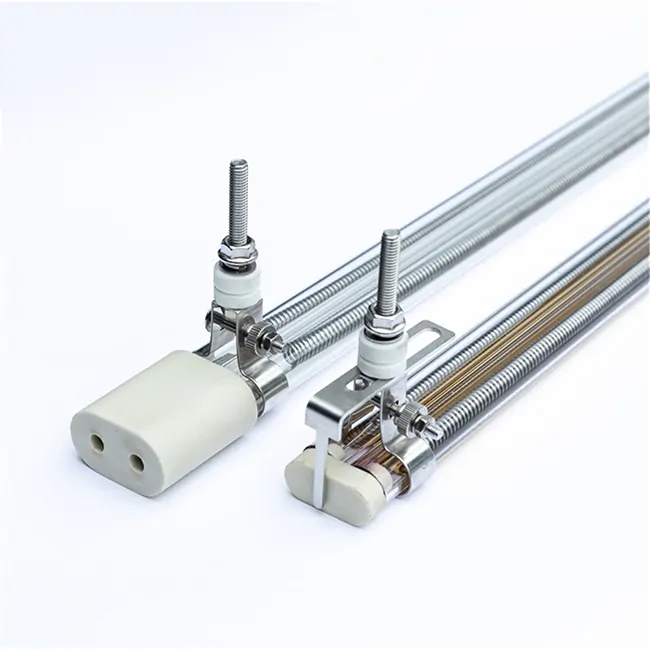
Electrical current heats the NiCr resistance element inside a quartz tube. The element temperature produces medium-wave infrared radiation, while the quartz envelope protects the element and supports the required geometry. The complete emitter may include a gold or ceramic reflector, cold ends, ceramic terminals, leads or connectors.
Performance therefore depends on the whole construction—not the alloy name alone.
Drying water-based coatings, inks and adhesives where moisture removal is properly ventilated
Heating plastic sheet, film and formed components with a controlled surface temperature
Continuous laminating, textile, paper and nonwoven processes
Preheating parts before bonding, embossing or forming
Applications that need stable continuous output more than instant lamp response
YFR provides medium-wave infrared lamps in different tube, reflector and termination configurations.
| Emitter option | Response characteristic | Typical selection reason |
|---|---|---|
| NiCr medium wave | Moderate response | Stable continuous heating and absorption by many coatings or polymers |
| Tungsten short wave | Very fast response | High intensity, short cycles and compact heating zones |
| Fast medium wave | Faster than conventional medium wave | Balance of response speed and longer peak wavelength |
| Carbon emitter | Fast response | Broad medium-wave output and responsive control for suitable materials |
The same nominal wattage can produce a different workpiece response because wavelength, heated length, geometry and reflector design change the delivered heat profile.
| Specification | Why it matters |
|---|---|
| Voltage and wattage | Define electrical load and nominal heat output |
| Overall and heated length | Determine mechanical fit and active-zone coverage |
| Tube diameter and construction | Affect mounting, strength and thermal behaviour |
| Reflector type and position | Direct radiation and define installation orientation |
| Ends, leads and connectors | Must match the equipment and temperature environment |
| Mounting orientation | Supports element stability and service life |
Uniform heating depends on emitter spacing, working distance, reflector condition and edge compensation. For wide webs or large panels, use multiple controllable zones rather than increasing the power of a single central zone.
Place temperature sensors where they represent the product response, and consider product emissivity when interpreting non-contact measurements. Control limits should protect stationary or slow-moving product during conveyor interruptions.
Incorrect voltage or uncontrolled over-power operation
Poor terminal contact that creates local overheating
Installing the emitter in an unapproved orientation
Contamination on the quartz tube or reflector
Insufficient cooling around seals, leads or connections
Mechanical stress caused by rigid mounting or thermal expansion
When replacing a failed lamp, inspect the equipment and operating conditions instead of assuming the emitter alone caused the problem.
No. NiCr is a metallic resistance alloy; carbon emitters use a carbon-based heating element and have different response and spectral characteristics.
Not without review. Wavelength, response, dimensions, current and mounting may differ even when wattage is the same.
No. A reflector redirects radiation toward the working side; it does not change the electrical rating.
Provide voltage, wattage, overall and heated length, diameter, reflector details, ends, leads, connector, orientation and application conditions.
Compare NiCr medium wave with fast medium-wave, short-wave and carbon options. Send YFR your process and lamp specification for a compatibility review.


