


Quick Answer: Are Quartz IR Lamps Suitable for Conveyor Dryers?
Quartz infrared lamps are suitable for conveyor dryers when the process requires fast heat response, compact installation, adjustable heating zones, or direct heating of a coating, ink film, textile, sheet, or moving web.
They can be used in a newly designed dryer or added to an existing hot-air tunnel as a localized booster. The infrared section can increase heat input at a specific bottleneck without requiring the entire dryer chamber to operate at a higher temperature.
The lamps should not be selected by wattage alone. A successful system must match the emitter type, radiant intensity, belt width, line speed, heated length, reflector design, airflow, and allowable product temperature.
1. Where Infrared Heating Fits in a Conveyor Dryer
Infrared heating can be positioned at different points in a conveyor drying line. The best location depends on what must happen to the product at that stage.
A flash-off zone is normally placed near the dryer entrance. Its role is to begin evaporation, stabilize a wet coating, or reduce surface tack before the product enters the main drying section. This zone often benefits from fast response and independently adjustable power.
A booster zone is added where the existing dryer has insufficient capacity. It may be installed before, inside, or after a hot-air section to provide additional heat at a specific process bottleneck.
A primary radiant drying zone uses several infrared lamps or modules as the main heat source. This arrangement is more suitable for thin products, surface coatings, inks, textiles, films, and moving webs than for thick products that require prolonged internal heating.
Infrared can also be used as a final finishing zone. In this position, the lamps help complete surface drying, stabilize a coating, or bring the product to the required exit condition before cooling or rewinding.
2. How an Infrared Conveyor Dryer Works
The conveyor carries the product through one or more controlled heating zones. Quartz infrared lamps direct radiant energy toward the product surface rather than relying only on heated air to warm the entire chamber.
When the product or wet coating absorbs this energy, its surface temperature rises. Water, solvent, or another volatile component begins to evaporate.
Air movement then breaks up the humid or solvent-rich boundary layer above the surface. The exhaust system removes the released vapor from the drying chamber.
This means the infrared lamps, airflow, and exhaust perform different functions. The lamps provide heat, circulating air supports evaporation and temperature uniformity, and exhaust removes moisture or solvent from the process.
Increasing lamp power without sufficient vapor removal may not improve drying. It may instead raise the product temperature, create surface defects, or overload the exhaust system.
3. Short Wave, Fast Medium Wave or Medium Wave?
Quartz infrared emitters are available with different response characteristics and radiant profiles. No single emitter type is suitable for every conveyor dryer.
| Emitter Type | Better Fit | Main Consideration |
|---|---|---|
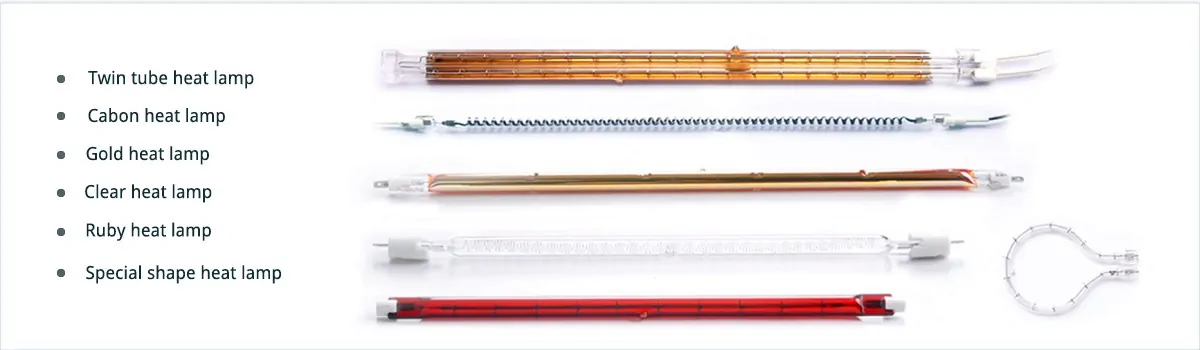
| Short wave infrared lamps | Rapid flash-off, fast preheating, dark inks, compact high-speed zones | High surface intensity requires careful distance and power control |
| Fast medium wave IR emitters | Printing, textiles, coatings, moving webs, medium-speed drying zones | Must be matched to coating absorption and line speed |
| Medium wave infrared lamps | Moisture-rich coatings, temperature-sensitive substrates, controlled surface drying | Slower response than short wave emitters |
| Carbon infrared emitters | Stable medium-wave heating for coatings and delicate surfaces | May not suit very short or high-intensity heating zones |
Short wave lamps reach operating output quickly and provide relatively high radiant intensity. They are useful where the line requires rapid startup, fast flash-off, or a short heating section.
Fast medium wave emitters provide a balance between response speed and controlled surface heating. They are often considered for textile drying, printing, coating lines, adhesive processing, and moving products that need more controlled heat than a high-intensity short wave zone.
Medium wave lamps are suitable where the process benefits from gentler and more stable surface heating. They may be useful for moisture-rich coatings, paper, textiles, and temperature-sensitive products.
Emitter selection should be confirmed with the actual substrate and coating. Material color, surface finish, moisture content, coating chemistry, and product thickness all affect infrared absorption.
4. Separate Lamps or a Complete IR Drying Module?
Separate lamps are suitable when an existing dryer already has compatible holders, reflectors, wiring, and controls. They are also useful for replacement, testing, maintenance, or a narrow localized heating area.
A complete module is more appropriate when the dryer requires several lamp rows, a wide working area, integrated reflectors, protective housings, mounting frames, zone wiring, or convenient maintenance access.
YFR IR drying modules can combine infrared emitters, reflector housings, lamp supports, wiring, and controlled heating zones for continuous industrial lines.
For broader equipment integration, infrared heater modules can be designed around the available installation space, heating width, lamp arrangement, reflector structure, and required mounting method.
A module may be installed above the belt, below the belt, or on both sides. The correct arrangement depends on whether the product is opaque, transparent, thermally sensitive, or supported by a belt that limits radiation from below.
5. Belt Width, Line Speed and Heated Length
The required heating capacity cannot be determined from lamp wattage alone. Conveyor speed and heated length determine how long the product remains under infrared radiation.
The basic relationship is:
Residence time = effective heated length ÷ conveyor speed
If the conveyor speed increases while the heating length remains unchanged, the product receives less exposure time. The system may then require more radiant power, a longer heating zone, or an additional module.
A wider conveyor also changes the lamp arrangement. The system must provide adequate coverage across the full working width without leaving cold edges or excessive heat in the center.
When products do not cover the full belt width, unnecessary heating of exposed belt areas should be considered. Cross-belt zoning or independent lamp groups can reduce heat input where no product is present.
The lamp’s heated length should match the useful process width. Total lamp length, heated length, end-cap position, holder spacing, and terminal direction must all be checked during replacement or module design.
6. Working Distance and Reflector Design
The distance between the lamp and product affects radiant intensity, heating width, and uniformity.
A shorter distance can create stronger local heating but also increases the risk of hot spots. A greater distance produces wider coverage but may reduce the intensity reaching the product.
Reflectors help direct infrared energy toward the conveyor and reduce unnecessary radiation toward the housing. Their shape, surface condition, and position influence heat distribution across the working area.
Lamp spacing must also be coordinated with the reflector. Lamps installed too far apart may leave cooler bands. Lamps installed too closely may create excessive local temperatures or unnecessary electrical load.
The final distance and spacing should be established through material testing whenever possible. A mechanically convenient mounting distance is not automatically the correct process distance.
7. Why Airflow and Exhaust Still Matter
Infrared lamps can heat a wet coating quickly, but heating alone does not remove the evaporated material from the dryer.
As water or solvent leaves the surface, it forms a vapor-rich layer above the product. Controlled airflow removes this boundary layer and allows evaporation to continue.
The exhaust system then carries the vapor out of the chamber. If exhaust capacity is too low, humidity or solvent concentration may rise, drying may become inconsistent, and condensation or odor problems may occur.
Airflow should be distributed uniformly across the belt. Excessive air velocity may disturb lightweight products, wet coatings, fabric, or paper. Insufficient airflow may leave slow-drying zones.
For solvent-based processes, ventilation, electrical design, hazardous-area requirements, and complete equipment safety must be evaluated by the machine manufacturer or qualified system integrator.
YFR supplies the infrared heating section and related control components. The complete airflow, exhaust, safety, and machine design remain part of the overall conveyor dryer system.
8. Temperature, Zoning and Power Control
A conveyor dryer should not rely on one fixed lamp setting for every product.
Different coatings, colors, substrates, and line speeds may require different power levels. Dividing the dryer into independently controlled zones allows the operator to create a more stable heating profile.
The entrance zone may use moderate power to begin evaporation without damaging the wet surface. The main zone can provide the highest controlled heat input. The final zone may use lower power to complete drying without overheating the product before exit.
YFR infrared heating systems and controls can support lamp grouping, manual adjustment, PID temperature control, PLC integration, and multi-zone heating configurations.
An IR lamp power controller can regulate output according to the electrical load and required control method.
For non-contact temperature measurement, an infrared thermometer for IR heating systems can provide surface-temperature feedback to a controller or PLC.
The sensor must be selected and positioned according to the target material, temperature range, viewing angle, emissivity, and available measurement area.
9. Conveyor Stop and Empty-Belt Protection
A moving conveyor carries heat away from the infrared zone. When the belt stops, the same product area may remain under the lamps and overheat quickly.
The control system should therefore respond to conveyor status. Depending on the equipment design, a line stop may trigger rapid power reduction, lamp shutdown, module retraction, or an alarm.
Empty-belt operation should also be considered. Some belt materials may absorb infrared energy and become hotter when no product is present.
Interlocks between the lamps, conveyor drive, airflow, and exhaust system help prevent uncontrolled heating.
The exact safety logic must be designed and validated as part of the complete dryer, not added only after the heating section is installed.
10. Printing and Ink Drying
Infrared conveyor dryers are commonly used for printing applications where the wet ink or coating must reach a stable condition before stacking, rewinding, cutting, or further processing.
Water-based inks require both heat and effective moisture removal. Increasing surface temperature without sufficient airflow may produce limited improvement because evaporated water remains near the print surface.
Short wave or fast medium wave emitters may be used where rapid response and localized evaporation support are required. Medium wave emitters may be more suitable where the substrate needs gentler heating.
The correct choice depends on ink film thickness, substrate absorption, print coverage, line speed, color, exhaust capacity, and maximum allowable substrate temperature.
11. Textile and Garment Conveyor Dryers
Textile conveyor dryers may process printed garments, fabric, coated textiles, nonwoven materials, or other flexible products.
Fast medium wave and medium wave emitters are often considered where the process needs controlled surface heating across a wide belt. Short wave lamps may be useful in rapid flash-off or compact booster zones.
The dryer must account for fabric weight, color, moisture, print chemistry, belt loading, and product movement.
Uniform heat distribution is particularly important because different areas of a garment or textile may contain different ink coverage or material thickness.
Airflow must remove moisture or vapor without disturbing lightweight products or causing uneven movement on the belt.
12. Coating and Adhesive Drying Lines
Infrared heating can be integrated into conveyor lines for coatings, primers, paints, adhesives, and protective finishes applied to metal, plastic, paper, wood, glass, and composite products.
These processes often benefit from targeted surface heating because the thermal requirement is concentrated in the wet layer rather than the full machine structure.
The emitter should be selected according to the coating chemistry and substrate limit. A metal sheet may tolerate a different heat profile than plastic film, paper, foam, or coated wood.
Airflow and exhaust should be matched to the quantity of water or solvent being released. A higher line speed or thicker coating may increase the vapor-removal requirement as well as the heating requirement.
13. Film, Paper and Moving-Web Applications
Films, paper, labels, foil, and continuous webs can be sensitive to curling, shrinkage, distortion, and uneven tension.
Infrared heating should therefore be applied in controlled zones rather than as one uncontrolled high-power section.
The distance between the lamps and web, heat distribution across the width, line tension, coating weight, and cooling after drying all affect the result.
Fast response is valuable because the heater output can be adjusted when line speed changes. However, the control system must react quickly enough to prevent overheating during slowdown or stoppage.
For temperature-sensitive webs, combining moderate infrared power with controlled airflow may provide a wider operating window than using maximum radiant intensity alone.
14. Retrofitting an Existing Conveyor Dryer
An existing hot-air dryer can sometimes be upgraded with an infrared flash-off or booster section.
Before adding lamps, the available installation space, electrical capacity, reflector clearance, belt temperature limit, exhaust capacity, and control system should be reviewed.
The retrofit should solve a defined process bottleneck. Common objectives include improving initial flash-off, increasing line speed, reducing wet spots, stabilizing coating quality, or adding adjustable heat to a specific dryer section.
Simply installing more wattage does not guarantee better drying. If the real limitation is insufficient airflow, short residence time, poor exhaust, uneven product loading, or incorrect temperature measurement, additional infrared power may not solve the problem.
A retrofit should therefore begin with process information and equipment drawings rather than only the dimensions of the old lamp.
15. Information Needed for Lamp or Module Selection
The following information is required to evaluate a conveyor dryer project accurately.
| Required Information | Why It Matters |
| Product material, color, and surface | Affects infrared absorption |
| Ink, coating, adhesive, or moisture type | Determines heat and exhaust requirements |
| Wet-film or coating thickness | Influences evaporation load |
| Belt width and product coverage | Determines lamp arrangement and zoning |
| Conveyor speed | Determines residence time |
| Available heated length | Determines total exposure time |
| Lamp-to-product distance | Affects intensity and uniformity |
| Maximum product temperature | Helps prevent thermal damage |
| Available voltage and electrical power | Determines lamp and controller design |
| Airflow and exhaust arrangement | Determines vapor-removal capacity |
| Existing lamp or module drawing | Supports replacement evaluation |
| Installation space and mounting points | Determines module construction |
For replacement lamps, provide the total length, heated length, voltage, wattage, tube diameter, reflector type, end caps, lead wires, terminals, and clear photos of both ends.
For a new module, provide the conveyor drawing, belt width, heating-zone length, available height, product description, line speed, control requirement, and expected operating environment.
16. Maintenance and Process Stability
Dust, ink mist, coating residue, oil, and fibers can accumulate on quartz tubes and reflectors. This contamination reduces radiant output and changes heat distribution.
The cleaning method should be compatible with quartz glass, reflector surfaces, electrical insulation, and the processed material.
Lamp holders and electrical connections should be inspected for overheating, looseness, contamination, and mechanical damage.
A gradual increase in required power may indicate dirty reflectors, aging lamps, changed product conditions, reduced airflow, or inaccurate temperature measurement.
Recording line speed, zone power, product temperature, airflow settings, and product results can help identify process changes before they become major quality problems.
17. What YFR Supplies
YFR supplies quartz infrared lamps, custom emitters, drying modules, heater modules, temperature sensors, and power controls for industrial conveyor dryers.
Relevant solutions include short wave infrared lamps, fast medium wave IR emitters, medium wave infrared lamps, IR drying modules, and infrared heater modules.
For projects requiring adjustable heating zones, YFR can also supply infrared heating controls, power regulators, infrared thermometers, reflector housings, and customized lamp cassettes.
For a broader explanation of wavelength, drying process, and emitter selection, review the industrial infrared drying guide.
YFR focuses on the infrared heating section. The complete conveyor, airflow, exhaust, solvent-safety, guarding, electrical safety, and machine certification requirements should be handled by the equipment manufacturer or qualified system integrator.
FAQ
Are quartz infrared lamps suitable for conveyor dryers?
Yes. Quartz infrared lamps are suitable for conveyor dryers that process inks, coatings, textiles, paper, films, adhesives, and other moving products requiring controlled surface heating. The complete system must also provide suitable airflow, exhaust, controls, and safety protection.
Which infrared lamp is best for a conveyor dryer?
The correct lamp depends on the material, coating, line speed, heating length, working distance, and maximum temperature. Short wave lamps provide fast and intense heat, fast medium wave emitters offer a balance of response and control, and medium wave lamps provide gentler surface heating.
Can infrared replace hot air in a conveyor dryer?
In some thin-product and surface-drying applications, infrared can provide most of the required heat. However, airflow and exhaust are still normally required when water, solvents, or other vapors must be removed.
How is conveyor dryer residence time calculated?
Residence time is calculated by dividing the effective heating-zone length by the conveyor speed. Increasing line speed reduces exposure time unless the heating zone is extended or the process is otherwise adjusted.
Is a separate lamp or complete IR module better?
Separate lamps are suitable for replacement and simple heating zones. A complete module is better when the system requires several lamps, reflectors, housings, mounting frames, wiring, zone control, or a wide working area.
Why does a product overheat when the conveyor stops?
When the conveyor stops, one product area remains under the infrared lamps. The control system should reduce or switch off lamp power when belt movement stops.
What information is needed for a replacement quartz IR lamp?
Provide voltage, wattage, total length, heated length, tube diameter, reflector type, end caps, lead wires, terminals, equipment model, application, and photos of the complete lamp.
Can YFR customize an IR drying module for an existing conveyor?
YFR can evaluate customized lamps and heating modules based on the available space, belt width, heated length, voltage, power, reflector design, mounting structure, and control requirements.
Final Recommendation
Quartz infrared lamps can improve conveyor drying when they are integrated around a clearly defined process requirement.
The system should not be designed by lamp wattage alone. Material absorption, coating type, belt width, line speed, heated length, working distance, airflow, exhaust, surface temperature, and stopping conditions must be considered together.
Short wave emitters are suitable for rapid flash-off and compact high-speed zones. Fast medium wave emitters provide a practical balance for printing, textiles, coatings, and moving webs. Medium wave emitters support gentler and more controlled surface drying.
Separate lamps are appropriate for replacement and simple heating areas. Complete IR drying modules are more suitable for wide conveyors, multi-row lamp arrangements, integrated reflectors, zoning, and equipment retrofits.
For accurate selection, provide the product data, conveyor dimensions, process speed, heating requirement, exhaust arrangement, and electrical conditions before finalizing the lamp or module design.


