Author: Site Editor Publish Time: 2025-09-16 Origin: Site
Last updated: October 19, 2026
Infrared paint curing can support a repeatable automotive finish when the coating supplier permits it and the actual part follows a validated drying or curing cycle. It does not, by itself, make a paint system more resistant to ultraviolet exposure, scratches or water, or guarantee that gloss will last longer.
For a bodyshop, the useful question is whether the specified coating has reached the condition required for inspection, polishing, assembly and delivery. Those decisions need separate evidence. This guide focuses on finish acceptance and care after curing; use the paint-curing process overview for the broader process discussion.
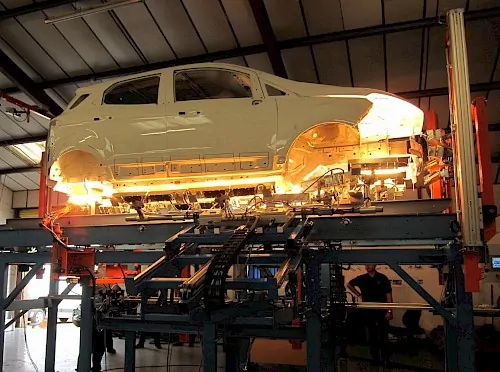
Vehicle body and heating equipment in an industrial production setting.
Infrared equipment supplies radiant heat to the painted workpiece. How that heat is absorbed and distributed depends on the coating, substrate, geometry and equipment arrangement. Evaporation and, where the coating chemistry requires it, chemical cure must meet the paint supplier's instructions. A surface that feels dry is not a complete record of those conditions.
The useful contribution is controlled heating within an approved process. Faster heating can be valuable when it shortens the time to an accepted result. A shorter lamp timer setting, however, is not evidence of greater hardness, deeper bonding or a more durable clearcoat. There is no general rule that every automotive coating cures uniformly from the inside out.
Identify the primer, basecoat and clearcoat, together with the specified activator or hardener, reducer and film build. Ask whether infrared drying is permitted for that combination. A lamp type or a wavelength label cannot supply the missing approval.
The distinction is practical: Axalta's HC-7776S Snap Dry Clearcoat technical data sheet does not recommend infrared drying for that product and identifies a solvent-pop risk. That is a product-specific restriction, not a verdict on every clearcoat. Read the current instructions supplied for the product and market being used.
A validated cycle should identify what is being measured, where it is measured and when the required exposure begins. Lamp power, air temperature and painted-part temperature describe different things. The relevant coating and equipment instructions determine which values must be controlled; a photograph of a glowing lamp does not show that the coating reached them.
Cooling and later treatment also matter. The Cromax CC3500 Multi-Use Clearcoat technical data sheet separates readiness for handling, polishing, delivery and decal application, and refers infrared setup to a separate guide. These are examples of distinct release conditions. Do not turn one listed drying time into a universal permission for every later operation.

Heater banks and guards within an industrial installation.
Gloss, color match and texture are visible finish qualities. They are affected by the coating system and application as well as drying or curing. A clear reflection cannot establish adhesion, chemical resistance or outdoor durability. Conversely, a finish problem should not automatically be blamed on the lamp before the material and application records are reviewed.
Finish acceptance: observation, evidence and its limit
Acceptance question | Useful record or check | What it does not prove |
|---|---|---|
Does the appearance meet the repair target? | Inspect the agreed area after the required cooling period, under consistent lighting. Record gloss or texture comparisons using the agreed method. | A glossy surface alone does not establish cure completion or long-term durability. |
Was the specified cycle achieved? | Retain the permitted coating procedure, measured part-temperature history where required, exposure record and cooling conditions. | A timer setting or lamp rating alone does not show the coating experienced the required cycle. |
Is the finish ready for the next operation? | Check the product-specific conditions for polishing, assembly, delivery and added films or decals. | Ready for one operation does not mean ready for all operations. |
Can a durability claim be supported? | Use the coating supplier's performance information and an agreed, relevant test plan for the actual system. | Water beading, a quick scratch demonstration or the use of IR alone is not a durability test. |
Hardness, adhesion, chemical resistance, weathering and gloss retention are different properties. If a customer requires a particular result, agree on the property, test method, acceptance criterion and conditioning period before treating a sample as approved. Do not substitute a general statement such as "fully cured" for a defined test result.
Comparisons between infrared and another drying route need the same coating system, film build, substrate and accepted finish requirements. Compare complete jobs or representative trials, including cooling, rework and the time to the next operation. An apparent speed advantage has little value if the agreed finish cannot be released.
A useful record connects the material applied, the cycle actually achieved and the inspection result. It also makes later changes easier to assess. Replacing a hardener, changing film build or moving a lamp can change the process; repeating the old timer setting is not a substitute for checking the revised conditions.
A practical record for a coating trial or repeat repair
Record area | Information to retain | Purpose |
|---|---|---|
Material and application | Product names and TDS revisions, specified mixture, substrate, surface preparation, film build and relevant application conditions. | Identify the actual system being accepted rather than "automotive paint" in general. |
Drying or curing cycle | Permitted method, flash-off, equipment arrangement, measurement locations, required temperature/exposure record and cooling stage. | Link the result to a documented cycle and identify what changed. |
Release and follow-up | Inspection conditions, agreed checks and results, release decision, care instructions and any later issue reported. | Separate an initial acceptable finish from a supported claim about service performance. |
These are suggested record categories, not a universal coating test protocol. The coating supplier and the responsible refinishing team should define the applicable release criteria. For a visible problem such as gloss loss, texture or pinholes, move to the paint-finish defect review rather than adding more heat on the assumption that the coating is undercured.
Proper care remains relevant after the repair leaves the workshop. Follow the coating supplier's and refinisher's instructions for washing, polishing, waxing, sealants and protective films. Avoid adopting a single waiting period for every product, and do not assume that an infrared-dried finish has no restrictions.
Use clean, suitable wash tools and the approved cleaning products. Contaminated cloths or abrasive cleaning can damage the appearance independently of the drying method.
Ask when polishing and added products are allowed. A blanket instruction to never wax or seal the finish is inappropriate unless it is part of the actual coating guidance.
Keep the care instructions with the repair record. If the finish changes later, record the exposure, cleaning products and timing before assigning a cause.
Infrared curing is therefore one part of a controlled repair process. A credible promise to a customer describes the coating system, the work performed and the applicable care or warranty terms. It should not turn the heating method into a guarantee against fading, chips, corrosion or scratches.
No. An approved and controlled cycle can support the intended finish, but lasting gloss also depends on the coating formulation, application, exposure and care. The use of infrared alone does not establish an improvement in gloss retention.
Use the exact coating product instructions and the approved equipment setup. Distinguish drying, required curing exposure, cooling and readiness for later operations. There is no universal six-minute or several-hour schedule for all automotive coatings.
No. Surface appearance and touch are limited observations. Use the coating supplier's required cycle and the agreed acceptance checks for the actual material system and next operation.
No. Those are coating-performance claims requiring appropriate material information and testing. Water beading or a hard-feeling surface does not establish resistance to weathering, scratching or corrosion.
Do not assume so. Confirm the coating system, substrate, component limitations and equipment suitability with the relevant suppliers. A process accepted for one panel or material is not automatic approval for plastics, composites or other components.
Follow the product-specific instructions and the refinisher's release decision. These operations can have different waiting conditions. Keep those conditions separate from the end of the heating cycle.
For a technical discussion with YFR, prepare the coating product and TDS, substrate and geometry, heated area, proposed cycle, measurement approach and finish acceptance requirements. This gives the review a defined process target without assuming a lamp alone will improve durability. Send the application details.


